Secondary Cities and the Question of Balance in Central Europe – SECPOLYC Closing Event at Corvinus

These questions were at the heart of an international seminar held at Corvinus University of Budapest, which explored the opportunities for polycentric development as the closing event of the SECPOLYC project.
The international seminar, Developing Cities Beyond Capitals – The Opportunities for Polycentric Development in the Visegrad Countries, was held on 17 March 2026 in the main building of Corvinus University of Budapest. The event was organised by Corvinus University of Budapest and the Hungarian Society for Urban Planning, in cooperation with the University of Wrocław, Pavol Jozef Šafárik University in Košice and the University of South Bohemia, with the support of the International Visegrad Fund. The event served as the closing conference of the SECPOLYC project, which focused on examining the structure and development opportunities of urban networks in Central Europe.
The conference was opened by Tamás Bartus, Professor and Vice-Rector of Corvinus University of Budapest, and György Alföldi, President of the Hungarian Society for Urban Planning. They highlighted that the spatial structure of the Visegrad countries is strongly shaped by the dominance of capital cities, while secondary and tertiary cities often face population decline and a lack of resources. In the long term, this monocentric development path may also reinforce economic and social inequalities, making the creation of a more balanced urban network structure increasingly urgent.
Géza Salamin, Head of the Doctoral Programme at Corvinus University of Budapest and Vice-President of the Hungarian Society for Urban Planning, pointed out that in the post-transition period, foreign direct investment was concentrated primarily in major cities, which further strengthened the role of the capitals. He stressed that promoting polycentric development requires targeted development policies, including strengthening regional centres, developing universities, improving transport and digital connections, and encouraging cross-border cooperation.
In his presentation, Urban Hierarchies and Polycentricity in the Visegrad Region, Robert Szmytkie, Professor and Head of Institute at the University of Wrocław, presented a comparative analysis of urban networks in the Visegrad countries. Their research was based on the examination of 81 functional urban areas and assessed the position of individual cities using several indicators, including population, economic performance, employment, higher education presence and business activity.
The results showed strong capital city dominance across the region as a whole: Warsaw, Budapest and Prague stand out as first-tier centres, accompanied by a secondary circle of cities. The research also demonstrated that even behind Poland’s seemingly more polycentric model lies a strong hierarchical structure.
The Hungarian case study was presented by Bence Tarnóczi, Chief Economic Analyst at EDC Debrecen Nonprofit Ltd. In his presentation, he shared detailed data on Debrecen’s economic development: over the past decade, around EUR 12 billion in foreign direct investment has arrived in the city, contributing to the creation of more than 20,000 new jobs. The city’s economic performance has grown dynamically, and it is increasingly functioning as a regional centre with a significant commuting catchment area. At the same time, he emphasised that rapid growth also generates serious challenges, particularly in the areas of transport infrastructure, housing and public services.
Stanislav Kraft, Vice-Dean of the University of South Bohemia, presented The Impact of Urban Systems on Spatial Justice – The Case of Educational Deserts in the Visegrad Region. His analysis focused on the phenomenon of so-called “educational deserts” and was based on daily school commuting distances and spatial accessibility. It showed that the structure of urban networks has a direct impact on educational inequalities. Long commutes are a particular disadvantage for those living in peripheral areas, meaning that polycentric development can also be understood as a matter of social justice.
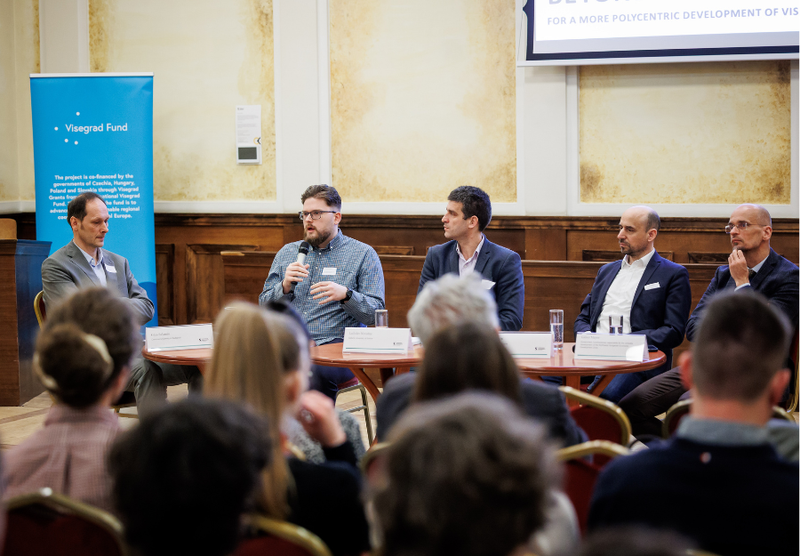
The event concluded with a roundtable discussion featuring Bence Tarnóczi, Ladislav Novotný, Professor and Head of Institute at Pavol Jozef Šafárik University in Košice, Márton Péti, Researcher at the Institute for National Strategy and Associate Professor at the University of Pannonia, and Gábor Mayer, Government Commissioner responsible for the development of the Northwest Hungarian Economic Development Zone. The discussion was moderated by Géza Salamin.
Through the examples of Debrecen, Győr, Veszprém and Košice, the participants discussed the role of regional centres. They agreed that strengthening secondary cities is essential; at the same time, development must be implemented through a functional regional approach so that smaller settlements do not end up in an even more disadvantaged position.
One of the conference’s main conclusions was that the urban networks of the Visegrad countries face many shared structural problems, meaning that solutions can only partly be addressed at the national level. Promoting polycentric development requires coordinated regional thinking, targeted public policies and stronger international cooperation. The closing event of the SECPOLYC project further strengthened this shared professional dialogue in Budapest.
You can read more about the project details here.