Student forum on the future of Corvinus – Expectations and reform proposals
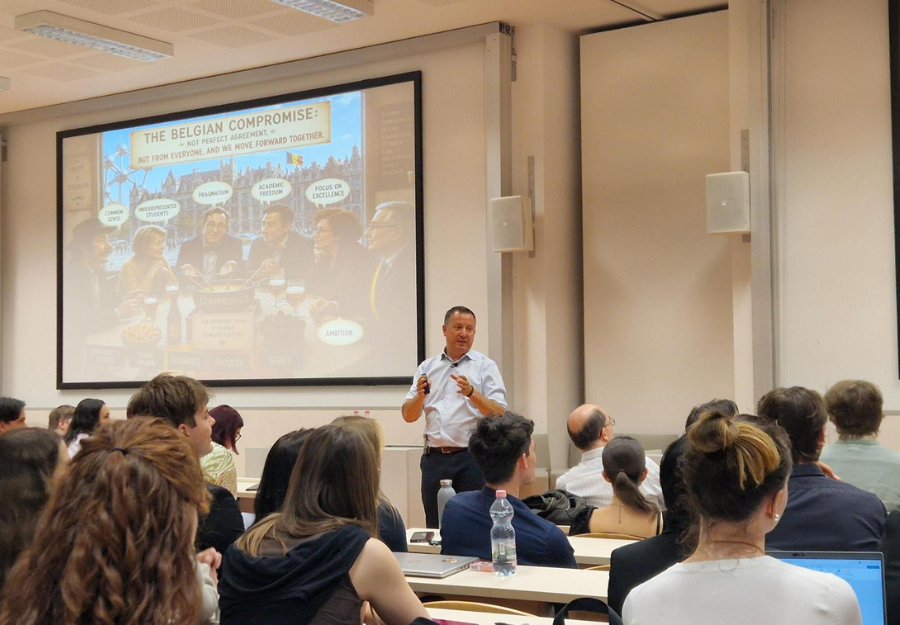
Nearly eighty Corvinus students and at least thirty university employees, including faculty and administrative staff, gathered at the student forum on the future of Corvinus University, which was organized by the Széchényi István College for Advanced Studies (SZISZ) and the Corvinus Student Union (HÖK) on 19 May 2026.
Among the participants in the moderated debate, Gergely Mészner, President of the Corvinus HÖK, represented the direct student perspective. Listing their expectations, he called for greater transparency, meaningful consultation, and stronger involvement, as well as more robust institutional guarantees to ensure that students—as the university’s “largest stakeholder group”—can take part in decisions that affect their future. From a student perspective, a stronger Senate should mean a higher proportion of student representatives than in the current structure. Regarding the university’s model change, Mészner noted that “students have experienced both the advantages and disadvantages of the system.” While the favorable funding conditions (such as tuition-free education, scholarships, benefits, and mobility opportunities) should not be forgotten, it is also worth acknowledging that not all positive developments in recent years can be attributed solely to increased financial resources.
In a more extensive part of the discussion, Gergely Kováts, a researcher on academic freedom and university model change and a staff member of the Corvinus Institute of Strategy and Management, and Bruno van Pottelsberghe, the Belgian-born rector of the university appointed two years ago, presented and contrasted their differing assessments and visions regarding the transformation of the university’s operating model. There was no disagreement between the parties on the need to regain the suspended EU funding as quickly as possible.
As the discussion progressed, organizational and operational details increasingly came into focus. Gergely Kováts, drawing on his extensive research in management science, presented a benchmark of the European university context, while the rector of the university shared insights from his experience in Brussels as an academic leader.
Gergely Kováts proposed that, as a short-term measure, key decision-making powers should be returned to the elected Senate, in which members of the university management would not have a seat. He also suggested that the role of the Board should be redefined as purely supervisory: the body should oversee the budget, financial reports, asset management, and the development and implementation of the university’s strategy. He further argued that the Board should include the most important stakeholder groups: academic representatives, the Senate, the ministry, and external members nominated jointly by the Senate and the ministry. He added that, across the higher education sector as a whole, he considers it necessary to restore trust in governing bodies such as senates, boards, and university leadership.
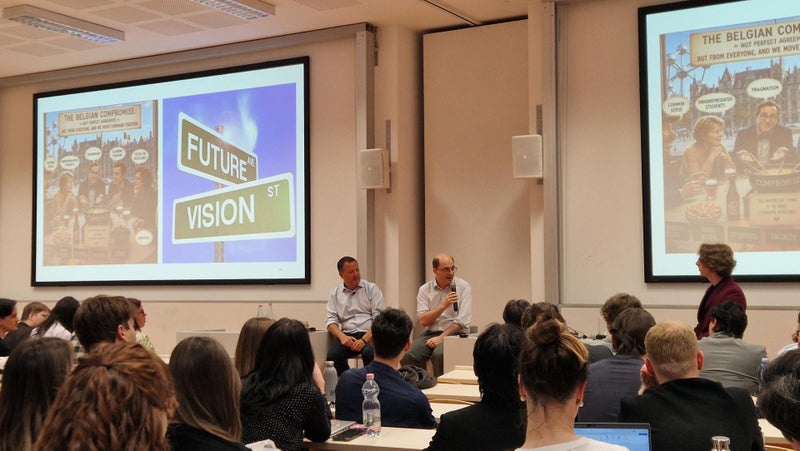
The rector of Corvinus University briefly reiterated his proposal, as set out in the Charter and continuously refined during consultations. It aims to introduce a hybrid (dual) governance model in which all academic and scientific responsibilities would fall under a Senate composed predominantly of elected members (students, academic staff, and employees). Budgetary and strategic decisions, on the other hand, would be partially assigned to a 5–7 member University Supervisory Board, consisting mainly of external members. The proposed model aligns with the widely used hybrid governance structures under which most leading European universities currently operate. He emphasized that the EU’s criticism does not concern the KEKVA model itself, but rather the indefinite appointment of board members and the rules governing their selection and operation. In his view, with amendments in these areas, Hungary could relatively quickly comply with EU requirements.
Beyond the details of established European models, Bruno van Pottelsberghe called for approaching a shared concept or proposal less through the grievances of the past and more from the perspective of the future: starting from a vision of the kind of university we want to become. If the goal is the Corvinus University described in the Bridge Strategy—an institution that is increasingly international, more visible, rising in rankings, and attracting the most talented students, researchers, and faculty—then we should choose the governance model best suited to achieving that aim.
Van Pottelsberghe proposed the “Belgian compromise” as a strategy for developing a shared solution. The term is used in a political and cultural context and describes the practice of resolving sharp social and community conflicts not through confrontation, but through continuous negotiation, mutual tolerance, and power-sharing.