“Corvinus can now confidently compete with a strong Dutch university” – Interview with alumnus Péter Eső
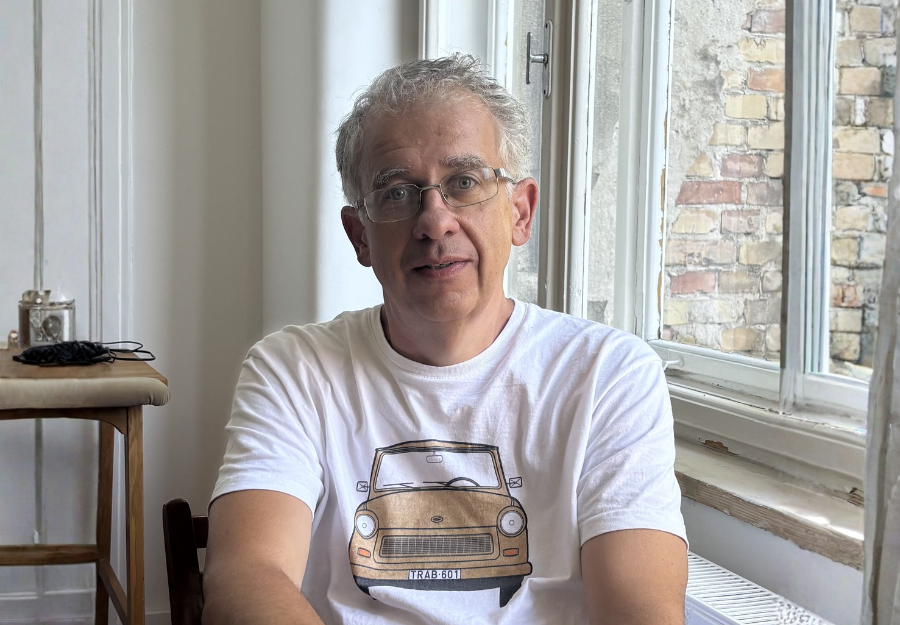
You studied at Corvinus around the time of the political transition and were also a member of the Rajk College. What are your memories of the university back then?
I began studying theoretical economics at the university in 1989, and I very quickly became fascinated by microeconomics. My professors in theoretical economics had a great influence on me, including Ernő Zalai and Imre Csekő. From Rajk, I gained a community, a profession, and a culture all at once. At the time, Rajk had three strong pillars: its political engagement in the years following the regime change, its community role, and its function as a professional workshop. Because of my interest in theoretical economics, I was mainly involved in Rajk’s academic track.
As a Rajk student, you were one of the founders of the Neumann Award, which has existed for thirty years and is now often referred to in the profession as a stepping stone to the Nobel Prize in economics. What was the intention behind founding this award as students?
We wanted to draw greater attention to outstanding contributors to the exact social sciences. The award’s namesake, John von Neumann, the father of game theory, was a pioneer in this field. From the outset, it was also an important goal to create a Hungarian professional award decided exclusively by students, based on how important the recipient’s work is for future generations.
I am particularly proud that the award has endured for thirty years, which reflects the strength of the Rajk community. I am also proud that over the past three decades, at least ten economists who later received the Nobel Prize were awarded this prize beforehand. This shows that, year after year, students have had a keen sense for recognizing truly outstanding academic achievement.
How did you manage to go from Hungary to the United States, to Harvard, for your doctoral studies?
At the time, it seemed to me that there were significantly more scholarship opportunities at universities in the United States, and there was a clear intention to help Eastern Europe catch up with the West. That is how I got there: my tuition was waived, and I also received a stipend for living expenses—I must have seemed sufficiently poor. For the cohorts before me, it was even more difficult to get out; for us, it was perhaps a bit easier. In my field, it was almost impossible to join the international academic community without doing a PhD in the United States, so obtaining a scholarship was particularly important to me.
I met my wife at Harvard, and in the end we stayed abroad. In the United States, I began researching and teaching at Northwestern University near Chicago, but since I did not receive a permanent professorship (tenure), we eventually moved to the United Kingdom, where I received an offer from the University of Oxford. At first, we thought we would only stay for a year, but in the end we have been living there for fifteen years with our three children. We do, however, consistently spend our summers at Lake Balaton.
What strategy would you recommend for a young researcher aiming for an international career?
An academic career has always been highly competitive, but perhaps the competition is even stronger now than when I was a young researcher. To stand out from the field, having a PhD from a well-known university or an international postdoctoral fellowship can be a major advantage. Academia is inherently very international, so it is worth taking advantage of these synergies and attending as many international conferences as possible. Hungary is now well integrated into the Western world, so mobility and gaining experience abroad have become an integral part of an academic career. At the same time, in recent years I have also seen very strong theoretical economists moving back to Hungary, so it is increasingly possible to build a solid academic career at home as well.
You regularly return to Rajk and Corvinus to give lectures. How do you see the university’s development, and where would you place it in the international higher education landscape?
I teach in Oxford and give talks at research seminars at many Western European universities. From this perspective, I can say that in recent years I no longer see major differences, for example, between research seminars at a Dutch university and those at Corvinus. I am more familiar with the Institute of Economics, but I know that colleagues across Europe regard it as an institute operating at a high professional standard. It is no coincidence that its researchers are consistently able to attract leading figures in the field to their international conferences. In my view, Corvinus is currently on a distinctly upward trajectory and can confidently compete with strong Western universities in Germany, France, Italy, or the Netherlands.