György Surányi: “We need to take the steps that bring us closer to the euro”
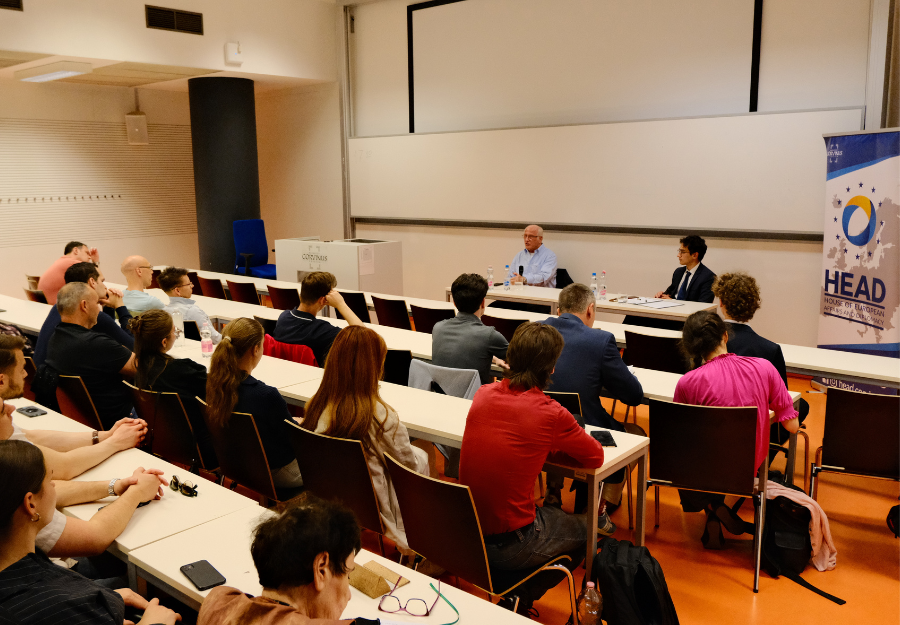
Asked by the moderator which period had been the most defining in his life, Surányi replied: “I am currently a teacher at Corvinus and have been for 50 years, and this is the most important thing in my life.” He immediately added that the periods when he served twice as president of the Hungarian National Bank, between July and November 1990 and from March 1995 to March 2001, had been difficult but, despite all their challenges, extremely exciting. To understand those difficulties, he said, we need to go back to the time of the regime change. “The period between 1989 and 2001 was the most promising for me, and I am glad I could be part of it. In fact, the process that led to the creation of the two-tier banking system had already begun in the mid-1980s, with László Asztalos and Lajos Bokros playing an active role. Alongside a modern tax system, the Companies Act, the Accounting Act and the rehabilitation of private property were established, and the foundations of the rule of law were laid.”
The former MNB president is convinced that without the regime change, Hungary would have experienced a much deeper economic downturn than the one because of the transition. In his view, Hungary’s growth in the 1960s was based on cheap Soviet energy. By the time of the regime change, however, the system burdened by heavy foreign debt was no longer capable of generating growth on its own, as was not the whole of Eastern Europe.
He noted that today’s students can hardly imagine what it was like when the forint was not yet convertible, which only became the case fully on January 1, 1997, and when people could only buy a limited amount of, very little foreign currency. “During the regime change, there was a 100 per cent difference between the official and the black-market exchange rate of the forint,” he recalled.
One of the decisive stages of the regime change was the start of privatisation, with Tungsram being the first example, which led to the inflow of foreign capital. Surányi also considers the adoption of the Bankruptcy Law, the Accounting Act, and the Bank Act an important milestone. Without it, he said, uncompetitive companies could not be filtered out, a queue formed among non-paying businesses, which were unable to pay the banks either. Instead of money, non-money mechanisms coordinated the system, and this situation had to be broken. The new laws adopted in 1991–92 eliminated this serious distortion in the market economy.
Growth potential has been eroded
At the beginning of his second term as central bank governor, the Hungarian economy was close to financial collapse, with a so-called twin deficit, meaning simultaneous deficits in the state budget and the current account. In 1995, public debt stood at 92 per cent of GDP. Surányi said that while domestic public debt is certainly not desirable, it does not in itself lead a country into bankruptcy. But external debt was also approaching 100%. In the summer of 1995, inflation was 32 per cent, but thanks to the effective work of the government and the central bank, it decreased year after year, while growth rose from 1 per cent to 4 per cent per year, even though Hungary was not yet receiving free funds from the EU. “It was a successful and exciting period,” Surányi said. He added that real wages began to rise visibly from 1996–97 onwards. In terms of consumption per capita, Hungary is last. Like it or not, we are the poorest in the EU,” he said.
Surányi added that although Hungary has an exceptionally high investment rate in the middle of 2022, investments were overpriced and wasteful. He cited the Budapest-Belgrade railway and the Mohács bridge as examples. The latter costs HUF 350 billion, yet only 200 vehicles cross it each day, while more than 2,000 vehicles use the Chain Bridge, which is closed to passenger cars. “Predictability is missing, the corruption level is high, and the market competition and the market itself has not been allowed to function. As a result, businesses that would not exist without subsidies have survived.” He said the outgoing government used socialist economic policies, spending a lot of money on the economy for the wrong purposes and in the wrong way, citing price caps, regulated fuel prices, utility bill subsidies, interest rate freezes, unjustified interest rate subsidies as an example. At the same time, the previous government did not spend enough on education, healthcare or digitalisation, D&I or targeted social policy.
According to Surányi, the overheated economy was the cause of the inflation that had been rising since 2017. Although EU funds were still arriving in abundance at the time, the country spent them badly. He also criticised the previous government for transferring huge sums of state money into opaque private equity funds, and for significantly loosening the budget in order to win the 2022 elections and “pushing out” enormous amounts of money already as early as from the second half of 2021. After that, EU funds stopped arriving because of the government’s policies. Surányi also disagrees with the MNB’s purchase of gold for USD 6 billion, which he believes results in annual interest losses of many hundreds of billions, since gold pays no interest, the change of exchange rate is extremely volatile. On the other hand, the rise in the exchange rate is unrealised income, meaning money on paper.
The EU’s most innovative product
The possible introduction of the euro was then discussed. The former central bank governor stated that he considers the creation of the euro to be the EU’s most successful and most innovative product. At the same time, the euro’s operating framework is burdened by many contradictions. “Until five or six years ago, I thought Hungary did not need to rush into the eurozone. The European Central Bank makes its decisions with the entire eurozone in mind, and it is poorly equipped to take account of the specific circumstances of a small country. In other words, the ECB cannot consider the interests of small, open economies, such as Estonia in recent years, and cannot reflect them in its decisions, which has resulted in high inflation, a significant real appreciation of the exchange rate and a prolonged recession”, Surányi said.
In the change of his opinion on the matter played a role the fact that, as an EMU member, no one can step out from the EU. Viktor Orbán once said that he does not support the euro because then it would not be able to leave the EU. “For once, I agree with the former prime minister, except I believe we need the euro precisely so that we never leave, and can never leave the EU,” the former central bank governor said. In his view, Hungary must take steps to bring it closer to introducing the euro, but he does not believe this can be achieved within 4 years. “Especially not if the new government keeps all the benefits introduced by Fidesz and also promises new ones itself,” Surányi explained in response to a question from the audience.
He believes the Hungarian public is not hostile to the introduction of the euro, so there is no political risk involved. The business sector would also welcome it. At the same time, he added that a country’s success does not depend on the euro. The Czech Republic, for example, does not plan to join the eurozone and is successful without it, while France is not successful simply because it has the euro.
Finally, Surányi gave his opinion on current measures and raised several issues. He believes that, in practice, half the country does not pay personal income tax. By this, he mainly referred to the tax exemption for people under 25, the various tax exemptions for mothers, and to the family tax allowance. In any case, he is more in favour of a substantial increase in family allowance. He would consider it justified to the exemption from tax on interest income from long-term investment accounts, known as TBSZ accounts, up to a certain threshold, but the exemption from tax on hundreds of millions in interest and exchange-rate income is fundamentally questionable. He considers a wealth tax, however, to be a bad idea.
He considers the 13th-month pension unfounded. “I do not remember ever paying a 13th-month pension contribution,” he said. However, it is very much justified that those who retired a long time ago and receive low pensions should receive a much higher supplement or social benefit than the amount of the 13th or 14th month pension.
Regulated prices are a discredited and harmful legacy of socialism. They lead to waste, shortages and corruption, while also undermining the budget. The utility price reduction scheme cannot be maintained in its current form either. All price subsidies distort the market, encourage waste and are antisocial in many respects. They are expensive, costing HUF 1,000 billion a year, while the support is not targeted at those for whom it would be justified. Since the subsidy reaches households through distorted prices, rather than through cash transfers, for example, it does not encourage energy saving either.
Katalin Török
Photo: HEAD