Does a Uniform European Student Identity Exist?
While many believe that European higher education has become a uniform experience due to increased mobility and market pressures, new research from the University of Oxford suggests the reality is far more complex.
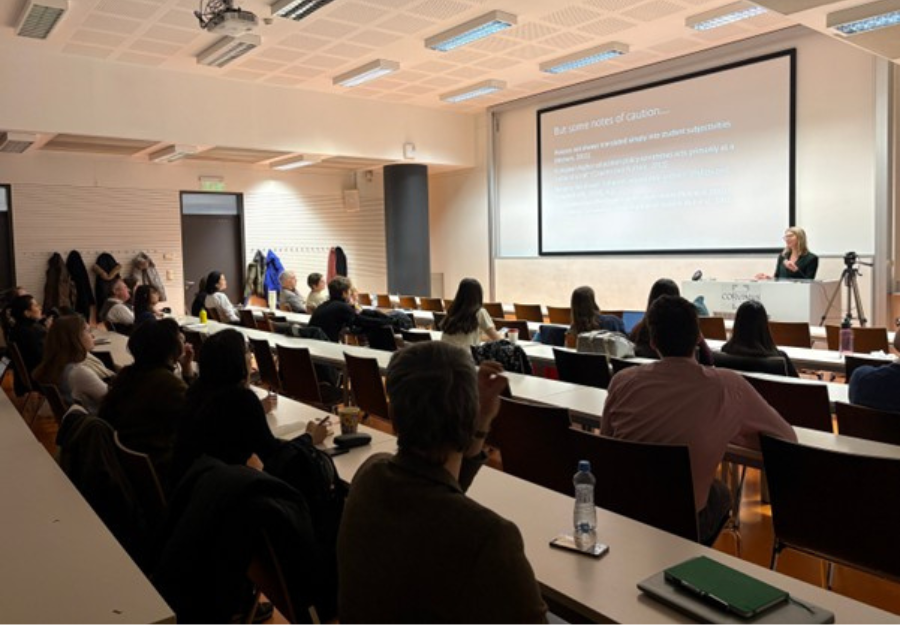
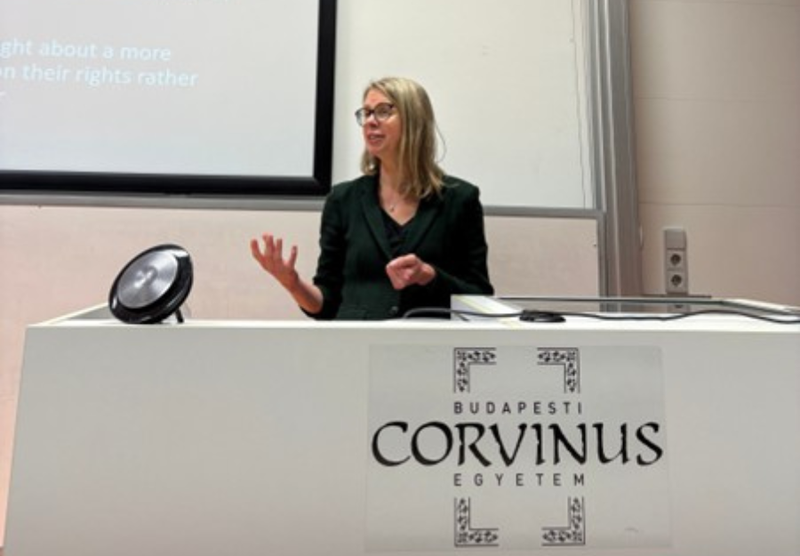
Professor Rachel Brooks challenges the notion of a singular “European student”. By examining perspectives across six countries, she investigates whether national borders still define the academic journey. A report by Panna Pipis on the lecture hosted by the Corvinus University of Budapest on 16 February, titled What is a higher education student? Perspectives from across Europe. Professor Brooks came to Budapest at the invitation of Corvinus University’s Institute of Social and Political Sciences.
There is a general assumption that student identities are becoming increasingly similar due to the impact neo-liberalisation and marketisation have had on higher education. This is particularly prevalent in the European Union due to the Bologna reforms and Erasmus opportunities. Scholars such as Kenway argue that learning has become a commodity, leading to the view of students as career-oriented consumers who see education as a tool for future financial gain. However, Rachel Brooks, a Professor of Higher Education at the University of Oxford and former President of the British Sociological Association and a leading academic editor, advises against this oversimplification, pointing out several complexities that require careful consideration. She notes that policies are not direct mirrors of student subjectivity, institutional policies often serve as symbolic cultural scripts. Moreover, differences persist between institutions and between student groups even within borders.
To empirically test these claims, Professor Brooks conducted the Eurostudent project, collecting data from six countries: Denmark, England, Germany, Ireland, Poland and Spain. By analyzing policy constructions, media representations, institutional perspectives and student understandings, the study identified six common constructitons of students: in transition (to fully formed adults), citizens (political actors), enthusiastic learners and hard-workers, future workers (preparing for the labour market), stressed, and threats and objects of criticism.
When examining the extent of students’ homogenisation, Poland stands out as an outlier where the specific identity of the “higher education student” appears to be fading compared to its European neighbours. Following a period of rapid massification, university attendance has become so commonplace that students often view themselves as regular people rather than members of a distinct social group, a sentiment reflected in the country’s lack of student-focused media and films. Crucially, Polish students prioritize a worker identity over a learner identity, driven by the belief that work experience is now a more important labour market signal than a ubiquitous degree. This pragmatic, employment-heavy focus, combined with a notable absence of the stressed student discourse found elsewhere, suggests that in Poland, higher education is increasingly viewed as a functional background task, rather than a transformative or socially unique life stage.
In contrast to the pragmatic student-worker model seen in Poland, Germany and Denmark maintain a “Humboldtian” approach, which prioritizes personal growth and academic freedom. In these nations, higher education is viewed not as a brief, job-focused hurdle, but as a distinct and vital stage of life dedicated to “Bildung”, the holistic development of one’s personality and citizenship. Students in these countries are more likely to see themselves as enthusiastic learners rather than just consumers or future employees. They place a high value on the freedom to learn, which includes the liberty to dictate the pace of their studies, a sharp contrast to the rigid, high-speed degree structures found in the UK and Ireland. While Brooks noted that policymakers in Denmark and Germany are increasingly pushing for more “instrumental” or faster graduation rates, the students and staff in these nations continue to resist these pressures, viewing the university as a protected space for intellectual exploration and self-discovery.
While some general constructions, such as the stressed student and the future worker, appear consistently across different actors within a country, Professor Brooks found that European states are rarely coherent educational entities. Instead of a unified national perspective, there is often a significant disconnect between how different groups conceptualise the student experience. For instance, while policy documents and media often frame students as instrumental, consumerist, or even passive and lazy, students themselves frequently resist these labels, viewing their time in university as a period of deep personal growth and committed learning. These internal divisions are further complicated by axes of difference such as academic discipline, where STEM students are often viewed as superior learners, while non-STEM students worry about their futures. Moreover, social background is also an influential factor, which dictates, among other things, whether a student has the luxury to focus entirely on their studies or must balance them with the necessity of paid work.
The study’s central conclusion is that the “European student” is far from a monolithic figure, as deep-seated national traditions and social inequalities continue to resist the forces of homogenisation. While a global shift toward marketisation has universally framed students as future workers, Professor Brooks demonstrates that significant divergence remains. Ultimately, the research proves that these conceptualisations are not merely academic, they have material consequences, dictating how students are funded, how their political protests are perceived, and whether their academic struggles are treated with support or social criticism.
The Q&A session sparked a broad conversation that extended Brooks’ findings into the future of academia, with participants asking how generative AI might redefine the traditional learner identity. Attendees also explored the nuances of international mobility with questions focusing on the specific constructions of international versus domestic students and how scholarship schemes, such as those in Hungary, might bridge or widen social class divides.