Eva Kovacs presents research on “bureaucracy under pressure” at COPPR26
At the 2026 Conference on Policy Process Research (COPPR26), held on January 20–23 at the University of Bern, Eva Kovacs from our Public Policy Department presented her working paper in the pre-conference workshop Public Administration under Pressure, hosted by Markus Hinterleitner, Céline Honegger, and Fritz Sager. She conducted this research as a visiting scholar at the University of St. Gallen during the spring semester, supported by a CPAP university scholarship.
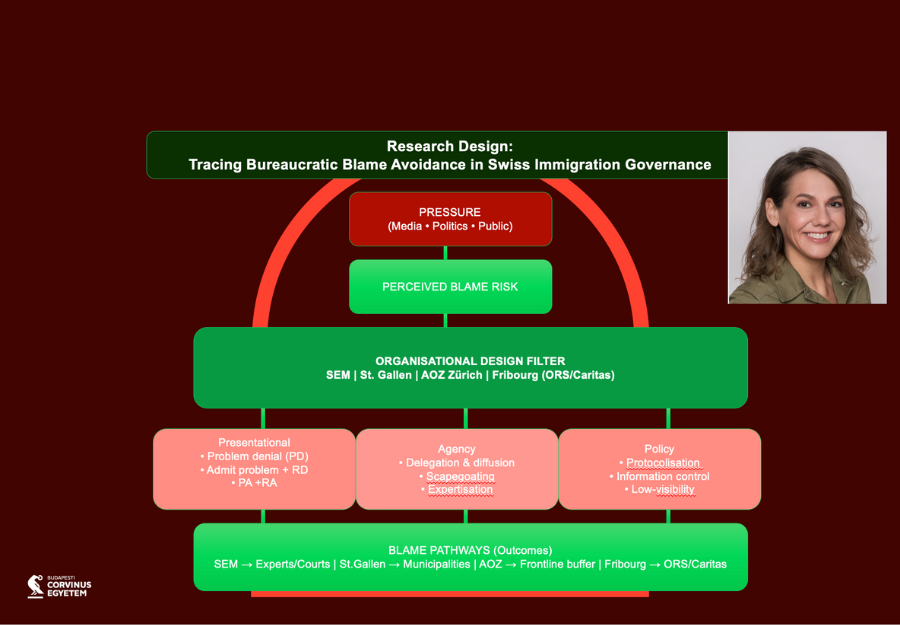
Her working paper examines how bureaucratic organisations cope with political, public, and media pressures in Swiss immigration and integration policy. Based on in-depth interviews with federal, cantonal, and municipal administrations, as well as semi-public and private service providers, the study analyses how administrative actors manage responsibility, blame, and public scrutiny in a highly politicised policy field.
Using a comparative design, the paper explores four organisational models: the federal administration (SEM), decentralised cantonal–municipal governance (St. Gallen), a semi-public organisation (AOZ, Zurich), and an outsourcing model (Fribourg). A key finding is that bureaucratic responses to pressure are not ad hoc reactions to crisis, but are systematically shaped by organisational design. Legalistic organisations rely on rules and procedures as shields against blame, decentralised systems diffuse responsibility across levels, semi-public organisations internalise pressure through professionalisation, while outsourced models actively use delegation to externalise political risk.
The project highlights Swiss immigration governance as a critical case of “bureaucracy under pressure” and shows how administrative systems are designed not only to deliver policy outcomes, but also to manage political risk and blame in multilevel governance settings.