Interview with Corvinus Alumnus and Olympic Cross-Country Skier
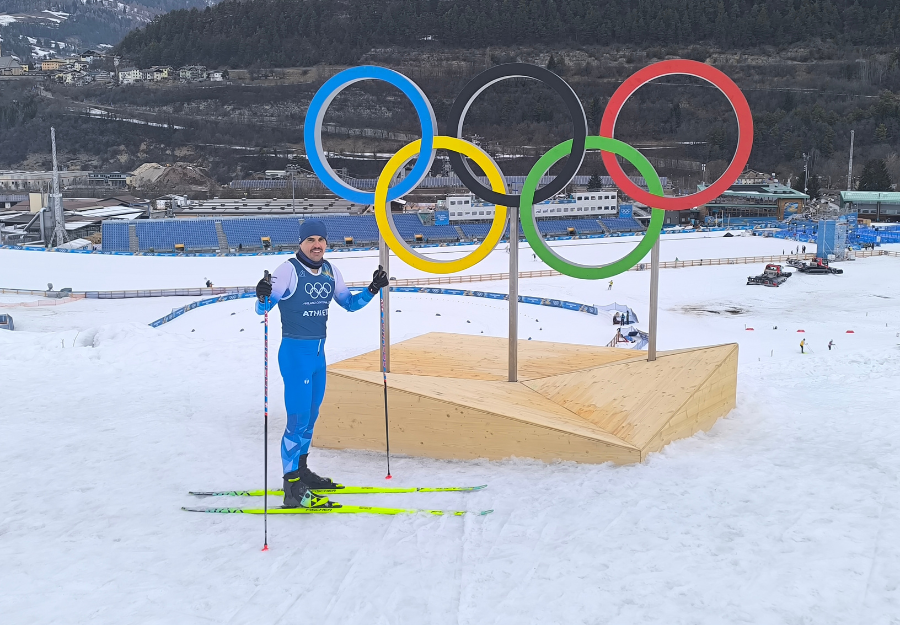
As the first Israeli cross-country skier ever, Mihály Kertész lined up at the start of the 2026 Milan–Cortina Winter Olympics. The road to qualification was anything but smooth, ranging from preparation in Thailand to receiving Israeli citizenship at the very last minute. In the end, everything came together: at 37, he fulfilled a lifelong dream by reaching the Olympics. In our short interview, we asked him about his experiences at the competition.
What emotions were going through you when, after many years of preparation, you finally stood at the start as a qualified cross-country skier at the Winter Olympics?
For a very long time, there wasn’t a single moment when I could truly believe I would actually be at the Olympics. At the Norwegian World Cup on December 8, when the last competitor crossed the finish line, I started to think that I had secured the quota spot. But I still had to wait for the official results, and an hour later it was finally confirmed.
Then came the most stressful part: the passport. I waited four weeks before receiving information that the parliament had passed the law, and only the Prime Minister, Benjamin Netanyahu, needed to sign it. After he signed, I still had to fly to Tel Aviv, so I still couldn’t quite believe it. I arrived in Tel Aviv six days before the final deadline, and at the airport my passport was issued within an hour. After sixteen hours of travel, I was so exhausted that I couldn’t even process what was happening.
But five days before my race, when I first stepped onto the Olympic cross-country track in Val di Fiemme, I skied slowly for two or three minutes just holding my head in disbelief that this had really happened. I was actually there. The Olympic rings were everywhere. I kept looking at them on every banner, and that was when it finally began to feel real.
What was the race experience like?
The 10-kilometer individual cross-country race is like a Formula 1 competition: in every corner you have to think three turns ahead to carry as much momentum as possible. Throughout the race, you constantly have to keep in mind how much distance remains and how close you are to your lactate threshold. If you push too hard on a climb, you can quickly accumulate too much lactic acid, your movement falls apart, and you can end up 20–30% slower.
For the first eight kilometers, you need to be cautious, and only in the last two can you really push as hard as you can. The Olympic atmosphere makes this even more difficult, as it encourages competitors to go full speed right from the start.
There was also an additional challenge: the snow was melting, and in the turns 20–30 centimeters of slush had formed after 110 competitors had raced through them twice at maximum speed. With cross-country skis, you can’t brake in slushy corners; you have to take small steps. There wasn’t a single meter of the course where you could rest. It was the toughest track of my life — even though I’ve competed on ten World Cup courses in five different countries.
Something I hadn’t expected: I was the last skier on the course, and during the final kilometer, five thousand spectators were cheering just for me. It was an incredible experience. Even with my heart rate at 170 and my legs burning from lactic acid, I was able to smile — and even increase my speed a little.
How satisfied are you with your result?
At the Norwegian qualification World Cup in December, I was only six seconds within the Olympic standard. Realistically, the goal was simply not to finish last — and I achieved that. Out of a field of 113 competitors, I finished 110th. I gave it everything I had and didn’t fall, while several World Championship and Olympic silver medalists did fall on the course. I’m completely satisfied.
What are your future plans in competitive cross-country skiing?
With my Olympic result, I have already qualified for next year’s World Championships, which will be held in Sweden in February 2027. At 37, I only dare to plan my competitive career one year at a time — for now, until next year’s World Championships. After that, we’ll see. But I hope I’ll be able to continue cross-country skiing for the rest of my life.