Rajk College Celebrates 30 Years of Student-Selected Excellence: The Neumann–Simon Conference
_20260113101523.png)
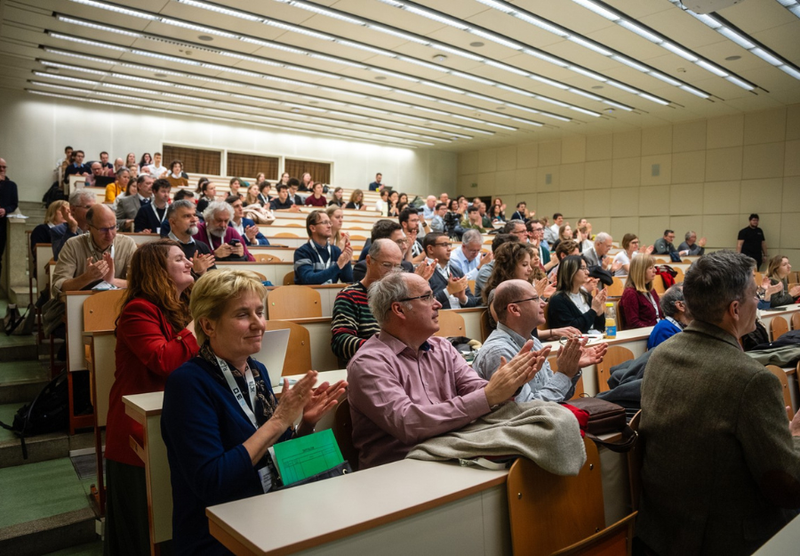
As Attila Chikán emphasized in his opening remarks, the John von Neumann and Herbert Simon Awards at Rajk College stand out in the academic world for their strictly democratic, student-driven selection process, including debates and a college-wide vote. Established in 1995 and 2005 respectively, these awards honor groundbreaking researchers in economics and business management, creating a unique personal bond between students and scholars through shared meals and masterclasses. The students’ foresight has been particularly notable; among the eleven Neumann laureates who have won the Nobel Prize, seven received the honor from the Swedish Academy only after being recognized by the Rajk community, underlying that this student-led model can successfully identify the future frontiers of economic thought.
The conference’s opening panel, featuring four distinguished Rajk alumni, sought to interpret the current global economy where security concerns, geopolitical rivalry and industrial policy have displaced cost-efficiency as the primary organizing principles. Moderated by Pálma Polyák, the discussion challenged the concept of simple deglobalization, proposing instead a shift toward geo-fragmentation and slowbalization. Rather than simply unraveling, globalization is reconfiguring into denser networks within politically aligned blocs, driven by shocks like the pandemic, the war in Ukraine, and US–China tensions. Speakers argued that while globalization is reconfiguring into denser networks within politically aligned blocs, market forces remain resilient: when old routes are severed, energy and capital find new paths, compelling firms to adapt to a transformed rather than vanished global system.
The discussion featured Andrea Gelei, Csaba Zsótér, and Miklós Koren, who also explored the practical implications of these shifts for production networks and national strategy. Andrea Gelei showed how multinational firms are restructuring supply chains for greater resilience, while Csaba Zsótér used his energy sector expertise to illustrate the difficult balance between security and efficiency in fuel strategy. Miklós Koren, utilizing big data analysis, traced how shocks ripple through trade networks. Ultimately, the conversation turned to the specific challenges facing a small, open economy like Hungary as it navigates these trade-offs. The panelists emphasized that while strategies like shortening supply chains and diversifying energy sources may incur higher costs, they are essential for managing geopolitical and climate risks. For Hungary, the key lies in leveraging its geographic position and industrial base to maintain deep integration with European and global networks while reducing critical dependencies and moving up the value chain, ensuring the country can thrive within the new economic order.
As the first lecture of the Neumann Award Panel, Péter Eső offered a guided tour of how Neumann Award-winning economists have used games of incomplete information to study strategic interaction, from poker tables to modern markets. He showed that abstract Bayesian game theory can illuminate very human questions about communication, deception and trust: starting from von Neumann’s seemingly simple poker model and sender-receiver games, the speaker traced a line through Harsanyi’s treatment of incomplete information to modern work on cheap talk, costly signalling and persuasion. He argued that these frameworks explain why more information does not always increase welfare and how selective disclosure can rationally shape beliefs; in doing so, the talk suggested that taking models seriously but not literally helps economists better understand the role of freedom of thought, speech and information in real societies, and invites the audience to “listen with an open mind as a Bayesian, be aware of biases, intentions and incentives”.
Celebrating this rich history, the Neumann Simon Conference served as a retrospective, using the foundational theories of past laureates to analyze contemporary issues ranging from deglobalization to artificial intelligence. The conference program featured several additional talks where Rajk alumni presented lectures that connected the theoretical frameworks of great researchers like Joshua Angrist, Susan Athey, Daron Acemoglu to modern realities, such as the mechanics of automation, the role of trust in AI implementation, and the impact of political polarization on team dynamics. By exploring topics like data-driven health policy and the shifting global economic equilibrium, the event demonstrated how the intellectual legacy of previous awardees continues to provide vital tools for understanding a fragmented and rapidly changing world.
Written by: Panna Pipis