Employees who move to better companies not only earn higher wages but also see improvements in their health
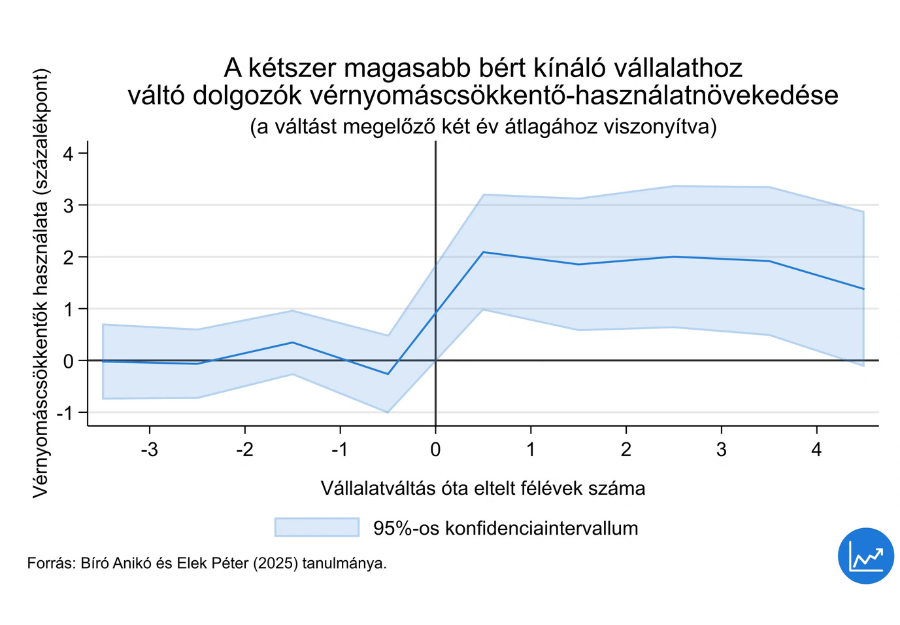
According to the findings, when an employee joins a higher-paying company, they are more likely to visit a doctor, undergo diagnostic tests, and begin treatment for cardiovascular conditions, including blood pressure and cholesterol-lowering medication. At the same time, they are less likely to start using medication for mental health issues, without any deterioration in their physical health.
The analysis, based on data from around 10,000 Hungarian workers between 2009 and 2017, shows that more productive firms offer better occupational health screenings and less stressful working conditions.
The study concludes that more productive firms have a positive effect on the detection of previously undiagnosed chronic diseases and on employees’ mental well-being. This is particularly significant given that high blood pressure may affect up to one in two or three people aged 30 to 79, yet only about half receive treatment. Similarly, a substantial share of diabetes cases remain undiagnosed.
“Overall, more productive firms contribute to preserving employee health through prevention. This positive effect can be seen as a kind of fringe benefit, equivalent to 1–2 per cent of wages,” said Péter Elek, one of the study’s authors and Associate Professor at Corvinus University of Budapest.
For example, moving to a firm that pays wages one standard deviation higher (around 26 per cent more) increases the probability of receiving blood pressure medication by 0.4 percentage points and cholesterol-lowering drugs by 0.2 percentage points. It also raises the use of primary care and diagnostic services by about 2 per cent, while hospitalisation rates do not increase.
These results may be explained by more thorough occupational health services at higher-quality firms, which help detect chronic conditions earlier, as well as lower workplace stress, which supports better mental health. Since the study period, the use of private healthcare has become even more widespread, potentially amplifying these differences.
The study was published in the Journal of Health Economics and was authored by Anikó Bíró of the ELTE Institute of Economics and Péter Elek, also a researcher at the institute and Associate Professor at Corvinus University of Budapest.