CIAS Inn: Making Macroeconomics More Human — Interview with Dr Giovanni di Bartolomeo
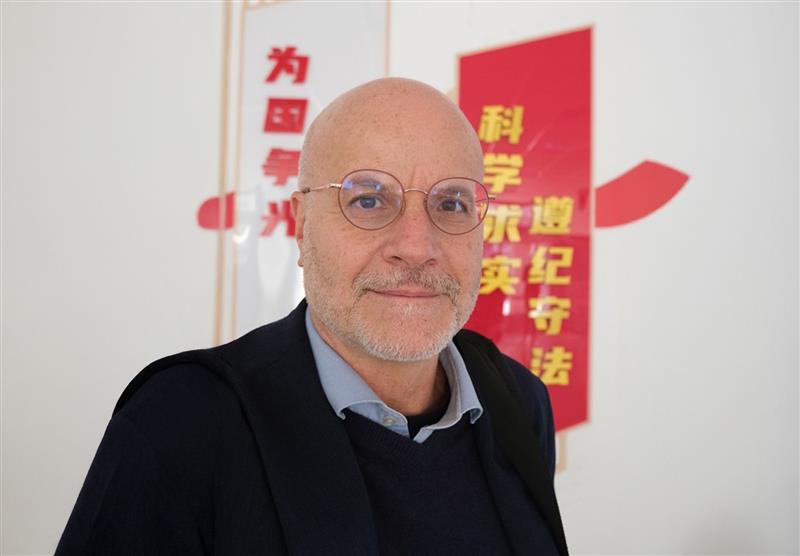
But what if those models assume people behave better and more rationally than they actually do? This question lies at the heart of Professor Giovanni Di Bartolomeo’s current research at the Corvinus Institute for Advanced Studies (CIAS).
Giovanni Di Bartolomeo is a professor of economic policy at Sapienza University of Rome and the dean of the Faculty of Economics. Over the years, he has held numerous academic and managerial roles and has been a researcher and visiting professor at several European universities.
His collaboration with Corvinus University grew out of academic networks and personal encounters. “I started to speak with colleagues at Corvinus, and we began to discuss potential collaboration,” he recalls. “I was fascinated by the environment, and in the end, I applied for the visiting fellowship, and now I’m here.”
His research project at CIAS — entitled “Extending DSGE models to behavioural macroeconomics” — is planned to be completed within this year, while it forms part of a broader research agenda the professor expects to pursue for around four to five years. The main outcome will be several academic papers, including at least a couple aimed at top-tier international journals.
His research focuses on a topic that lies at the intersection of macroeconomic theory and behavioural economics: extending DSGE models to better reflect how people actually behave. “DSGE (Dynamic Stochastic General Equilibrium) models are the mainstream models used in central banks and governments to understand aggregate economic dynamics,” the professor explains. At their core is the idea of rational expectations, meaning that “people do not make systematic errors.”
It is a clean and powerful assumption, but his experience in experimental economics tells a different story. “When you test these ideas in experiments, people are not rational. People make systematic errors,” the researcher says. “They make systematic errors for different reasons, maybe because they are ‘stupid’, or because they are not able to collect and arrange all the information, or because they have to pay for it.”
This gap between theory and observed behaviour has long bothered the researcher. “On one side, I was studying macro-models where people are perfectly rational. On the other side, I was studying experiments showing exactly the opposite.” His current research is an attempt to bridge that divide.
The key concept connecting behavioural economics and macroeconomic models is expectations. “The key variable to understand these distortions is expectations,” Professor Di Bartolomeo says.
Traditional models assume that individuals can predict the future accurately. In reality, “people are influenced by emotions, optimism, pessimism, what John Maynard Keynes called animal spirits.” These beliefs shape decisions long before the future arrives. “Expectations are not about the future,” he explains, “expectations influence what you are going to do today.”
For decades, the business cycles in advanced economies were relatively predictable. That changed dramatically after the global financial crisis. “We now live in the era of the turbulences,” Professor Di Bartolomeo notes, pointing to the financial crisis, the pandemic, inflation, and geopolitical conflicts.
“The mainstream framework was very good up to the financial crisis. After that, it became very difficult to apply.” While behavioural macroeconomics cannot predict crises themselves, it can help policymakers respond more effectively once they occur. “We cannot predict the pandemic, but we can predict the effects of the policies used to face it.”
As a policy advisor for several institutions, Professor Di Bartolomeo has seen this firsthand: “The effect of public investments depends on a lot of things: on how funds are spent, where they are directed, and above all, on expectations. Different expectations lead to different outcomes, because economic decisions are shaped not only by present actions but by beliefs about the future.”
Although economists have debated expectations since the 1970s, integrating experimental insights into DSGE models is still relatively new. “The idea of adding ‘non-rational’ expectations based on experimental economics is on the research frontier,” he says. “It is an interesting development in economics.”
Ultimately, the goal is not to remove existing models, but to improve them. “The idea is to develop a paradigm that is more suitable for a world that is changing,” Professor Di Bartolomeo concludes.