Advancing pay transparency at Corvinus

The European Union’s new Pay Transparency Directive aims to make compensation more transparent and equitable, while helping to reduce potential pay gaps between women and men. Although the directive is still in the process of being implemented in Hungary, Corvinus University already operates a modern and transparent compensation system.
“As soon as it became known that the regulation would also be introduced in Hungary, we immediately began preparing. As a first step, we established a broad working group representing all segments of the university community, including the trade union, the staff council, HR, legal experts, and colleagues responsible for the area. On the one hand, we set ourselves a clear and ambitious goal: to be the first university in Hungarian higher education to take this step and implement it. In fact, even in the corporate sector, relatively few companies operate with fully transparent salary bands. On the other hand, there has been a growing internal demand within the university for greater pay transparency. We would have preferred to align this process with the Hungarian implementation of the EU Pay Transparency Directive, but this is still pending,” said Klára Tatár-Kiss, Chief Culture and People Officer at the university.
Transparent compensation system
Since the model change in 2019, the university has implemented a transparent, performance-based compensation policy built on clear performance expectations and evaluation criteria. The aim of the system is to strengthen meritocracy, recognize outstanding performance, and support the achievement of academic objectives.
The main elements of the compensation system are set out in the Employment Requirements System:
- the Remuneration Policy,
- the Academic Career Model,
- and the Performance Regulation.
All relevant documents are available to colleagues through the university’s legal repository platform: Jogtár.
Performance-based compensation
The Remuneration Policy sets out the fundamental principles of compensation, which are based on the expectations associated with different job categories and on differentiated performance evaluation. The system is built on the classification of positions (across both academic and professional support functions) and the salary bands assigned to them.
A key achievement is that significant salary increases have been implemented in recent years for employees in both academic and service area roles.
|
Average salary increase |
2022. |
2023. |
2024. |
2025. |
2026. |
|
academy |
12% |
17% |
11% |
9% |
7% |
|
service |
10% |
15% |
10% |
7% |
6% |
“Thanks to the salary increases implemented in recent years, we have achieved a more balanced base pay structure, helping to ensure fair working conditions and competitive compensation for our colleagues. Another important outcome has been our ability to attract a number of international faculty members and researchers through open recruitment processes. In addition, we have successfully brought back several Hungarian professionals with substantial international experience—across both academic and professional support functions—whose expertise contributes significantly to the university’s continued development,” emphasized Klára Tatár-Kiss.
The salary alignment process toward the cost-of-living-adjusted compensation benchmarks of the WU Vienna University of Economics and Business is currently ongoing. As part of this process, academic compensation is being gradually brought closer to international market levels, guided by a performance-based remuneration philosophy. For employees working in service and professional support functions, the objective is to align compensation with the median salary levels of Hungary’s private sector.
“This reflects the logic that academic roles operate within a relatively well-defined career progression system, from assistant lecturer level up to full professor, with requirements also set out in legislation. In contrast, service areas function much more like the private sector, for example in fields such as finance, law, communications, or HR,” added the Chief People and Culture Officer.
Salary bands in the academic area
A significant proportion of the academic (teacher-researcher) staff already falls within the defined salary bands; however, minor deviations still occur, primarily as a result of earlier compensation practices or individual career trajectories. Cases that may fall outside the band are reviewed individually, and a corrective action plan is developed accordingly.
In the case of international faculty members, mobility and living costs were previously included as part of the base salary. From 2025 onwards, the university is gradually reforming this practice: mobility allowances are being treated separately from base salary, which increases transparency and strengthens pay equity among academic colleagues.
|
Academic job levels |
Minimum base salary (monthly HUF) |
Maximum base salary (monthly HUF) |
|
University professor, research professor |
1 300 000 |
2 100 000 |
|
Associate Professor, Professor of Practice II, Senior Research Fellow |
900 000 |
1 500 000 |
|
Assistant Professor, Professor of Practice I, Research Fellow |
700 000 |
1 200 000 |
|
Assistant Lecturer, Assistant Research Fellow |
600 000 |
900 000 |
|
Academic leader (deans, HoI) |
2 000 000 |
2 900 000 |
Salary bands in the service areas
In non-academic (service) roles, the university has introduced the Korn Ferry (Hay) job evaluation system, which provides a consistent framework for assessing positions and strengthening internal equity. Keeping this up to date is an important task in a dynamically changing organization; therefore, it will be reviewed over the next 12 months to further strengthen organizational and market alignment.
|
Job levels – Service |
Minimum base salary (monthly HUF) |
Maximum base salary (monthly HUF) |
|
Senior Leadership (high level of responsibility, complexity, and multifaceted roles) |
1 800 000 |
3 000 000 |
|
Mid-Management, Senior Expert |
1 200 000 |
2 000 000 |
|
Team Lead, Expert |
800 000 |
1 400 000 |
|
Specialist, Coordinator |
530 000 |
920 000 |
|
Admin, Assistant, Referent |
420 000 |
690 000 |
Total compensation and external activities
Current transparency applies to base salary; however, the full compensation system is considerably more complex. Our plans include conducting a similar analysis of the total compensation package and sharing it with the community.
In academic roles, there is a broader range of opportunities for supplementary income, which is justified by the nature of teaching, research, grant-funded, and external professional activities.
- 79% of academic employees receive some form of supplementary allowance from university resources. For approximately 4% of them, this salary supplement is significant, exceeding 40% of their annual base salary, typically linked to additional responsibilities or externally funded projects.
- By contrast, only 7% of non-academic staff receive supplementary benefits.
At the university, all external positions, appointments, board memberships, corporate ownership interests, as well as participation in non-profit and for-profit organizations are subject to disclosure and registration obligations. According to available data, approximately 55% of academic employees hold external professional roles, whereas this figure is below 20% among non-academic staff.
Rector and senior leadership compensation
On November 1, 2024, the university’s organizational structure was reformed, resulting in the establishment of a new governance system. The members of the Executive Committee include the Rector and six additional senior leaders (three from academic areas and three from service areas, the Chief of Staff position is currently vacant), who are responsible for managing their respective portfolios as defined in the organizational structure and who hold leadership roles within their designated fields.
The remuneration of committee members is determined based on an external benchmarking system grounded in the Korn Ferry–Hay methodology. Leadership salary levels have been defined according to consistent principles and are aligned with the university’s overall compensation philosophy.
Base salary bands (excluding the Rector, gross HUF/month):
- Minimum: 3,000,000 HUF
- Maximum: 4,000,000 HUF
Based on the principles outlined above, there may also be cases within the newly established structure where, in the case of the Executive Committee, certain salaries fall below the defined band.
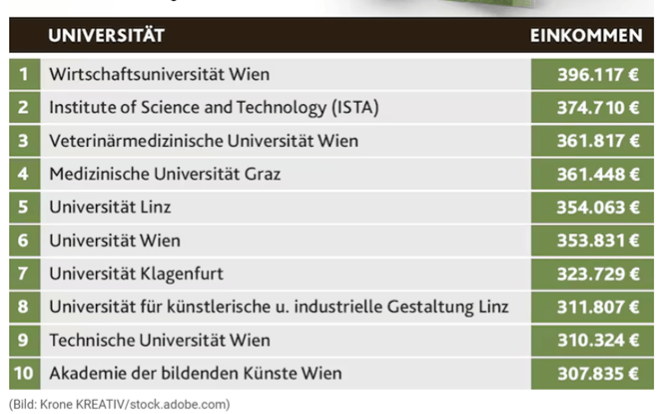
The Rector’s base salary (who also holds the position of President) is a gross monthly salary of 16,670 euro, which is approximately equivalent to 5,800,000 HUF gross. This amount is roughly half of the benchmark rector’s salary at the WU Vienna University of Economics and Business. Based on benchmark data from comparable European higher education institutions (e.g. WU Rector €400,000 (gross); Copenhagen Business School Rector (ca. gross HUF 9.500.000); ETH Zürich President (ca. gross HUF 12.000.000); Univerzita Karlova Rector (ca. gross HUF 4.400.000)), the base salary of the Rector of Corvinus is broadly in line with the level observed at peer institutions.
Measuring the gender pay gap
Although the current Hungarian legal framework does not yet impose mandatory pay transparency requirements, the university has been consistently monitoring the gender pay gap for two years. As part of its commitment to transparency and fair compensation, the results are also shared with the Trade Union. According to the analyses, most job categories fall within the 5% tolerance threshold set by the EU directive, meaning that no systemic gender pay gap can be identified.
Continued development of the compensation system
Our work with this step is not yet complete. There is still much to do in the area of pay transparency. In the autumn, leadership workshops will be launched to support managers in the practical implementation and day-to-day management of pay transparency. The Pay Transparency Working Group will continue its work, with particular attention to the fact that further tasks will certainly arise in line with Hungarian legislation. The other key direction is the development of the aforementioned total compensation analysis system, followed by the analysis of the related data and its joint review with the wider community.
At the same time, we recognize that pay transparency is a highly important culture-shaping topic, which is why we have set up a dedicated email address to handle related queries from colleagues. This contact point is available on the intranet.