Eight suburban towns emerge as new centres around Budapest, Corvinus study finds
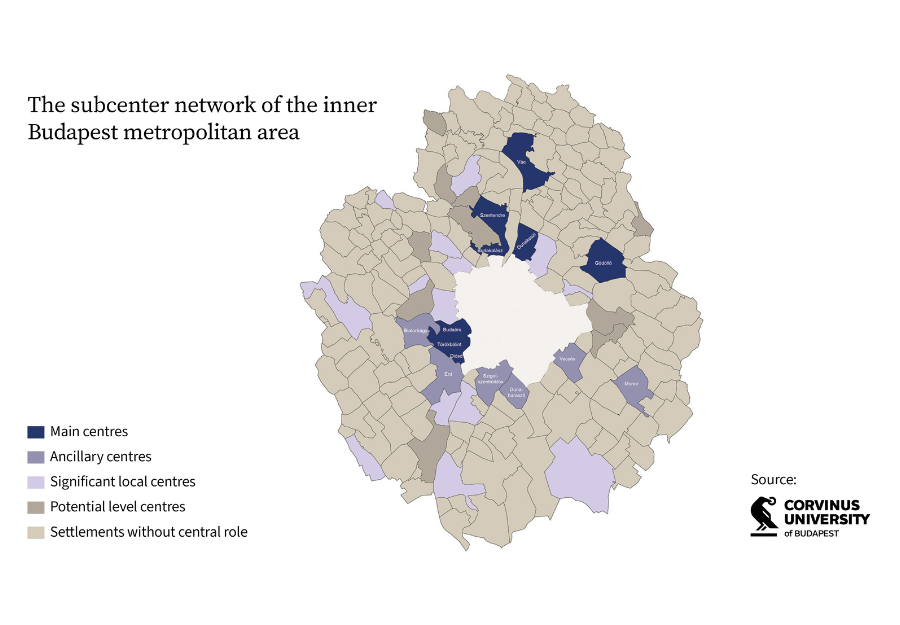
From Vác to Diósd, from Szentendre to Gödöllő, eight urban centres are taking shape around Budapest, while urbanisation in the south-eastern part of the metropolitan area is lagging behind, according to a study by Corvinus University of Budapest. The researchers argue that motorway access plays a far more important role in the formation of centres than rail connections.
Two researchers from Corvinus University of Budapest, János B. Kocsis and Virág Varga, examined 203 settlements in the Budapest metropolitan region based on their roles within the wider area. Their findings were published in the Journal of Urban Affairs. According to the authors, Budapest’s distinctive pattern of urban development means that the emergence of “classic” sub-centres within the city itself can only be interpreted in a limited way.
The results show that primary centres are concentrated mainly in the northern, north-eastern and western parts of the agglomeration. By contrast, the north-western, southern and south-eastern zones feature fewer hubs with a broad range of services and strong labour market positions. In the north-west, geographical constraints, poor accessibility and a lack of cross-connections are holding back development. At the same time, the authors identify several sub-centres in the southern belt, though these are generally less developed and focused mainly on logistics and industrial functions.
The south-west is the strongest
The researchers identified eight major central towns in the agglomeration: in the south-west, the trio of Budaörs, Törökbálint and Diósd; in the north, the pair of Budakalász and Szentendre; Dunakeszi and Vác; and in the north-east, Gödöllő. These towns stand out from their surroundings thanks to stable economic activity, higher-level services and functions that serve a wider catchment area.
The authors also see six secondary centres emerging: Biatorbágy, Dunaharaszti, Érd, Monor, Szigetszentmiklós and Vecsés. While several of their indicators resemble those of the main centres, they tend to be less economically active overall. The lack of major sub-centres in the north-western zone is linked to poor accessibility, as the north-western section of the M0 ring road has yet to be completed.
The study also lists 14 more significant local centres with a primarily economic and labour market focus, including Dabas and Százhalombatta, which could over time evolve into residential and recreational hubs. In addition, nine settlements are classified as potential lower-level centres, among them Pomáz and Ercsi. These places have strong local labour markets and retail sectors, and improvements in transport links and basic functions could allow them to move up a level. Functional gaps were identified in 149 settlements, while nine function purely as residential areas. Eight holiday settlements have well-developed cultural, hospitality and sports activities, but would need several basic central functions to strengthen their role, including places such as Taksony and Kisoroszi.
Four criteria for becoming a centre
To define central roles, the researchers considered a wide range of factors, including local employment opportunities, retail and service provision, education and healthcare, hospitality and recreation, cultural and leisure activities, sports facilities, housing quality, property prices and commuting patterns.
The study’s main conclusion is that proximity to motorways is the key factor in the emergence of sub-centres. It shows a significant, multi-dimensional link with retail activity, residential functions and employment. Rail connections, by contrast, are less important and show only a weak but measurable correlation, mainly with residential functions. “Soft” functions such as culture, recreation and hospitality are less directly linked to transport indicators, which may partly reflect the capital’s strong pull effect. Poor accessibility and the limited purchasing power of the catchment area have, for example, constrained the central role of Ráckeve, despite its strong historical urban identity.
“Decision-makers often think in a single dimension, focusing on efficient infrastructure. Our research shows that while this matters, it is not enough on its own. Historical conditions, local communities and identity, and socio-economic status all strongly influence which settlements can become lasting, genuine centres. This is particularly clear in the case of the south-western sub-centres, which perform well across all four criteria,” stresses János B. Kocsis, associate professor at Corvinus and lead author of the study.
What lies ahead?
The researchers also note that without regional cooperation it is difficult to plan the joint development of emerging centres. Competition for funding, widespread commuting and social fragmentation weaken long-term, coordinated spatial development in many areas. Strengthening new centres is desirable, as it can reduce agglomeration-related disadvantages such as congestion, rising housing costs, pollution and crime risks. New centres are emerging as the economy becomes more decentralised, technology and transport continue to develop, the M0 ring road has been built out, agglomeration towns take on more urban functions, and non-traditional forms of employment spread.
Fót and Budakeszi could become more prominent sub-centres as the share of highly educated residents in the agglomeration increases. Pomáz, Solymár and Pilisvörösvár could operate as a connected sub-centre if the north-western section of the M0 ring road is completed, while modernisation of the HÉV suburban rail line could strengthen Szentendre’s central position. Upgrading the Lajosmizse–Kecskemét railway line, which runs parallel to the M5 motorway, could support the emergence of strong sub-centres in the south-western sector. However, projects planned within Budapest’s southern urban gateway may hinder the development of a more complex and robust southern agglomeration centre.