Submitting a valid application
Follow these steps when you apply so we can start processing your application immediately:





Step 1
Supply all the requested personal details
Step 2
Upload the required documents for your programme
Step 3
Upload a valid passport or national ID document (EU students)
Step 4
Pay your application fee

Where required.
Step 5
Submit your application
Entry requirements
Bachelor’s
Application fee
- €95 compulsory and non-refundable for fee-paying applicants
- No application fee for Stipendium Hungaricum or Hungarian Diaspora scholarship applicants
Documents
- Valid passport or national ID (EU applicants)
- Proof of secondary education: original and translated transcripts and final certificate. If you are still studying at the time of applying, you can provide “in-progress” academic transcripts (minimum of two years of transcripts), including your last fully completed academic year or term. Your final documents must be submitted as soon as they become available. For general admission, there are no overall GPA requirements at Corvinus, you simply need to have completed your secondary education in your country of residence and received your final certificate by the time of enrolment.
We accept the following education:
- Secondary education national curriculum in your country of residence, equivalent to Hungarian Matura (‘érettségi’) standard
- International Baccalaureate (IB) Diploma Programme
- Cambridge curriculum
– At least 2 different A-Levels and 3 different GCSEs with A–C (9–4) grades (total 5 subjects), or
– At least 3 different A-Levels and 1 GCSE with A–C (9–4) grade (total 4 subjects), or
– At least 4 different A-Level results (in this case, GCSEs are not required) - GED together with a High School Equivalency diploma certificate where studies are proven by transcripts
- Application fee (only for fee-paying applicants)
- Letter of motivation (only for Stipendium Hungaricum or Hungarian Diaspora scholarship applicants)
English language proficiency
Corvinus accepts the following proof of English language proficiency (minimum equivalent B2 level) submitted no later than 1 August:
- if your mother tongue is English, please make a declaration and upload it to the University’s online admissions platform at the time of submitting your application
- Cambridge language certificate, minimum level: First (FCE)
- IELTS language certificate, minimum score: 6.0
- TOEFL language certificate, minimum score: 65
- TOEFL iBT language certificate, minimum score: 72
- TOEFL Home Edition language certificate, minimum score: 72
- TOEIC language certificate, minimum score: 785
- Duolingo English Test language certificate, minimum score: 100
- SkillCert English for Global Professionals (EGP) certification, minimum score: 96
- A-level or International A-level exam in English Language, minimum grade: B
- International Baccalaureate in English Language, minimum result: Standard Level 5 / Higher Level 4
- Advanced level Matura exam in English Language ( obtained in Hungary), minimum grade: 45%
- GCSE or IGCSE exam in English Language, minimum grade: 6 (or B)
- Internationally recognised preparatory programme (INTO, Study Group, Kaplan, Navitas, Corvinus Preparatory Programme), minimum level: B2 certified by the provider
Note: English being listed as the language of instruction is not enough to get an exemption. You must show official documents issued by the institution proving that all exams — including the final high school diploma exams — were taken in English.
Mathematics requirements
If you are an applicant for one of the following, you will be required to meet the Mathematics requirements:
- BSc Applied Economics
- BSc Business and Management
- BSc Data Science in Business
- BSc International Business
- BA Philosophy, Politics & Economy (PPE).
- BSc Business Informatics
To meet the mathematics requirement, you need to have one of the following:
- Advanced Placement Exam (AP Mathematics AB or BC), minimum grade: 3
- SAT Math Level II, minimum score: 680 (mathematics component; only SAT taken before 2021 accepted)
- ACT exam (mathematics component), minimum score: 27
- International Baccalaureate in Mathematics, minimum result: Standard Level 5 / Higher Level 4
- Advanced level Matura exam in Mathematics (Hungary), minimum grade: 45%
Mathematics GCSE or IGCSE, minimum grade: 6 (or B) - United Kingdom – A levels or International Alevel (Mathematics), minimum result: B
- Germany – Abitur (Zeugnis der Allgemeinen Hochschulreife) – Mathematics, minimum result: 12
- France – French Baccalauréat – Mathematics, minimum result: 13
- Slovakia – Vysvedcenie o Maturitnej Skúške / Maturita – Mathematics, minimum result: 2 (very good) and 60% in the written exam
- Romania – Romanian Diploma de Bacalaureat – Mathematics, minimum result: 8.0 in written examination (or final-year grade if no written exam available)
- Bulgaria – Diploma Za Zavarsheno Sredno Obrazovanie – Mathematics, minimum result: 5
- Austria – Reifeprüfungszeugnis / Maturazeugnis – Mathematics, minimum result: 2
Czech Republic – Maturita – Mathematics, minimum result: 73% or grade 2 - Spain – Título de Bachiller / Bachillerato – Mathematics, minimum result: 8
- Ireland – Irish Leaving Certificate – Mathematics, minimum result: H2
- Lithuania – Brandos Atestatas (Maturity Certificate) – Mathematics, minimum result: 85%
- European Baccalaureate – Mathematics, minimum result: 8
If you do not or will not have any of these qualifications by the time of enrolment, you can take the Corvinus mathematics entrance exam instead.
Corvinus online written mathematics exam
We organise maths entrance exams, written, online, at no extra cost. For fee-paying applicants these are held monthly, and for Stipendium Hungaricum and Diaspora Scholarship applicants they are typically held in April every year. Applicants are invited automatically as part of the admissions process.
Prepare thoroughly
The mathematics test consists of 26 questions and is 60 minutes long. Questions can be of two types: problem solving and data sufficiency. To answer them, you need some knowledge of arithmetic, elementary algebra and geometry. A calculator can be used.
Sample questions and answers are available here (these questions are the same as in the practice paper below).
Click here for a practice paper in the real test environment. You will only get one attempt, and you will receive your score at the end of the test. Please do not use another email account to attempt the practice test multiple times. We recommend that you only take the practice paper after you have studied the sample questions and answers.
Online interview
We organize admissions exams each month for self-funded applicants. For scholarship applicants the entrance exam period is April-May. You will be invited for an interview if you are an applicant for:
Our interviews are generally held online via Teams and they usually last 10-15 minutes. Please make sure you have a reliable internet connection for the event. You should receive an email inviting you to schedule an interview a minimum of five days before the interview date. The following will be assessed at your interview:
- Knowledge relevant to your programme
- Skills relevant to your programme
- Motivation
Note: applicants for BA Philosophy, Politics & Economics (PPE) must pass both the mathematics exam and the interview to be admitted to Corvinus.
Entrance exam results
You will achieve a score out of 100 in the admissions process. For each programme, the Dean will set a points threshold. Applicants scoring above the points threshold will be conditionally accepted – the points thresholds can vary from year-to-year and programme-to-programme.
Fee-paying applicants will receive the results on the Corvinus admission portal, typically within 2-3 weeks of the entrance exam period.
Stipendium Hungaricum and Diaspora applicants will be notified of their results via the Tempus Foundation application platform by the end of May.
Application fee
- €95 compulsory and non-refundable application fee for self-funded applicants
- No application fee for Stipendium Hungaricum or Diaspora scholarship applicants
Documents
- Proof of completed or in-progress undergraduate education: transcripts (minimum of completed semesters), degree certificate, along with their English translations
- A valid passport or national ID (EU applicants)
- Application fee (only for self-funded applicants)
- Letter of motivation (only for scholarship applicants)
- You will also need to meet the minimum credit requirements for your programme of study (see below).
English Language proficiency
Applicants are not required to submit an English language proficiency certificate, except for Management and Leadership, which is an integrated CEMS programme. Please see further details in the Managmenet and Leadership with CEMS section.
Entrance requirements
Admissions exams are held each month for self-funded applicants.
For Stipendium Hungaricum and Diaspora scholarship applicants, the entrance exam period is April-May.
The Corvinus written entrance exam has 2 types: Type A & Type B
It is a 100-minute online test that evaluates analytical and problem-solving skills, rather than prior academic knowledge. The format includes a mix of multiple-choice and write-in questions. Evaluated areas include:
| Skill Area Tested | Sub-Skill | Definition / Description | Type A | Type B |
| Logical Reasoning / Data Insights | Critical Thinking | Ability to objectively analyze and evaluate information and ideas, understand cause-and-effect relationships without being influenced by subjectivity/bias | YES | YES |
| Analysis under uncertainty | Ability to understand what is implied and draw conclusions in scenarios with incomplete or ambiguous information | YES | YES | |
| Pattern analysis | Ability to infer patterns, trends and exceptions, even in the face of multiple information | YES | YES | |
| Spatial intelligence | Visualization of complex and multifaceted structures, with simultaneous processing from different perspectives | YES | YES | |
| Lateral and creative thinking | Ability to approach problems in unconventional ways, generating new and original ideas | NO | YES | |
| Planning | Ability to organize ideas and tasks around a project, to identify priorities and propose efficient sequencing | YES | YES | |
| Quantitative Skills | Quantitative reasoning | Ability to use basic algebra, arithmetic and geometry to decipher and solve problems or to ascertain what data are sufficient for a problem to be solved | YES | NO |
| English / Interpretation | English | Proficiency of English language skills, including vocabulary, grammar and reading comprehension | YES | YES |
Please find below which programme requires which exam type:
|
Programme |
Requirements |
| Advanced Supply Chain Management | Advanced Supply Chain Management 60 points |
| + Oral examination 30 points | |
| In-house written admission exam, type ‘A’ 60 points | |
| topics: language skills; quantitative analytical skills; logical reasoning and data insights | |
| Oral examination 30 points | |
| topics: motivation and aptitude interview | |
| Agile Entrepreneurship | In-house written admission exam, type ‘A’ – 60 points |
| topics: language skills; quantitative analytical skills; logical reasoning and data insights | |
| Oral examination – 30 points | |
| topic: motivation and aptitude interview | |
| Artificial Intelligence in Business | In-house written admission exam, type ‘A’ 60 points |
| topics: language skills; quantitative analytical skills; logical reasoning and data insights | |
| Oral examination 30 points | |
| topics: motivation and aptitude interview | |
| Business Informatics |
In-house written admission exam, type ‘A’ – 90 points |
|
topics: language skills; quantitative analytical skills; logical reasoning and data insights |
|
| Climate Policy and Regional Development | In-house written admission exam, type ‘A’ – 60 points |
| topics: language skills; quantitative analytical skills; logical reasoning and data insights | |
| Oral examination – 30 points | |
| topic: motivation and aptitude interview | |
| Communication and Media Studies |
In-house written admission exam, type ‘B’ – 90 points |
|
topics: language skills; logical reasoning and data insights |
|
| Design, Business, Society | In-house written admission exam, type ‘A’ – 60 points |
| topics: language skills; quantitative analytical skills; logical reasoning and data insights | |
| Oral examination – 30 points | |
| topic: motivation and aptitude interview | |
| Digital Innovation | In-house written admission exam, type ‘A’ – 60 points |
| topics: language skills; quantitative analytical skills; logical reasoning and data insights | |
| Oral examination – 30 points | |
| topic: motivation and aptitude interview | |
| Economic Analysis | In-house written admission exam, type ‘A’ – 60 points |
| topics: language skills; quantitative analytical skills; logical reasoning and data insights | |
| Oral examination 30 points | |
| topics: interest in economics, logical thinking (including motivation and aptitude) | |
| Economic Behaviour Analysis |
In-house written admission exam, type ‘A’ – 60 points |
|
topics: language skills; quantitative analytical skills; logical reasoning and data insights |
|
|
Oral examination – 30 points |
|
|
topic: professional exam topics, based on recommended literature (including motivation and aptitude) |
|
| Finance |
In-house written admission exam, type ‘A’ – 60 points |
|
topics: language skills; quantitative analytical skills; logical reasoning and data insights |
|
|
Oral examination 30 points |
|
|
topic: solving and understanding corporate financial issues (including motivation and aptitude) |
|
| Global Development Policy | In-house written admission exam, type ‘A’ – 60 points |
| topics: language skills; quantitative analytical skills; logical reasoning and data insights | |
| Oral examination – 30 points | |
| topic: motivation and aptitude interview | |
| Health Economic Evaluation | In-house written admission exam, type ‘A’ – 60 points |
| topics: language skills; quantitative analytical skills; logical reasoning and data insights | |
| Oral examination – 30 points | |
| topic: motivation and aptitude interview | |
| Innovation and Entrepreneurship |
In-house written admission exam, type ‘A’ – 90 points |
|
topics: language skills; quantitative analytical skills; logical reasoning and data insights |
|
| Intellectual Property Management | |
|
In-house written admission exam, type ‘A’ – 90 points |
|
|
topics: language skills; quantitative analytical skills; logical reasoning and data insights |
|
| International Accounting and Auditing |
In-house written admission exam, type ‘A’ – 90 points |
|
topics: language skills; quantitative analytical skills; logical reasoning and data insights |
|
| International Economy and Business |
In-house written admission exam, type ‘A’ – 60 points |
| topics: language skills; quantitative analytical skills; logical reasoning and data insights | |
|
Oral examination – 30 points |
|
|
topics: international trade and international finance |
|
| (including motivation and aptitude) | |
| International Relations |
In-house written admission exam, type ‘B’ – 60 points |
|
topics: language skills; logical reasoning and data insights |
|
|
Oral examination – 30 points |
|
|
topics: current international issues (including motivation and aptitude |
|
| International Sport Business | In-house written admission exam, type ‘A’ – 60 points |
| topics: language skills; quantitative analytical skills; logical reasoning and data insights | |
| Oral examination – 30 points | |
| topic: motivation and aptitude interview | |
| Management (MiM) |
In-house written admission exam, type ‘A’ – 90 points |
|
topics: language skills,; quantitative analytical skills,; reasoning, and data insights |
|
| Management and Leadership (CEMS) | In-house written admission exam, type ‘A’ – 60 point |
| topics: language skills; quantitative analytical skills; logical reasoning and data insights | |
| Oral examination – 30 points | |
| topic: Intellectual Potential, Critical Thinking, International Openness and Intercultural Competence, Interpersonal Skills, Motivation to Achieve Performance, Integrity (including motivation and aptitude) | |
| Marketing |
In-house written admission exam, type ‘A’ – 90 points |
|
topics: language skills; quantitative analytical skills; logical reasoning and data insights |
|
| Marketing Strategy and Innovation |
In-house written admission exam, type ‘A’ 60 points |
|
topics: language skills; quantitative analytical skills; logical reasoning and data insights |
|
|
Oral examination 30 points |
|
|
topic: basics of Marketing (including motivation and aptitude) |
|
| Political Economy |
In-house written admission exam, type ‘A’ – 90 points |
|
topics: language skills; quantitative analytical skills; logical reasoning and data insights |
|
| Public Governance | In-house written admission exam, type ‘A’ – 60 points |
| topics: language skills; quantitative analytical skills; logical reasoning and data insights | |
| Oral examination – 30 points | |
| Topic: Fundamentals of Public Policy (also serves as a motivational and aptitude assessment) | |
| Public Policy and Management |
In-house written admission exam, type ‘A’ – 60 points |
| topics: language skills; quantitative analytical skills; logical reasoning and data insights | |
|
Oral examination – 30 points |
|
|
topisc: basics of Public Policy (including motivation and aptitude) |
|
| Social Data Science |
In-house written admission exam, type ‘A’ – 60 points |
|
topics: language skills; quantitative analytical skills; logical reasoning and data insights |
|
|
Oral examination – 30 points |
|
|
topic: motivation and aptitude interview |
|
| Strategic Project Management | In-house written admission exam, type ‘A’ – 60 points |
| topics: language skills; quantitative analytical skills; logical reasoning and data insights | |
| Oral examination – 30 points | |
| topic: motivation and aptitude interview | |
| Sustainability Management and Entrepreneurship |
In-house written admission exam, type ‘A’ 60 points |
|
topics: language skills; quantitative analytical skills; logical reasoning and data insights |
|
|
Oral examination 30 points |
|
|
topics: motivation and aptitude interview |
The written examination can be waived in the following circumstances:
- If you have a highly recognised higher education diploma rated at least good/B (ECTS) or a diploma obtained in a specialist postgraduate programme*,
- If you have a diploma with a good, grade (4)/B(ECTS) and cum laude you will get 50 points for the written exam, or 75 points if there is no oral examination).
- If you have a diploma with an excellent, very good, with distinction grade (5)/A(ECTS), summa cum laude you will get 60 points for the written exam (or 90 points if there is no oral examination)
- Results from a recognised international test will also be accepted, if minimum scores have been achieved: at least GMAT 500 or GRE 300 or NMAT 150 or GMAT FE or CAT 80 percentile.
Please note that as these are minimum scores, you may need to achieve more points to be admitted.
* A highly recognised higher education diploma: in the Master’s degree admission procedure:
- Diploma certifying tertiary qualification and vocational qualification obtained at a university with a valid accreditation through AACSB or EQUIS institutional accreditation, or
- CEMS member university, or
- at an institution that is one of the top 400 institutions of the QS World University Rankings by Subject for Social Sciences and Management in effect on the first day of the semester (during which the admission procedure starts). Please see the list here: QS World University Rankings 2026: Top Global Universities | TopUniversities
10 extra points
If you choose to replace the written exam with an international exam (GMAT, GMAT FE, GRE, NMAT) and submit your results before 1st April, you will receive an additional 10 points.
Oral entrance exam
Oral interviews are held online, and usually last 10-15 minutes. Please make sure you have a reliable internet connection for the event.
Preparation materials
How to prepare for the exam
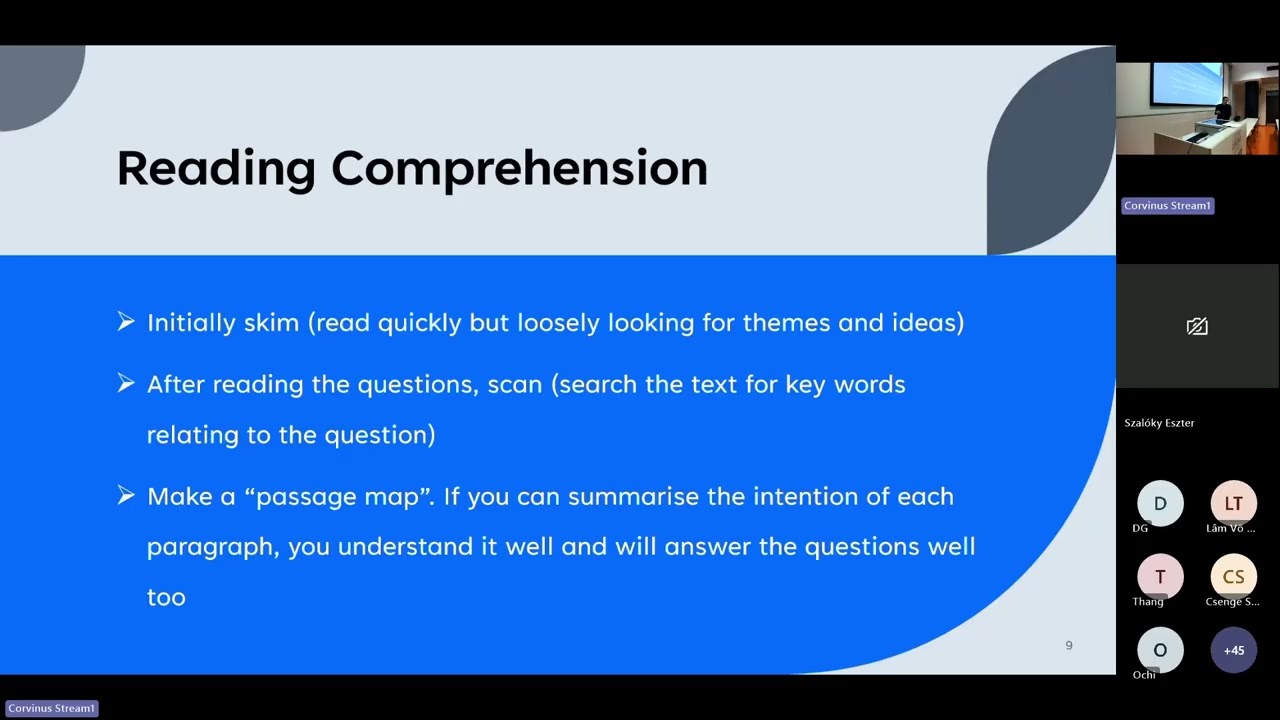
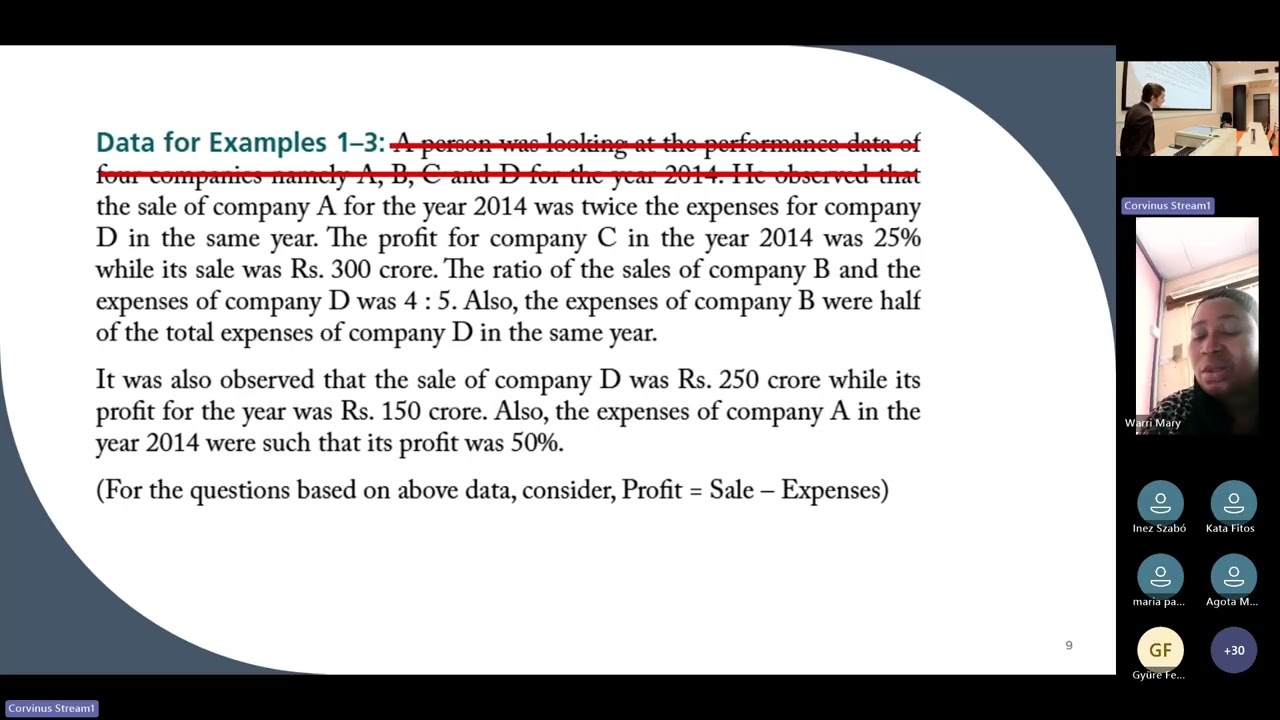
Watch videos of our entrance exam demo sessions here:
- Build your logical reasoning ability
- Practice and hone your language skills
- Master quantitative skills I.
- Master quantitative skills II.
Preparation materials for the oral interviews
Master’s Preparatory Videos
Entrance exam results
The written exam is worth 60 points, and the oral exam can add up to 30 points. If there is no oral exam, the written exam is worth 90 points. The Dean set a points threshold. Applicants scoring above the points threshold will be conditionally accepted.
Stipendium Hungaricum and Diaspora applicants will be notified of their results via the DreamApply application platform by the end of May.
Self-funded applicants will receive their results in the Corvinus University DreamApply system, typically within 2-3 weeks of the entrance exam period.
Credit requirements
There are some credit requirements you need to meet to study your chosen programme at master’s level. To check how well the content of your first degree is aligned to your intended Corvinus master’s, please see our pre-requisites table here.
We ask you to upload all relevant documents to our online application platform as part of the application process. These need to show the content of your prior studies (e.g.: diploma transcript, credit transcript, or any other official records of completed courses). Credit recognition is carried out based on these, while we also assess other aspects of your application. It is your responsibility to provide all details when submitting your application. If you don’t fully meet the credit requirements for
your chosen programme, you can also include documents demonstrating relevant professional experience or other related activities, which we may be able to take into consideration.
Possible outcomes:
- Credit requirement fully met: All credits and grades for the submitted courses are accepted, so no additional coursework is required.
- Credit requirement partially met: Some credits or elements of your prior study are accepted, but you will need to complete the remaining requirements as part of your master’s programme, if you gain admission and accept a place with us.
- Credit requirement not met: Your submitted credits cannot be recognised, due to insufficient alignment with the requirements of your intended degree course, or due to missing documentation.
We may ask for further documents before making a final decision. We will notify you of the outcome as part of the admissions process.
Management and Leadership with CEMS
| Programme | Requirements |
| Management and Leadership – CEMS |
topics: language skills; quantitative analyitical skills; logical reasoning and data insights
topics: intellectual potential, critical thinking, international openness and intercultural competence, interpersonal skills, performance orientation, integrity One of these language certificates (name of language examination and the minimum advanced level: TOEFL iBT – 100 IELTS – 7.0 CPE – C CAE – B C1 Business Higher (BEC Higher) – B Corvinus Business English – C1 TOEFL iBT Special Home Edition – 100, plus 20 in each section Pearson test of English Academic (PTE) – 68 |
Exemptions:
- a higher education diploma acquired in a bachelor-level study programme taught entirely in English either at a university operating in a majority English-speaking country, a university accredited by AACSB/EQUIS, or a university enjoying CEMS membership.
Video summary
MBA
Application fee
- €95 compulsory and non-refundable application fee for self-funded applicants
- No application fee for Stipendium Hungaricum or Diaspora scholarship applicants
Documents
- Proof of completed bachelor’s or master’s degree, including transcripts, degree certificate, and English translations of both)
- Letter of motivation
- CV/resume, employment certificate, recommendation letters
- A valid passport or national ID (EU applicants)
- Proof of paid application fee (only for self-funded applicants)
English Language proficiency
Applicants must have a minimum B2 level of English. This will be assessed during the entrance interview. Applicants are NOT required to submit an English language proficiency certificate.
Work experience
The programme is post-experience, so we are expecting prospective students with at least 3 years of professional experience. It is recommended they prove experience from a relevant field. The 3 years can be completed by the commencement of the academic year.
Interview entrance exam
Interviews are generally held online via Teams, once a month for self-funded students. For Scholarship applicants the entrance exam period is April-May.
The following will be assessed at interview:
- Knowledge relevant to your programme
- Skills relevant to your programme
- English language proficiency
- Motivation
Before the interview applicants are asked to submit an essay. The topic of the essay will be provided at the beginning of the entrance exam process.
Results
You will achieve a score out of 100. For each programme, the Dean will set a points threshold. Applicants scoring above this will be conditionally accepted. Points thresholds can vary from year-to-year and programme-to-programme.
Stipendium Hungaricum and Diaspora applicants will be notified of their results via the DreamApply application platform by the end of May.
Self-funded applicants will receive the results in the Corvinus University DreamApply system, typically within 2-3 weeks of the entrance exam period.
Credit requirements
In Hungary, there are legal pre-requisite credit requirements to study postgraduate programmes.
Please make sure you meet the minimum requirements for this programme before applying. Missing credits must be acquired in accordance with the study and exam regulations of the higher education institution.
| Full-time MBA | International MBA |
Credit requirement | Minimum credit requirement: 6 ECTS credits. Full credit requirement: 18 ECTS credits.
| Minimum credit requirement: 12 ECTS credits. Full credit requirement: 24 ECTS credits.
|
Subject | -Methodology (e.g. Mathematics, Statistics, IT) 6 ECTS credits; -Economics (e.g. Micro- and Macroeconomics, International Economics, Environmental Economics, Economic Theory, Economic Statistics, History of Economic Theory, Economic Modelling, Economic Policy, Sectoral and Functional Economics, Community Economics, World and European Economics, Public Policy) 3 ECTS credits; – Business Studies (e.g. Corporate Economics, Finance, Economic Law, Decision Theory and Methodology, Business Ethics, Business Communication) 3 ECTS credits. – Social Sciences (e.g. European Union, General and Economic Law, Economic History, Sociology, Philosophy, Psychology) 3 ECTS credits; – Professional Knowledge (e.g. Organisational Behaviour, Accounting) 3 ECTS credits. | – Methodology (e.g. Mathematics, Statistics, IT) 9 ECTS credits; – Economics (e.g. Micro- and Macroeconomics, International Economics, Environmental Economics, Economic Theory, Economic Statistics, History of Economic Theory, Economic Modelling, Economic Policy, Sectoral and Functional Economics, Community Economics, World and European Economics, Public Policy) 3 ECTS credits; – Business Studies (e.g. Corporate Economics, Finance, Economic Law, Decision Theory and Methodology, Business Ethics, Business Communication) 6 ECTS credits. – Social Sciences (e.g. European Union, General and Economic Law, Economic History, Sociology, Philosophy, Psychology) 3 ECTS credits; – Professional Knowledge (e.g. Organisational Behaviour, Accounting) 3 ECTS credits.
|