State Secretary vs Researcher: What Makes a Green Transition Orderly?
_20260315084649.jpg)
The green transition is no longer only a matter of climate policy. It has also become a key issue for competitiveness, energy security and the transformation of economic structures. These questions were at the centre of a discussion held at Corvinus University of Budapest on 10 March, organised by the Institute for Sustainable Development, where Csaba Gondola, State Secretary for Circular Economy and Climate Policy at the Ministry of Energy, and economist Zoltán Pogátsa, associate professor at the University of Sopron, debated their views with Csongor Gáll moderating the conversation.
One of the central questions of the roundtable, held at the Corvinus Faculty Club, was how climate targets can be aligned with economic interests in a world where energy systems, regulatory environments and technological capabilities differ widely. The debate quickly reached one of the key fault lines: sustainability and competitiveness may still be compatible, but can sustainability advance alongside continued economic growth?
Growth and sustainability: part of the same path or opposing forces?
According to Zoltán Pogátsa, competitiveness and sustainability do not necessarily exclude one another, but growth and sustainability may. In his view, global emissions are driven simultaneously by population growth, rising income per capita, energy demand and the structure of energy systems. Because of this, a rapid turnaround cannot be expected on technological grounds alone. As he put it: “It’s a bit like when a plane is falling. Instead of expecting the pilot to pull up the control stick, we are waiting for someone to invent a technology that can stop the plane.”
Csaba Gondola, however, argued that economic development and sustainability are not inevitably in conflict. Technological modernisation, the transformation of energy systems and a reconsideration of consumption patterns together could create real room for progress. He pointed to developments in both Europe and Hungary that suggest reducing emissions while maintaining economic performance is not mutually exclusive but may even reinforce each other. To illustrate the scale of global differences, he remarked: “China produces in 32 hours the amount of greenhouse gas emissions that Hungary emits in a whole year.”
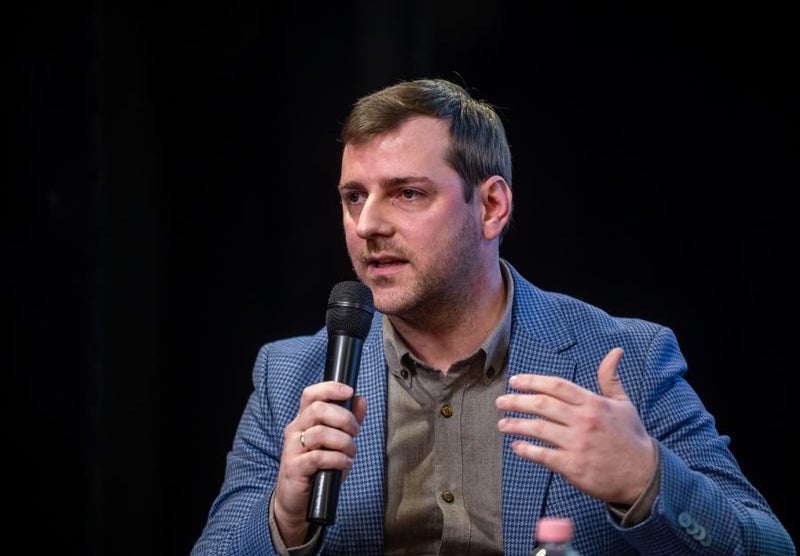
The participants also differed in their interpretation of the figures. Pogátsa argued that part of the emissions decline seen in Europe and Hungary is linked to the relocation of a significant share of production to other regions, meaning the environmental burden has not disappeared but simply shifted geographically. Gondola, by contrast, highlighted the transformation of Hungary’s energy system, particularly the rapid expansion of solar energy, as evidence of genuine structural change rather than merely a statistical effect.
Technology, nuclear energy and circularity
Another major topic of the discussion was whether new technologies can truly be considered green. Both speakers agreed that it is not enough to look at emissions during use; the full life cycle must also be taken into account. According to Gondola, solar panels, electric cars and other new technologies may reduce emissions locally, but the environmental costs of manufacturing, transport and supporting infrastructure must also be included in the calculation. Pogátsa did not dispute this, but added that even when full life-cycle impacts are considered, some solutions still appear more favourable than fossil-based systems, even if they do not represent a complete solution on their own.
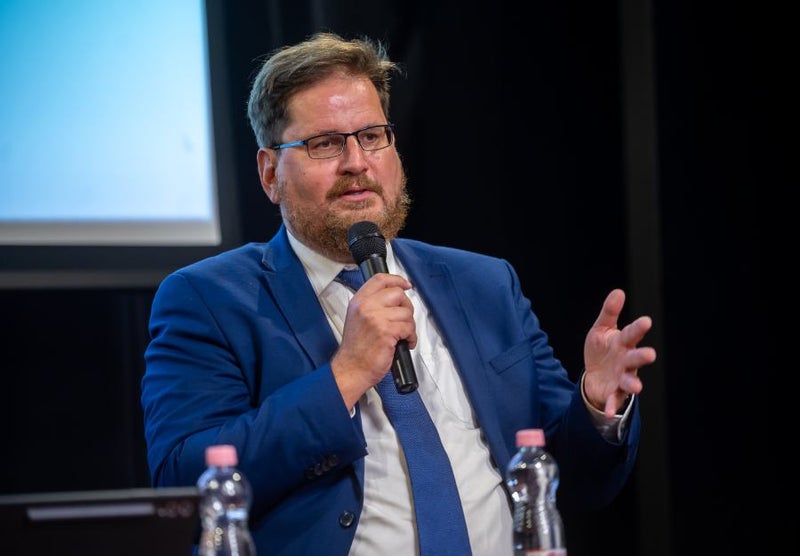
More pronounced differences emerged on the question of nuclear energy. Gondola argued that Europe made a strategic mistake when it scaled back nuclear capacity years ago. In his view, nuclear energy could be a “cornerstone” of European energy independence. Pogátsa, however, warned that nuclear power cannot be considered a universal solution on a global scale, particularly in politically unstable regions where the conditions for safe operation may not be guaranteed.
The discussion of the circular economy produced a similarly nuanced exchange. Pogátsa said recycling is important but cautioned against creating the impression that a circular economy alone can resolve the sustainability crisis. Gondola, however, emphasised that although a completely closed system may not be realistic, there are still areas where measurable results can be achieved. As an example, he mentioned Hungary’s deposit return system, which in a short time has managed to channel significant volumes of materials back into the system.
By the end of the debate, two different emphases remained. According to Pogátsa, it is still too early to speak of a genuine green transition, because that would require global emissions to fall sharply and consistently. Gondola, by contrast, concluded: “The green transition is happening. We are at the beginning of it, at the very beginning.”
What both speakers agreed on, however, was that the key question is no longer whether change can be avoided, but at what pace, with which tools and at what social and economic cost it will take place.
The full discussion can be watched here (in Hungarian): https://indaplay.hu/video/economx/zoldatallas-vagy-gazdasagi-onsorsrontas-egymasnak-ment-gondola-csaba-es-pogatsa-zoltan