New academic book shows how the ecological crisis becomes a financial risk

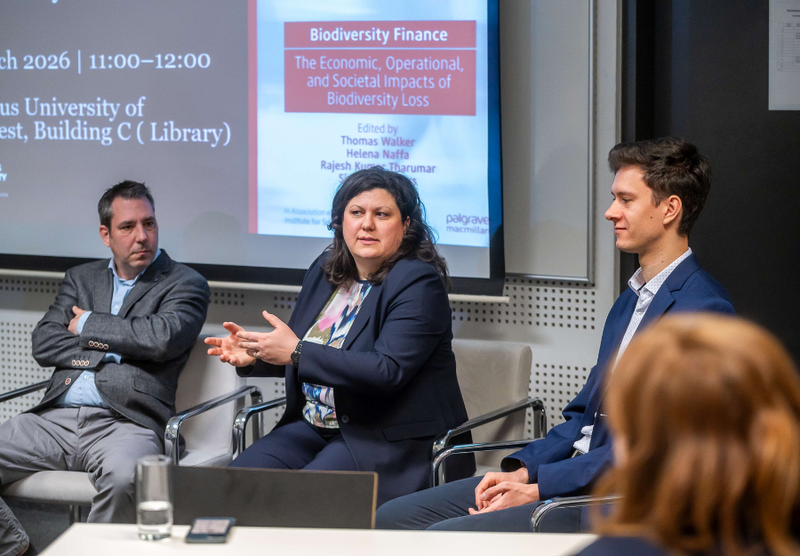
The international academic book Biodiversity Finance: The Economic, Operational, and Societal Impacts of Biodiversity Loss brings together the latest research on the financial dimensions of biodiversity, an area that has received relatively little attention so far. The volume was presented at Corvinus University on 11 March.
The book’s central argument is that biodiversity loss is not an isolated environmental phenomenon but a systemic risk embedded in the economic and financial system. It shows how the degradation of nature can translate into measurable, quantifiable risks within finance. The decline of ecosystems affects supply chains, corporate value, credit risk and, ultimately, financial stability.
“This book addresses a long-standing gap. For a long time biodiversity loss was treated as a peripheral and hard-to-define topic, even though it is a growing global crisis that can be linked to measurable and manageable financial risks. If treated as a strategic area, finance could play a key role in preserving biodiversity,” said Helena Naffa, co-editor of the volume, Associate Professor at Corvinus and founding director of the Sustainable Finance Research Centre at the university.
The book explains how biodiversity risk can be integrated into banking and corporate risk management, and which financial instruments, such as performance-linked bonds, can help finance conservation goals. It also devotes a separate chapter to measuring biodiversity differently from traditional ESG indicators. Instead of relying on general sustainability scores, the authors analyse ecological thresholds, spatial exposure and non-linear risks.
At the launch event it was noted that, according to estimates by the World Economic Forum, nearly half of global GDP is moderately or highly dependent on the state of natural systems. As a result, the financial sector is under increasing pressure to integrate these risks into corporate decision-making.
The volume also presents practical examples, including the emergence of biodiversity-linked bonds. In these instruments, the interest rate is tied to measurable environmental performance, such as forest conservation or ecosystem restoration targets. Financial returns are therefore directly linked to ecological outcomes.
Published by Palgrave Macmillan, the book contributes to one of the fastest-growing areas within sustainable finance and aims to serve as a common reference point for business leaders, finance and conservation professionals, researchers and policymakers. The volume is the joint work of four editors and appears as part of the publisher’s series Palgrave Studies in Emerging Risk Management and Sustainable Finance.
Group photo: Helena Naffa (in the middle), co-editor of the book Biodiversity Finance: The Economic, Operational, and Societal Impacts of Biodiversity Loss, associate professor at Corvinus University, associate professor at Corvinus University, and founding director of the university’s Sustainable Finance Research Centre, at the book’s Hungarian launch at Corvinus University on March 11, 2026. On the left: Tamás Kállay, biodiversity specialist (Corvinus University of Budapest), on the right: Gergely Gajdócsi, PhD student (Corvinus University of Budapest) Photo: István Bielik, Corvinus University of Budapest