DSG German-Language Case Study Competition – Summary
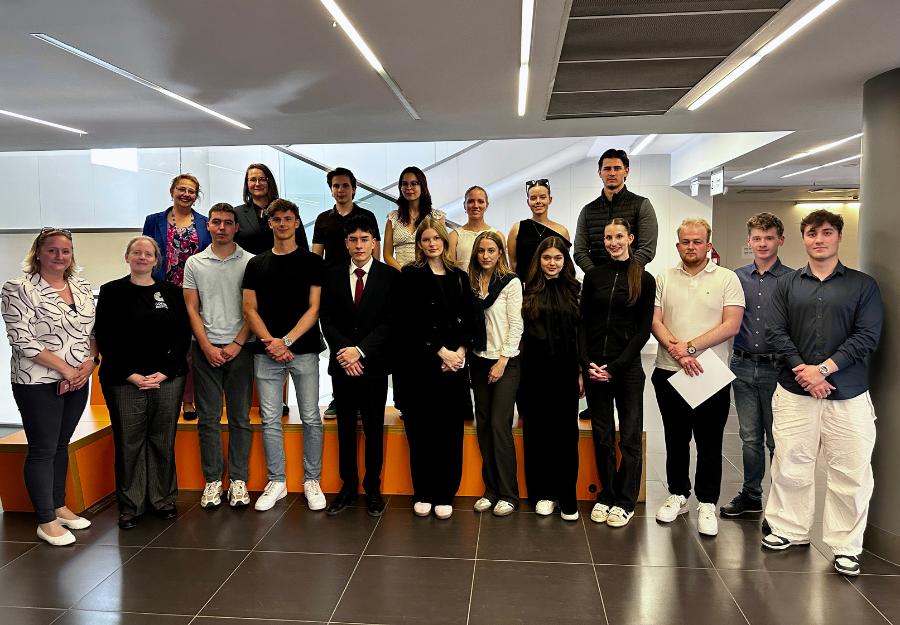
The German Management Training Programme (DSG) organized its traditional case study competition on 15 May 2026, in the topics of sustainability and artificial intelligence. The competition aims to encourage students with German language skills of at least B2 level to elaborate practical solutions that address environmental, social, and economic challenges with the aid of digital technologies. The available topics included the optimisation of renewable energy sources, smart food supply chains, Smart City concepts, the circular economy, sustainable tourism, climate protection and environmental monitoring, ESG transparency, and sustainable marketing.
The task of the teams, consisting of 2-3 students, was to solve a freely chosen sustainability problem by relying on the example of an existing company, city or their own fictitious business idea. The proposals had to incorporate an action plan encompassing a 2-year time horizon and a cost-benefit analysis. The participants also had to conduct a questionnaire survey, and then the results were presented in a 15-minute presentation in German. The jury included one representative each from the German Language Centre, the DSG, and the Goethe Institute. Ayden Virág and Ferenc Major won 1st place with their presentation on the topic of sustainable marketing. The first three winners were awarded by SPAR Hungary Trading Ltd., and the Goethe Institute offered a Goethe-Certificate C1 German language exam as a special prize to the benefit of one participant.
DSG considers it crucial to steer attention to the added value of German language skills in our era, when knowledge of English has already become a basic requirement. The event created an opportunity for the participants to simultaneously make use of several of their competencies while gaining insight into real labour market situations. An effective combination of confident language skills, complex problem-solving, creativity, teamwork, persuasive reasoning, and presentation skills was essential for success.