ESG Outlook 2025 Report
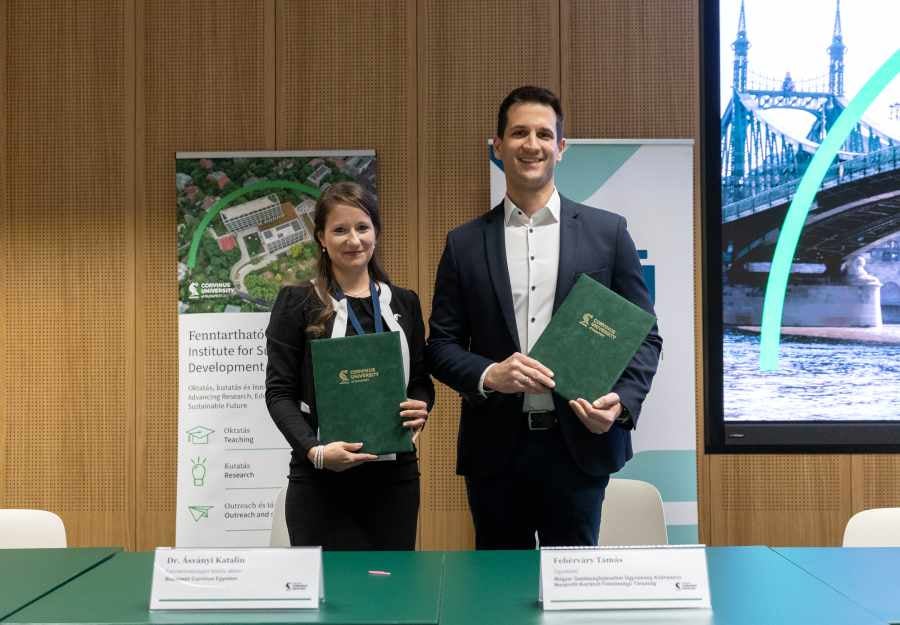
The event featured opening remarks from Dr. Katalin Ásványi, Dean for Sustainability at Corvinus University, Tamás Fehérváry, CEO of Hungarian Economic Development Agency (MGFÜ), Dr. Péter Bera, Head of Department at the Ministry of Energy’s Secretariat for Environmental and Circular Economy Affairs, Dr. Hajnalka Csorbai, Strategic Director at Opten Ltd., and Dr. Attila Jámbor, Head of the Corvinus Institute for Sustainability. The first part of the event also saw the signing of an agreement between MGFÜ and Corvinus University of Budapest.
Following the opening remarks, the findings of the publication were presented by Anna Horváth (IVE), László Trautmann (IVE), and Anett Zanócz (Corvinus). The results indicate that environmental exposure remains the biggest challenge for the agricultural sector, while governance (G) performance shows significant variation based on company size. There is no strong correlation between the three ESG dimensions, and companies increasingly view sustainability as a matter of competitiveness.
The conference also featured two panel discussions exploring practical challenges in the sector.
The first panel, with József Tóth (KALL Ingredients), Ibolya Nyitrai (KITE), László Podmaniczky (MATE), and Tamás Éder (Hungarian Meat Processors Association), discussed factors that facilitate or hinder the integration of ESG considerations into Hungarian agri-business operations. Participants agreed that ESG is not a short-term campaign but a long-term corporate culture shift, requiring predictable regulation and standardized reporting.
The second panel, featuring Bertina Baksa (UBM), Anna Hőgyész (Nestlé), and Gábor Bidló (Első Pesti Malom), highlighted that greening supply chains has become inevitable. Success, however, depends on long-term partnerships, data-driven operations, and the ability to manage consumer price sensitivity.
The conference’s message was clear: sustainability is now a core component of competitiveness, and Hungarian agriculture can only progress if ESG is treated as a strategic priority across the entire supply chain.