Elite athletes at Corvinus: how can elite sports and university studies work together?
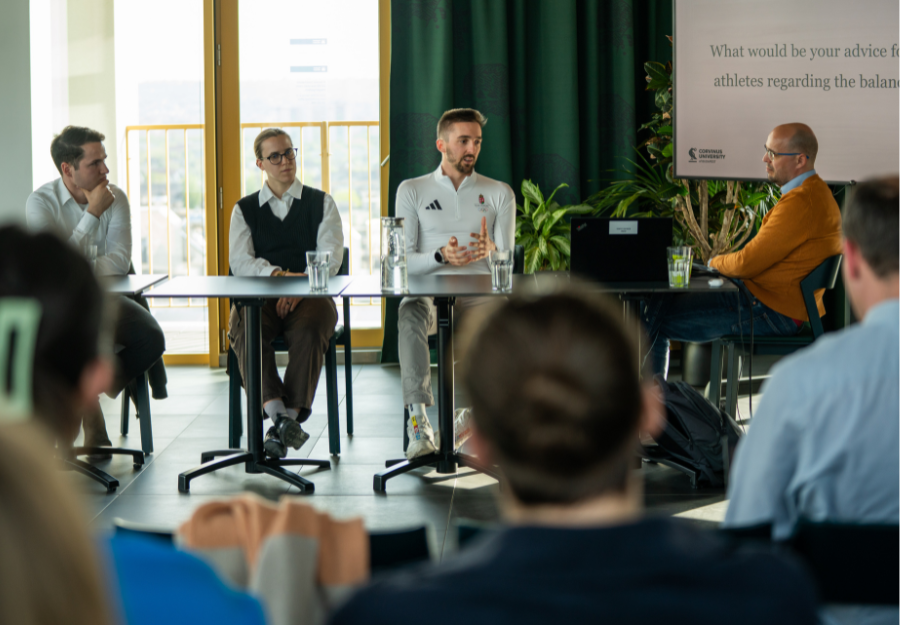
The main message of the discussion was the importance of continuous improvement – not only in sports but also in studies – which requires careful planning and commitment. The athletes agreed that balancing elite sports with higher education is no simple task, but with the right support and mindset, it can be successfully achieved. Furthermore, all three emphasized the importance of the family’s role. Family support not only provided them with motivation but also ensured a stable foundation, which is essential during a period filled with competitions and exams. In addition, the flexibility of university lecturers also played a key role; although the same requirements and expectations applied to elite athletes as to their peers, deadlines were often adjusted to accommodate the competition schedule.
Sára Bácskai highlighted the professors’ flexibility and the opportunity to complete the required assignments on her own schedule. Sára pursued her university studies alongside her short-track speed skating career, where the main season runs from September to March. Mid-January was always a particularly important time, as the European Championships are often held then. This often made organizing the winter exam period especially difficult, but despite this, she successfully completed her studies. She used to think that after ending her athletic career, she wouldn’t want to work in a sports-related field, but she has since become open to the idea and would be happy to work in her own sport or even in another one. She currently plans to start a job that matches her degree.
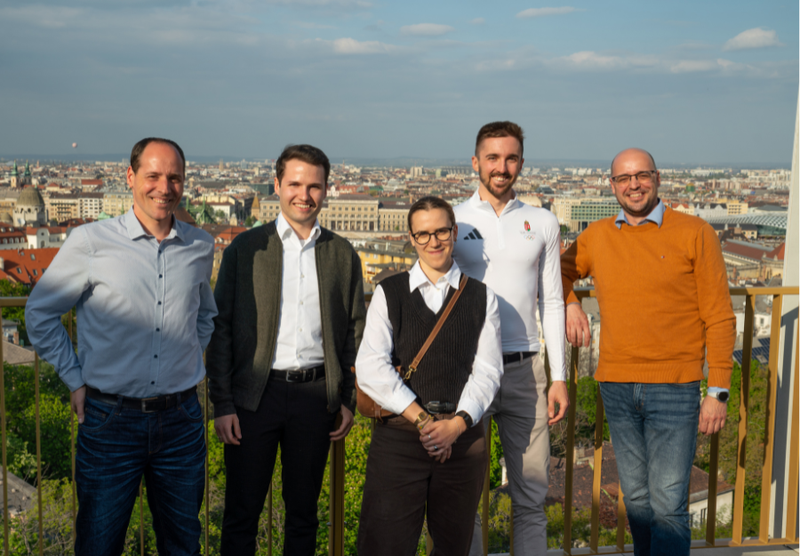
Cross-country skier Ádám Büki chose to study economics – and later pursued a master’s degree in sports economics – because of his strength in mathematics. During his university studies, his excellent time-management skills were a great help to him, as they are essential for balancing elite sports and academics. Ádám currently works full-time in the marketing department of a sports-related fashion company while continuing his athletic career. Among cross-country skiers, only the world’s best earn enough in salary and sponsorship deals to consider the sport their primary source of income; thus, past a certain age, those who wish to continue their athletic careers often have to work alongside it. Although Ádám received offers from several employers during his job search, he wanted to stay as close to the sport as possible, which is why he chose his current workplace.
His message to young people is that if they put in the work, they will see results – even if those results aren’t immediately apparent. He mentioned from personal experience that many athletes quit competitive sports when they started university. Ádám believes that although balancing studies and sports isn’t easy, developing good time management skills, learning how to study, and gaining experience early on in university can be very helpful in the second half of your studies. He takes great pride in the fact that, after 14 years of training, he reached the Olympics and that he never gave up on his dream along the way, even when it was difficult to do so while holding down a full-time job.
István Péni found it beneficial to have the opportunity to write his thesis on a topic related to sports economics, as this allowed his studies to be directly linked to his athletic career. While sports play a prominent role in his life, he agrees with his family that education is what provides lifelong security. This is another reason why he wanted to pursue university studies alongside competitive sports. Although he was often excused from classes due to competitions, he didn’t like missing them, because university fosters a sense of community in addition to learning, and it’s often hard to stay away from that.
He currently works as a professional athlete, which is his main source of income. Unlike many other sports, competitive shooting offers the possibility of a long career, so he can remain an active athlete for quite some time. In addition, he would like to continue working in the sport in the future, where he could apply what he has learned in management, and continuing his education has also been considered as an option. István also emphasized the importance of conscious planning; in sports, it is essential to identify the major competitions and milestones and to know exactly when and what to really focus on.
In summary, based on the athletes’ experiences, sports and university studies do not exclude one each other, but rather reinforce both. With careful planning, strong determination, and the support of family and university faculty, it is possible to succeed in both sports and earning a degree.
At Corvinus University of Budapest, students can study sports business in the undergraduate program’s Sports Economics specialization (taught in Hungarian) and in the master’s program’s International Sport Business degree program. For more information about the sports business programs, please contact Associate Professor Zsolt Havran, the program coordinator, at zsolt.havran@uni-corvinus.hu.