Debate Series on the Future: A Paradigm Shift Is Needed
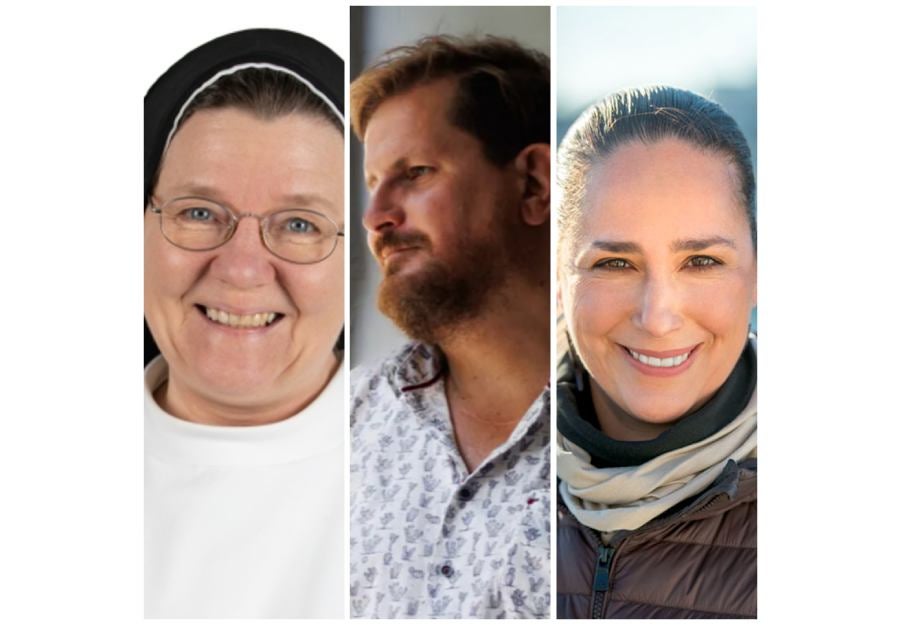
Three economists with contrasting perspectives talked about what a sustainable, humane and genuinely good world beyond economic growth might look like. The discussion was moderated by philosopher and Dominican sister Mónika Míra Pigler.
In her opening talk, economist and Dominican sister Laura Sarolta Baritz – who presented her new book Summa Oeconomiae at Corvinus at the end of the summer – posed the question: is the driving force of development the individual or the structure? She stressed that although the participants hold different views of the world, they all agree that a paradigm shift is needed. In other words, we want to move toward a peaceful human life in which people can be happy and live in prosperity and wellbeing.
“A human being is ultimately shaped by themselves”
People create the systems they live in, but of course systems and structures also shape people. Laura illustrated this with two images. One was of a little boy eating happily at McDonald’s who becomes badly overweight because of too much unhealthy food – here, the environment shapes the individual. The other showed prisoners in the Gulag, one of whom focused only on the good, inspired by positive psychology, even in those horrific conditions. His approach helped the group survive their ordeal. In this case, the individual shaped their environment. She also referred to “corporate offences”, mentioning the 1984 Bhopal chemical disaster as an example of people violating moral principles in the interests of the company, the structure.
Laura pointed out that in the 1990s, behaviourism weakened and psychology began to focus more on the individual and their character. The group one belongs to still has a strong influence, she noted, citing Solomon Asch’s well-known experiment on how group opinion shapes individual judgement. The study showed that the clearly incorrect judgement of the majority can make some people with low self-confidence conform, while those with healthier self-esteem resist it. Even so, “a human being is ultimately shaped by themselves”, she said. Responsibility cannot be shifted away; the human person is free, and no one can take that freedom away. She believes we can work on changing our value systems.
In a network, no one is too small to make a difference
Next, Alexandra Köves, ecological economist and habilitated associate professor at Corvinus, who researches policies that go beyond economic growth, delivered her opening talk. She described the current global situation as a time of polycrisis: many people see the need for action, yet everyone waits for someone else to take the first step. Individuals expect the state to act. This creates paralysis, with each actor pointing to another or waiting for a foolproof masterplan to ensure a successful transition. Our hierarchical thinking means that those at the bottom feel powerless, while those “at the top” might wonder whether change is possible at all.
Instead of hierarchy, Alexandra suggested thinking in terms of networks, because that is how all living systems work. “Very complex networks emerge from the intertwining of economic, social and ecological systems,” she said, showing the metabolic network of a simple bacterium as an example of surprising complexity. In such a system, the emergence of something new depends on the unpredictable interaction of impulses from different nodes. If we do nothing, the system is more likely to remain unchanged. So individuals, as nodes, have a responsibility to act in ways that encourage the changes they want to see. Their influence becomes significant only through messages amplified by others. “No one is too small to influence the system,” she noted. While people do not have complete freedom in a network, because everything they do affects others, they do have autonomy to decide which direction they want to nudge the system.
Certain memes persuade us
The third speaker, economist and sociologist Zoltán Pogátsa, habilitated associate professor at the University of Sopron, argued that it is the structure, not the individual, that drives events, and that free will does not really exist. In his view, free will is an illusion in Western societies, whereas Eastern societies accept that one must fit into the community.
“When we are born, the structure is already there; we learn it from the outside, from our parents and at school. We learn it through socialisation,” he said. Morality, too, is knowledge that comes from outside. He explained that his reading of neuroscience convinced him that biology determines our predispositions rather than our personality itself.
He believes that change depends on complex memes, narratives that spread according to certain rules but whose ultimate effects remain unpredictable. Throughout life we encounter countless memes from various sources, and some persuade us, reshaping our opinions. He also addressed the issue of responsibility. “We are responsible only for what we have been taught. If someone does not understand what is happening to them because they only hear oversimplified stories, then they cannot be held responsible,” he argued.
Sparking ideas
In the discussion that followed the opening talks, sister Laura disagreed with Zoltán Pogátsa’s claim that a newborn is neutral; she believes a baby has a conscience and a soul. She understands freedom as “being free to do good”. Alexandra Köves referred to memes as elements of the social imagination. Zoltán Pogátsa added that the learning of memes begins when a baby signals discomfort by crying or expresses contentment with a smile.
The debate briefly shifted to theology before the speakers took questions from the audience. Two attendees remarked that the past ninety minutes had felt like watching fireworks because the speakers’ ideas sparkled throughout.
One participant asked how, in light of the discussion, a truly new idea emerges – for example, Einstein’s discoveries. Sister Laura said such breakthroughs come from intuition and creativity: “We once came up with the concept of a human-centred economy, we worked on it, and now books are being written on the subject.” She added that a meme can indeed spark change. Alexandra Köves said we still do not know how discoveries arise, but they require two ideas or memes to meet in a space we do not yet understand. Responding to the question, Zoltán Pogátsa mentioned discoveries that were made simultaneously by different people. History offers many examples, from the telephone to the light bulb, including cases where it is clear that the inventors could not have known about each other’s work. At the same time, he believes the chain of earlier knowledge leading to such discoveries can usually be reconstructed. Some explain this phenomenon through the idea of a collective consciousness.
Alexandra Köves closed the event by announcing that the debate series will continue in February 2026, with the next topic still being developed.
By Katalin Török