Conference on Russian disinformation in the Visegrad region about the war in Ukraine
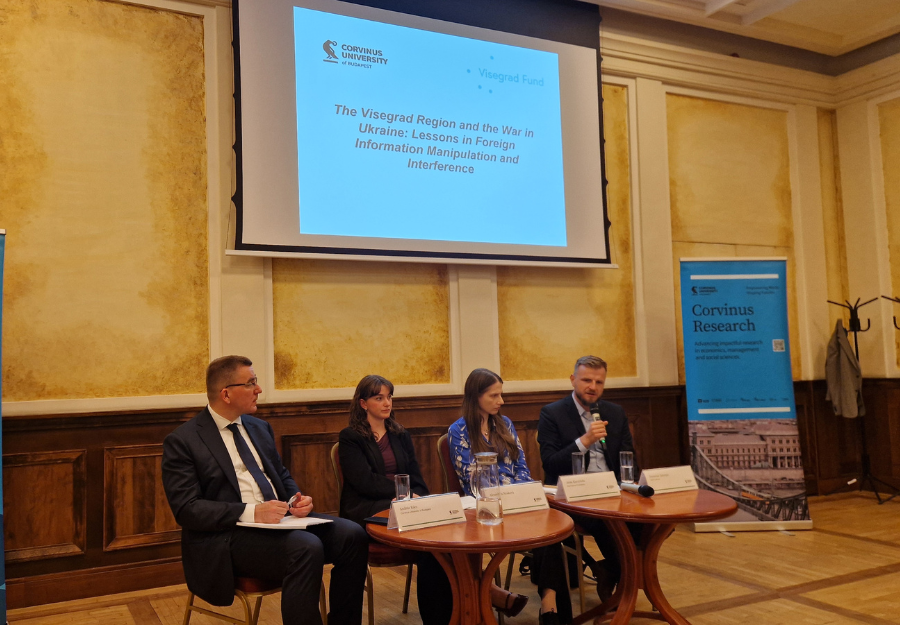
Corvinus University of Budapest has won a research grant from the International Visegrad Fund in 2024, titled “The Visegrad Region and the War in Ukraine: Lessons in Foreign Information Manipulation and Interference”. The project studied how Russia’s disinformation apparatus in the Visegrad countries intended to frame and explain certain events of the war in Ukraine.
The research focused on three key events from the early period of the full-scale war against Ukraine, which all received widespread international media attention: the bombing of the Mariupol maternity hospital (March 2022), the Bucha-massacre (became known from April 2022 on) and the destruction of the Nova Kakhovka dam (June 2023), which caused a major environmental disaster.
During the project we studied how Russian disinformation websites and Youtube channels have covered and framed these three events.
In terms of methodology, the main novelty of the project was that it not only mapped out Russian disinformation narratives, but also mapped out and compared the timely order, in which these narratives appeared in the given channels.
The research confirmed that Russian disinformation in the V4 countries has worked in a highly centralized, coordinated way. The key narratives have been the same in all four Visegrad countries and appeared in largely the same timely order. These Russian narratives have not been customized according to the individual characteristics of the V4 countries. Another proof for a closed coordination has been that the studied disinformation channels have not published any alternative explanation or coverage of the studied events, which would have differed from the interpretations of the Kremlin.
The research has been conducted in cooperation between Corvinus University of Budapest, the Bratislava-based NEST Institute, the Prague Security Studies Institute and the Res Publica Foundation from Poland. The project has been led by Dr. András Rácz, Associate Professor of the Institute of Global Studies at Corvinus University.
The video recording of the conference is available here.
The project is co-financed by the Governments of Czechia, Hungary, Poland and Slovakia through Visegrad Grants from International Visegrad Fund. The mission of the fund is to advance ideas for sustainable regional cooperation in Central Europe.