The Ethics of Climbing as a Compass for Sustainability — or the Moment of Realisation When the Rock Talks Back
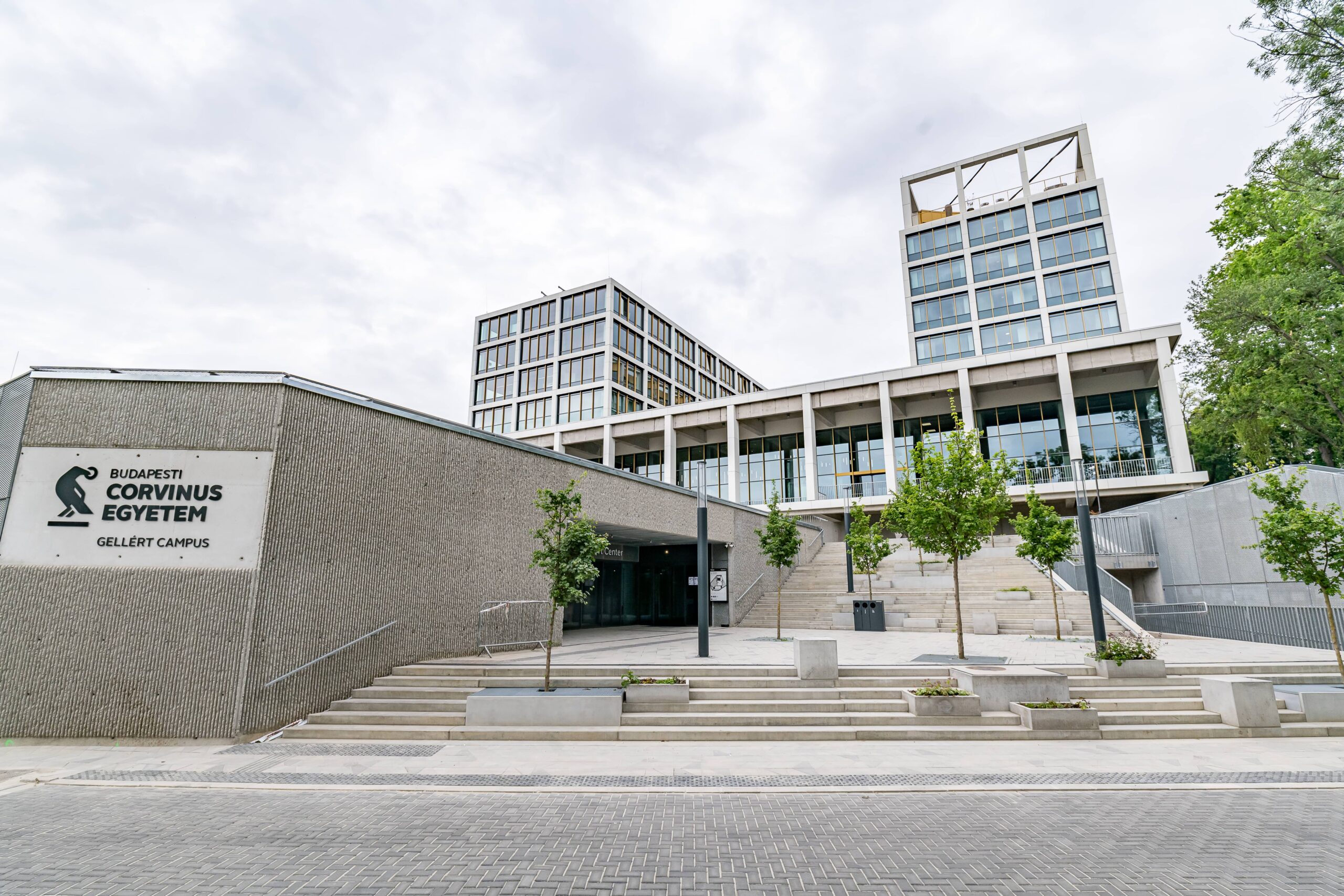
Who doesn’t know that rock climbing is one of today’s most popular sports? Some practise it indoors — just think of the climbers on the Gellért Campus — while many others head outdoors to “the real thing”, scaling actual rock faces in search of the sky, or at least the next summit.
This is what made Tamás Veress’s lecture so engaging: through a popular and universally understandable example, he showed what it means to reinterpret a trend.
The workshop “Redefining Fashion – Leading the Transition to a Sustainable Future” was organised by the Unitelma Sapienza BiT RG research group, the CIAS Centre of Corvinus University of Budapest, and the Gellért Green project, and took place on the afternoon of 18 May 2026 at the Gellért Campus.
One of the most impactful presentations was delivered by Tamás Veress, titled “Earth Is Our Only Shareholder: Patagonia and the Ethical Foundations of Responsible Business.”
His lecture used the example of Patagonia to demonstrate how a business can be consistently built on social and environmental values. The company’s approach stands in sharp contrast to Milton Friedman’s profit‑centred view, showing that a business can remain sustainable in the long term if it follows non‑materialistic, other‑regarding values.
Yvon Chouinard entered the world of business from the world of rock climbing, and he recognised early on that if a product harms nature, then it is not only the product that must change — the culture behind it must change as well. The company originally manufactured and sold climbing equipment, and this is how the ethos of “clean climbing” was born: a call for responsible, trace‑free climbing. Traditional pitons and metal wedges hammered into cracks caused significant damage, eroding and fracturing the rock — leaving behind permanent environmental scars.
Yet the movement also created a paradox: while it eliminated the most harmful tools, it simultaneously helped turn climbing into a mass sport and contributed to the rise of a new climbing culture. This highlights the tension Patagonia later faced across the entire industry: the ethical commitment is sincere, but the systemic consequences are not always within one’s control.
A Tool That Leaves a Wound — One the Rock “Feels” Too
Patagonia’s story begins with a moment of realisation: Yvon Chouinard understood that the tools climbers used did not merely support movement — they also wounded the rock. Every strike of a piton or metal wedge caused tiny but permanent damage, and when hundreds of climbers repeated the same motion, climbing itself became an agent of environmental destruction. This insight emerged not as a technical issue but as a moral one: if nature is our playground, then we bear responsibility for its well‑being.
The Birth of “Clean Climbing”: Technique and Ethics Hand in Hand
The answer was not simply new equipment, but a new way of thinking. The shift from pitons to active protection devices — chocks and other removable gear — was revolutionary in itself, yet Chouinard knew that technology alone was only half the solution. The culture of climbing had to change as well. The clean climbing manifesto therefore promoted not just a new method, but a new kind of presence in nature: humility, self‑reliance, and the simple yet radical principle that the rock should look the same after the climb as it did before.
From Climbing Ethos to Corporate Philosophy
This mindset later came to permeate Patagonia’s entire operation. In every decision, the same question echoed as on the rock face: how can we be present while causing as little harm as possible? This is how the transition to organic cotton began, followed by the use of recycled materials, the culture of repair and resale, and eventually the ownership structure that legally cements the company’s environmental mission. The ethics of climbing thus became not only a philosophy of sport, but a model for corporate governance.
Recognising the Limits: Respect for Nature Does Not Solve Everything
At the same time, Patagonia’s story also shows that the ethics derived from climbing — no matter how consistently applied — cannot fully counterbalance the force of consumer culture. Repair, durability, and responsible material use are important steps, but they do not override the structural logic of consumption. Humility toward nature is an inspiring compass, yet without transforming the system as a whole, it can only partially fulfil its purpose.
Behavioural change is real — but mostly among those who were already committed: people who buy for durability and see repair as a value. Patagonia, however, has not been able to meaningfully reach the broader consumer segments beyond this group. And at the most general level, there is no comprehensive calculation that would show whether the sum of its interventions has actually resulted in a net reduction in emissions or resource use when considering the company’s total footprint.
The Paradox of Clean Climbing
Patagonia operates in a market culture still overwhelmingly shaped by materialistic values — the pursuit of wealth, status, image, and novelty, all of which inherently drive overconsumption. No single company, however well‑run or sincerely motivated, can unilaterally change the value system in which the market operates. Patagonia can embody other‑regarding values internally and refuse to amplify materialistic ones — but it cannot prevent its customers from living in a consumer culture that partially neutralises even the most conscientious purchasing decisions.
This is precisely why the case study is so important: it shows what a company looks like when it takes responsibility seriously at every level — in its products, its supply chain, its governance, and its organisational culture. And yet, despite all of this, it has not solved the problem it set out to address.
Chouinard himself was unequivocal: “Patagonia is not a sustainable company. Such a thing does not exist.” The sober conclusion, then, is not that the company’s efforts were futile, but that what still lies ahead is on a scale far beyond the capacity of any single enterprise.