From SDG cards to the future of a city – How teaching innovation becomes a meaningful learning experience at Corvinus
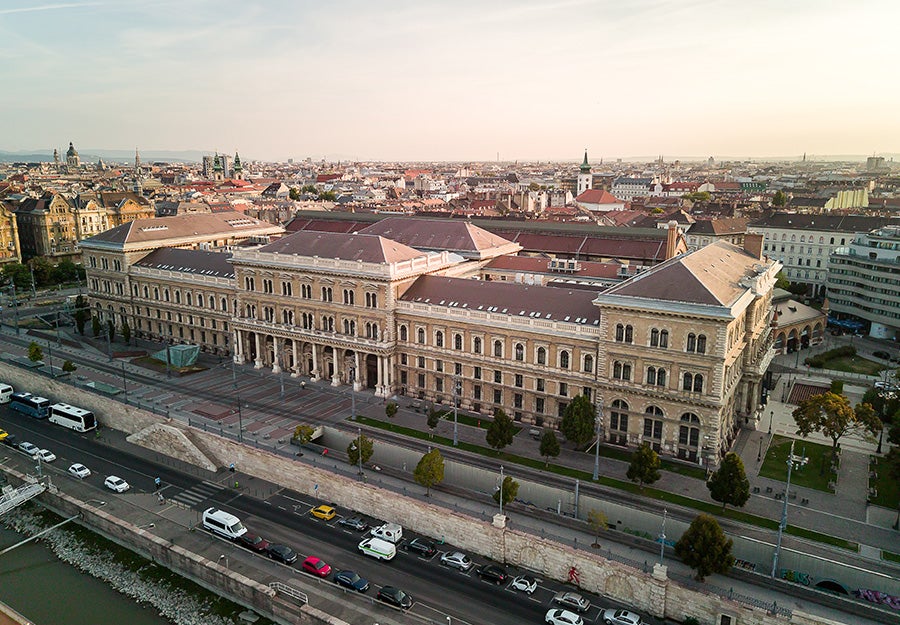
Students of the Public Policy and Management (PUMA) Master’s programme at Corvinus University of Budapest explored this question through an interactive simulation. This unique learning experience grew out of a summer faculty development workshop, demonstrating how innovative teaching methods can translate into valuable, hands-on learning opportunities for students.
From Programme Director Training to the Classroom
One of the key objectives of Corvinus University of Budapest’s sustainability strategy is to ensure that sustainability is not confined to dedicated courses but becomes an integral part of teaching across all academic disciplines.
To support this ambition, the University launched a series of pedagogical development workshops for programme directors as part of its Faculty/Staff Pedagogical Training (G1c) strategic initiative. The aim is to introduce faculty members to new perspectives, teaching methodologies and practical tools that enable them to develop students’ sustainability competencies in ways that are relevant to their respective disciplines.
During the summer workshop, participants explored how the United Nations Sustainable Development Goals (SDGs) could be integrated into teaching and experienced the interactive, experiential methodology of the SDGs Game. Their discussions centred on three fundamental questions: What do we teach? How do we teach? And what mindsets and competencies do our students develop by the time they graduate?
One of the workshop’s key messages was that sustainability is not exclusively an environmental issue, nor does its integration necessarily require the introduction of new courses. Rather, it represents a cross-cutting perspective that can enrich existing teaching by helping students understand complex problems, balance competing interests, think critically and make responsible decisions. It did not take long for the initiative to produce its first practical outcome.
PUMA Students Take on the Challenge of Shaping a City’s Future
Following the summer workshop, Éva Kovács, a faculty member of the Public Policy and Management (PUMA) Master’s programme, decided to bring the approach into her own classroom. As part of the Public Policy Actors, Institutions and Processes course, she organised a case study-based simulation in which students did more than simply learn about the Sustainable Development Goals: they actively applied them as decision-makers.
Working in international teams, students took on the role of public policy consultants. Their task was to develop a sustainable development strategy for a city facing interconnected economic, social and environmental challenges. Using SDG project cards, the teams selected policy interventions while managing a limited budget. They had to consider the expected benefits, costs, potential unintended consequences and interconnections between different measures. The exercise quickly revealed an important lesson: in sustainable urban development, no decision exists in isolation. A single intervention can affect multiple social groups, economic processes and environmental objectives.
“The SDGs do not necessarily introduce entirely new principles into public policy. Rather, they help us place familiar problems into a broader context, recognise connections between different policy areas and develop a shared language for discussing sustainable development,” explains Éva Kovács.
This approach is particularly relevant to the PUMA Master’s programme, where students develop the analytical and practical skills needed to examine public policy challenges from multiple perspectives, reconcile competing interests and address complex governance problems.
What Did Students Learn? Different Countries, Different Perspectives
One of the greatest strengths of the simulation was the international learning environment of the PUMA programme. Students from different countries brought diverse experiences and perspectives to the decision-making process.
For Alina (Moldova), the most important insight was the interconnected nature of the Sustainable Development Goals: “I am always surprised by how interconnected and complex a single SDG can be. When we try to address one specific problem, we often discover that our solutions can have a positive impact on other issues as well.”
Gellért (Hungary) highlighted how the gamified approach helped him experience the complexity of real-world policy decisions. He recognised that an intervention may affect not only its intended beneficiaries but also other stakeholders who were not initially considered by policymakers.
For Sámuel (Hungary), allocating limited resources presented the greatest challenge: “The toughest decision for our team was deciding whether to spread our limited resources across smaller, targeted policies or commit heavily to expensive, high-impact SDG cards.”
Vera (Russia) emphasised the importance of creative policy solutions and collaboration. Her team discovered that strategically combining different interventions could address multiple challenges simultaneously while saving resources. Achieving this, however, required continuous discussion, negotiation and compromise.
Together, these four student reflections point to a shared lesson: effective public policymaking is not simply about identifying the right solution, but also about understanding how decisions interact and how competing priorities can be balanced.
When Faculty Development Multiplies Its Impact
The simulation delivered in the PUMA course is more than a successful classroom activity. It also provides a tangible example of Corvinus University’s broader commitment to teaching innovation. The story began with a faculty development workshop where participants were introduced to new methodological tools. One programme director subsequently adapted the approach to her own discipline, creating a learning environment in which students could engage actively, collaboratively and creatively with realistic policy challenges.
This process demonstrates how the impact of professional and pedagogical development can extend far beyond a single training session: a workshop can inspire a new teaching practice, which in turn can create a meaningful new learning experience for students.
Encouraging initiatives like this is precisely what Corvinus aims to achieve. Integrating sustainability into education is not only about increasing students’ knowledge of the SDGs. It is also about enabling them to think systemically, collaborate effectively, make responsible decisions and recognise their own professional role in shaping a more sustainable future.
Let’s Keep the Game Going! – SDGs Game Workshops at Corvinus
The PUMA experience also demonstrates that the SDGs Game and its associated teaching tools can be applied across a wide range of academic disciplines, from public policy and business management to marketing and international relations. The Corvinus sustainability team is therefore happy to organise SDGs Game workshops for institutes, departments, academic programmes, faculty communities and student groups.
These workshops offer participants an opportunity to explore the interconnected dimensions of sustainable development through experiential learning and to reflect together on how sustainability can be linked to their own disciplines, courses or everyday decisions. For programme directors and faculty members, the sessions can also provide inspiration and methodological support for integrating sustainability into their teaching practices. Because teaching sustainability does not necessarily begin with a new course. Sometimes, all it takes is a good question, a few cards and an educator willing to try something new.
If your institute, department, academic programme or student community would like to experience an SDGs Game workshop, please contact the Corvinus sustainability team at dean.sustainability@uni-corvinus.hu.