Employees at Family Firms Are Happier
_20260421013951.jpg)
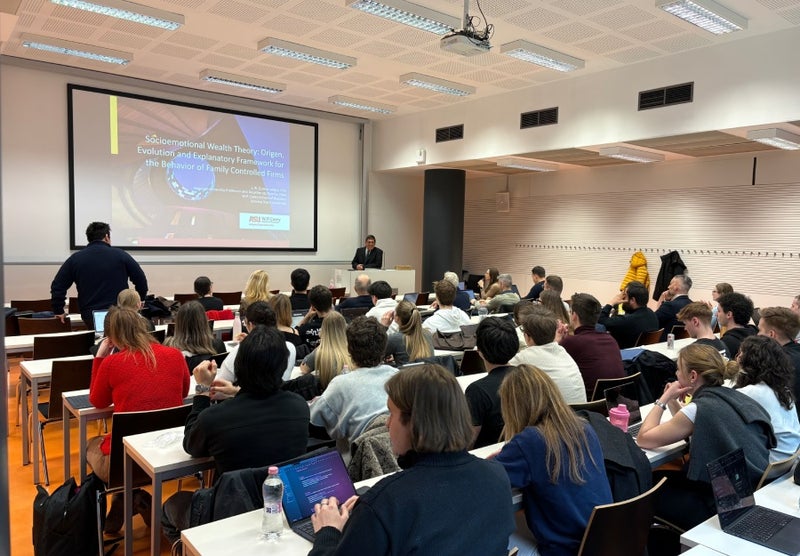
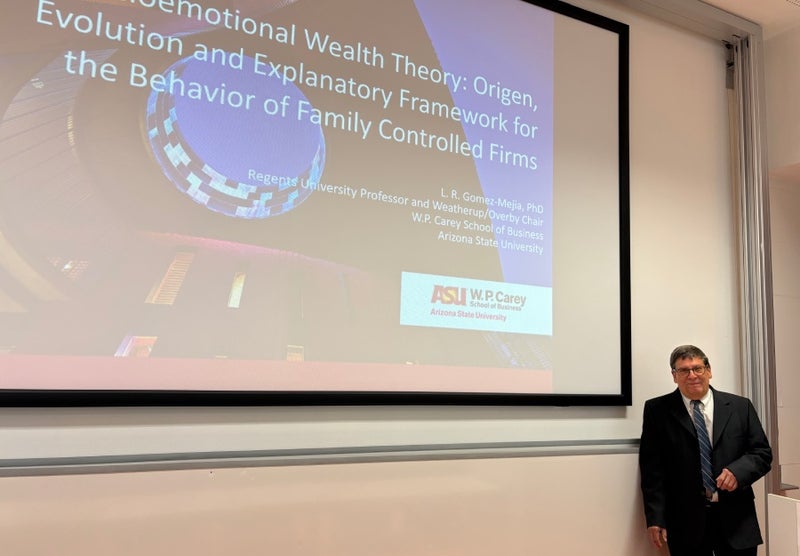
One of the pioneers of family business research, a true global star of academia, recently gave a Corvinus research seminar.
Luis Gomez-Mejia visited us at the invitation of the Institute of Entrepreneurship and Innovation. The rich programme organised during his stay was made possible by the Corvinus Institute for Advanced Studies (CIAS), together with the extensive research support portfolio provided by the Vice-Rector for Research and Academic Community. We spoke to him about research on family businesses and about the concept of socioemotional wealth, which he introduced.
Why are family businesses important to the economy, and why are they worth studying in 2026?
First of all, I think family firms matter because they are the dominant form of ownership worldwide. Around 95% of businesses are family-owned, and even among Fortune 500 companies, about a third fall into this category. The world’s largest conglomerate, India’s Tata Group, is a family business. So these are not just small local firms, but also some of the largest companies in the world, often already in the hands of the second or third generation. A similar example from Mexico is Carlos Slim, one of the richest people in the world, whose family owns Latin America’s leading telecommunications company. He has now retired, but his four children have taken over the leadership. In so-called Latin countries, these firms are essentially dominant. Even the largest banks are family-owned, such as Banco Santander.
Family firms are engines of economic growth and account for a decisive share of GDP in most countries. Whatever happens to family businesses will certainly affect the economy and society.
How would you briefly sum up the distinctive logic of how family businesses operate for those unfamiliar with the field, and what fundamentally sets them apart from non-family firms?
The main difference is that family firms follow two kinds of logic. What matters to them is not only the firm’s financial wealth, but also its socioemotional wealth. They look at both sides of the equation, not just the financial one, as a typical publicly listed company would. That is the key difference. And it affects virtually everything they do: when they diversify, how they diversify, where they expand, as well as their management structure, incentive systems, and many other areas.
Socioemotional wealth plays a role in major decisions because they want to preserve it and increase it. Sometimes, even when it comes at a financial loss, they may still emphasise the importance of the socioemotional side.
Your research explores the role of socioemotional wealth in depth. What exactly does the term mean? Why is it so important for understanding family firms, and although it has emotional components, can this resource be managed consciously?
First of all, what is socioemotional wealth? I have done a great deal of research on this with others. Basically, we identified five dimensions. One is the structure of control, where the head of the family is also the head of the firm. Another is the family’s identification with the business, meaning that the firm is part of the family members’ personal identity. It often carries the founder’s name, which is a very strong sign of this identity. The third is emotional attachment to the business. According to our research, the fourth factor is that social ties are extremely important for family owners: ties with other family members, the wider family, and employees. Several studies, including my own, show that family firms are particularly reluctant to downsize or lay off workers, even when they are facing financial difficulties.
The last factor we identified is the need for dynasty, meaning that the owner wants the firm to continue into the future. Legacy matters enormously to founders. They do not want the story of the business to end with their own life. So when they make decisions, they also think about how those decisions affect what they will leave behind. These five dimensions have a serious impact on the logic behind many of the decisions made by family business owners.
These factors may also explain why family firms are often seen as risk-averse. According to your research, to what extent is their behaviour irrational, and does it put them at a competitive disadvantage in terms of growth?
Researchers of business behaviour see it this way: if all your wealth, or most of it, is concentrated in a single entity, then you are naturally more risk-averse, because you are afraid of losing it. If you lose your business, you lose your entire accumulated wealth. That is quite straightforward. At the same time, it is worth adding some nuance. Family firms are in fact willing to take business risks if doing so helps them preserve some of their socioemotional wealth. That was the starting point when we developed the concept.
In one study, we examined family-owned olive oil mills in Spain. They knew they could receive financial support, tax breaks, marketing support, and guaranteed prices for the olive oil they produced if they joined a cooperative. Under an agreement with the government, the cooperative could not refuse them anything. If they wanted to join, it had to accept them. Our research showed that the olive oil businesses that still chose not to join were typically family firms. But why would they resist such an attractive offer?
The interviews made it clear that they saw joining the cooperative as a deal with the devil, because it would have taken control of the business out of their hands. The cooperative community would have elected a CEO from among its members, and every family firm would then have had to accept that person’s decisions.
Would you describe that resistance as an irrational decision or as an obstacle to growth?
Again, it may be irrational from a financial or economic perspective, but from a socioemotional perspective it is not irrational at all. They wanted to preserve their independence, their control, and their ability to continue running the olive oil business as a family unit.
Family firms are always exposed to this tension between economic rationality and socioemotional rationality. In our study, we identified a tipping point: when the firm’s viability is threatened, the family business shifts towards financial rationality. If the financial situation deteriorates, they are obviously willing to take more risks, including business risks, in order to save the company.
Why do family firms often remain local, and how sustainable is that in a deeply globalised economy?
Primarily because of emotional attachment. Family firms are emotionally tied to the place where the business was created and grew up, and to the local communities around it. Secondly, if I may return for a moment to socioemotional wealth, some of our research shows that once a company expands beyond the local community, it has to rely on people who are not members of the family, and that means beginning to lose control. They have to delegate part of that control to others, which is a very difficult step for a family business.
What can non-family firms learn from the way family businesses operate?
Let us start from the fact that in a non-family firm, relationships are transactional. The average tenure of CEOs in non-family firms is around three years. The average tenure of CEOs in non-family firms is around three years. These are short, transactional relationships. An appointed executive thinks, “If I feel good here, and if I get the rewards I believe I deserve, I’ll stay. If not, I’ll go somewhere else.” That is an opportunistic approach.
In family firms, the situation is completely different. If you are a member of the family, you cannot simply walk away, whatever happens. And of course, tenures are much longer as well. Empirically, family managers and family CEOs tend to remain in office for around 17 years, so these are very long-term roles.
These stronger bonds create value for the business, and that is something non-family firms could learn from. Family businesses often have a long-term vision. Their commitment to the organisation is stronger. Medical research has also shown that employees tend to be more balanced and happier in family firms. Family businesses are also more likely to engage in corporate social responsibility. They are more willing to support the arts and education because they are more deeply embedded in their local communities. There are also studies showing that family firms are less likely to pollute the environment.
And much of this can be explained by the concept of socioemotional wealth. Why do they behave this way? Because it gives them emotional satisfaction to be good citizens of their community.
These days it is almost obligatory to ask how artificial intelligence is transforming business. In your view, how is AI reshaping the way family firms operate?
Family firms are reluctant to use artificial intelligence because they fear losing control over their processes. AI is like a black box: we cannot see inside it, we do not know its internal workings, and family businesses like to understand what is happening in their business. Of course, if they are forced to adapt, they will take the necessary steps. As AI becomes more and more of an industry standard in certain sectors, family firms will also become more willing to follow the trend.
Again, it is worth referring to the transactional nature of business relationships. In a non-family firm, they hire AI experts and expect them to deliver results. For a family business, it is not that simple. They need to understand more clearly what is going on, because they feel uncomfortable with any technology they do not know well enough.
What ties do you have to Corvinus, and what have you experienced so far?
I have only recently arrived at CIAS, and this is my first time at Corvinus. This is still the early stage of our joint professional work, but we have already launched several projects, and I am planning to get to know all the researchers involved. We have also spoken with some businesspeople, and some excellent new ideas have come up. Everyone has been very helpful and open.
There is a real sense throughout the whole place that this is an academic community that wants to get better. You can feel that in the atmosphere, and that is very encouraging.