Economic data scientist: knowledge follows the laws of nature
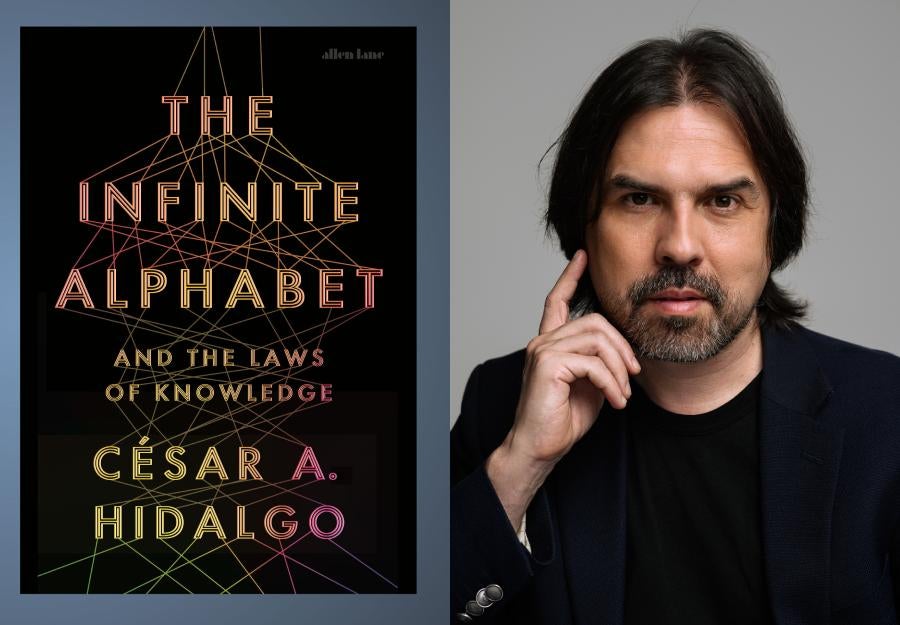
When we think about the laws of nature, we think of gravity, motion or thermodynamics. But what if knowledge – the engine of human progress – also followed certain principles? In The Infinite Alphabet, published recently by Penguin, César A. Hidalgo, head of the Collective Learning Centres at Corvinus University of Budapest and the Toulouse School of Economics, makes exactly this case.
The story begins not in a laboratory but in an airport lounge, where Hidalgo met a lawyer named Charlie who turned a drunken favor into a thriving “court-coverage” business. He specialised in filing extensions for other lawyers to extend court cases in Florida. The colourful anecdote is a simple way to show just how nuanced knowledge can get.
Hidalgo, a researcher known worldwide for his work on economic complexity, argues that knowledge behaves much like matter and energy. It is shaped by principles that govern how it grows, moves and generates value. In his book, he describes a hidden order behind the engines of economic creation, from typing classes in Pittsburgh in the 1910s to the rise of China’s Silicon Valley. He explains why knowledge grows exponentially in the electronics industry and what mechanisms govern its diffusion across geographic borders, social networks and professional boundaries.
The Principles of Time, Space and Value
According to Hidalgo, what makes the study of knowledge difficult is that it is not one single thing, but a sprawling web of specific and non-interchangeable components. An infinite alphabet of skills, facts, rules, and wisdom. The book, years in the making, uses dozens of vivid stories to bring the theory closer to readers. We learn, for example, why Italian aircraft manufacturers turned to making scooters after the Second World War, and how immigrants helped reshape the United States’ industrial landscape.
Several chapters unpack these principles down into three sets of laws. The Principles of Time, which govern how knowledge grows and decays, and explains why laggards sometimes become leaders. The Principles of Space, which explain how knowledge crosses oceans and mountains, and how it diffuses from industry to industry. And the Principles of Value, which explore why some combinations of knowledge are better at creating wealth.
Hidalgo argues that these principles should guide international development and innovation policy. Without them, he says, billion-dollar attempts to “build” knowledge from scratch often fail, such as Ecuador’s planned knowledge city, Yachay, or Saudi Arabia’s Neom smart city. These initiatives are, in his view, as ill guided trying to build a rocket without understanding aerodynamics or the chemistry of its fuel.
The book offers a fresh way of understanding economic and technological evolution that bridges physics, psychology, economics and policy. “If knowledge has laws, perhaps progress does too. Learning the inner workings of the infinite alphabet may be a key step for building a better collective future,” says César A. Hidalgo.
Hidalgo is a physicist, professor and author known for pioneering work in economic complexity, data visualisation and applied artificial intelligence. He led MIT’s Collective Learning Group for nine years before moving to France, where he founded the Collective Learning Centre (CCL), an international interdisciplinary research lab based at the Toulouse School of Economics and Corvinus University of Budapest.