Artificial Intelligence and Business Sustainability – Why Humans Must Remain Part of the Process
Artificial intelligence is playing an increasingly important role in business sustainability, but it is not a solution in itself to the challenges facing companies. How can AI create real value, and why are human responsibility and oversight indispensable? These were the key questions explored by participants at the AI & Sustainability Workshop organized by the Corvinus Institute for Advanced Studies (CIAS) as part of the Gellért Green programme series.
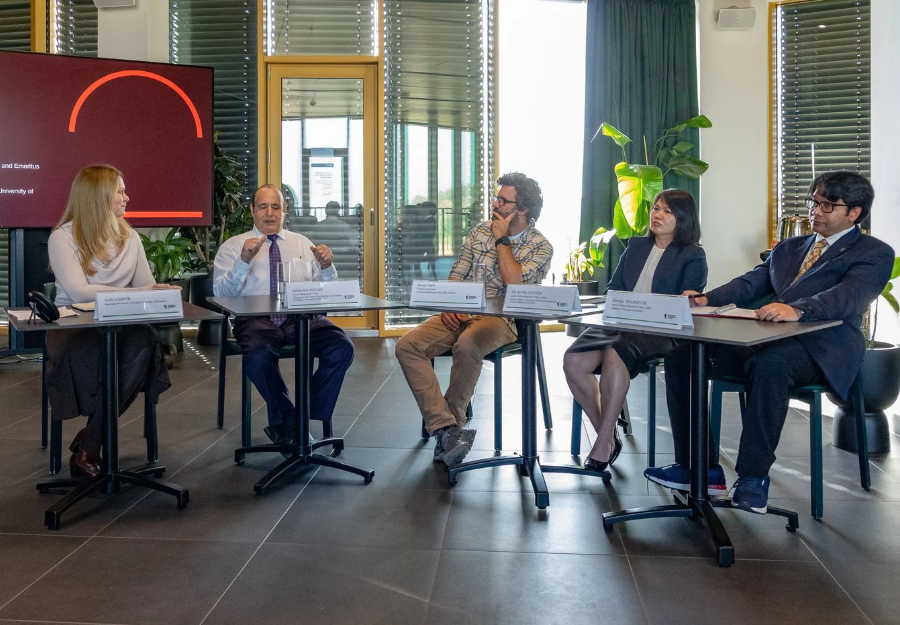
The workshop was opened by Zoltán Oszkár Szántó, Dean of CIAS. At this international professional gathering, researchers, educators, experts and students explored the scientific, educational and practical intersections of artificial intelligence and sustainability through presentations and two thematic roundtable discussions.
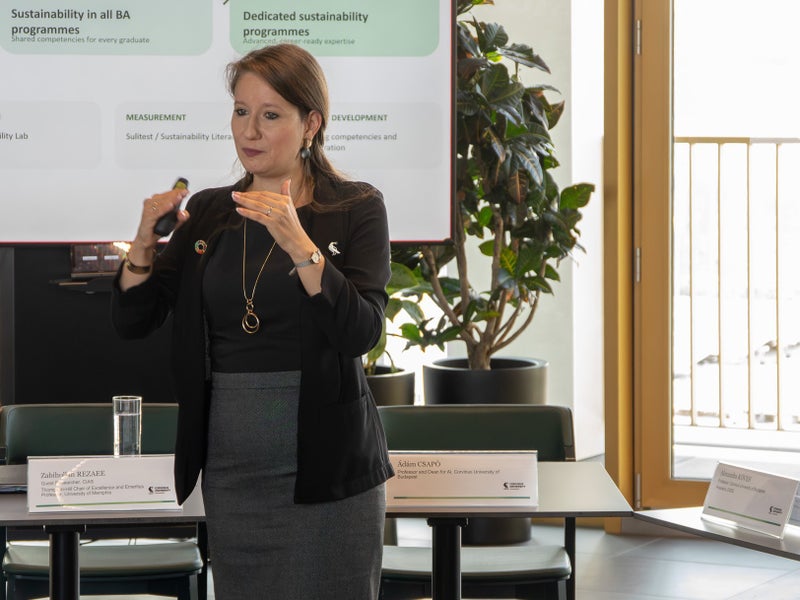
Katalin Ásványi, the university’s Dean for Sustainability, presented Corvinus University’s sustainability achievements and the objectives of the AI & Sustainability Transition Lab. She highlighted opportunities to connect education, research, institutional operations and international collaboration.
Technology Is a Tool, Not a Solution in Itself
AI creates lasting value when it improves the quality of business decisions and contributes to measurable improvements in economic performance, governance, social outcomes, ethical standards and environmental impact. Sustainability, after all, goes beyond reducing environmental burdens: companies must align their financial viability with the interests of employees, communities, society, the environment and future generations.
Artificial intelligence can support these efforts in several ways. It can analyse data on emissions, energy consumption and water use, help allocate resources more efficiently, identify risks in supply chains and support strategic decision-making through forecasting.
At the same time, companies need to assess their financial and non-financial performance together. Economic results and ESG objectives—that is, environmental, social and governance considerations—can reinforce one another, but they can also come into conflict. This makes it essential to define objectives, trade-offs and performance indicators transparently.
Scientific and Research Perspectives – An International Dialogue
The workshop’s first roundtable discussion, entitled “AI & Sustainability: Scientific / Research Perspectives,” was moderated by Zabihollah Rezaee and featured Saeid Homayoun (University of Gävle, Sweden), Carsten Dirk Schultz (University of Hagen, Germany), Ádám Csapó (Corvinus University’s Dean for AI) and Alexandra Köves (Professor at Corvinus University and President of ESEE).
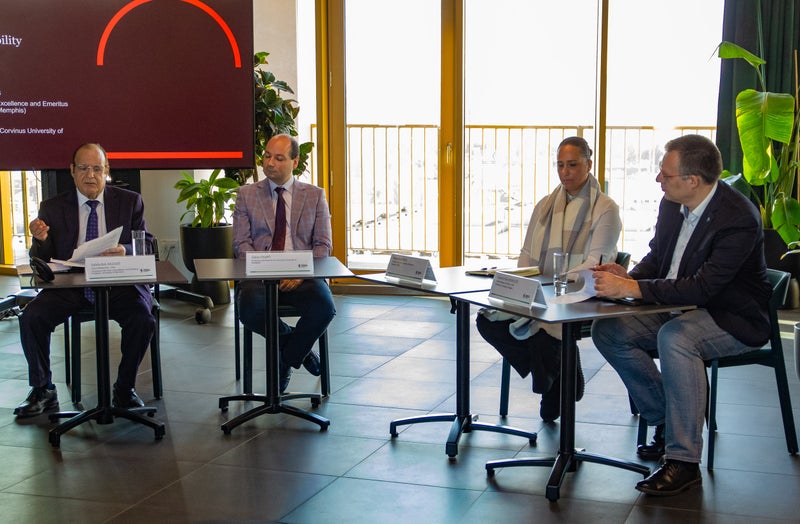
The discussion provided an opportunity to explore the scientific intersections of artificial intelligence and sustainability, potential avenues for research, and the importance of interdisciplinary collaboration. Bringing together different academic disciplines and international perspectives is particularly important to ensure that AI applications are assessed not only from a technological standpoint, but also in terms of their economic, social and environmental impacts.
Continuous Learning and Human Oversight
A well-functioning algorithm alone is not enough to create sustainable value. Reliable data, clearly defined responsibilities and continuous human oversight are also essential.
The decision-making model presented at the workshop consists of five interconnected steps. First, the relevant business and sustainability challenge must be identified, followed by the collection of measurable baseline data. This can then be followed by AI-powered analysis, forecasting or optimisation; a decision based on the results and subject to human review; and, finally, an assessment of the impacts and feedback of the findings into the process.
In this way, the application of AI can become not a one-off technological development, but an ongoing process of learning and improvement.
Measure, Demonstrate, Verify
Credible sustainability practices are built on the principle that companies must do more than set goals: they must also substantiate their results with reliable data. The GRI, ISSB and SASB reporting frameworks, along with integrated reporting, address different information needs, but they share a common principle: sustainability claims must be grounded in verifiable performance.
AI can facilitate data collection and analysis, but it cannot replace human review and independent assurance. This is particularly important in the case of so-called agentic AI systems, which can initiate actions autonomously, execute transactions or interact with other digital tools. Their operations must therefore remain within clearly defined boundaries: their decisions must be traceable, their actions authorised, and their data and activity logs verifiable. Accountability must always rest with an identifiable human being.
At the workshop, Zabihollah Rezaee also explored the opportunities and challenges of applying AI to sustainability from an international perspective in his presentation entitled “AI & Sustainability: Global Perspectives”.
AI and Sustainability in Practice and Education
The second roundtable discussion, entitled “AI & Sustainability in Practice / Education,” was moderated by Judit Gáspár, Associate Professor at Corvinus University, and featured Dávid Papp (professional lead of the Corvinus Makerspace and Managing Director of FabLab), Jhanghiz Syahrivar (President University, Indonesia), Thi Anh Nhu Nguyen (University of Economics and Law, Vietnam National University, Ho Chi Minh City) and Zabihollah Rezaee.
The discussion focused on the practical and educational intersections of AI and sustainability. Key questions included how emerging technologies can be integrated with innovative teaching methods, student skills development, and efforts to address real-world sustainability challenges.
Workshop participants also had the opportunity to learn about the activities of the Corvinus AI & Sustainability Transition Lab, which provides a platform for interdisciplinary learning, collaborative experimentation, prototype development and research partnerships. The Lab aims to translate the knowledge acquired at the university and the application of emerging technologies into tangible sustainability solutions.
International Collaboration for Sustainable Innovation
In closing, Katalin Ásványi and Zabihollah Rezaee emphasised the importance of continuing the professional dialogue and establishing international collaborations. The event also marked an important step towards building an international professional network for the AI & Sustainability Transition Lab.
Corvinus University intends to develop the Lab as an interdisciplinary platform connecting sustainability, artificial intelligence, education and research, while creating opportunities for experimentation in real-world settings.
The initiative aims to establish a collaborative environment in which innovative teaching methods, research initiatives and practical sustainability solutions can be developed, tested and subsequently applied on a wider scale. To this end, the university seeks to engage academics, students, industry partners and the wider community in collaborative efforts.
To support the Lab’s international professional development, the International Advisory Board of the AI & Sustainability Transition Lab has been established. Four invited experts have already accepted membership:
- Zabihollah Rezaee (University of Memphis, USA)
- Carsten Dirk Schultz (University of Hagen, Germany)
- Thi Anh Nhu Nguyen (University of Economics and Law, Vietnam National University, Ho Chi Minh City, Vietnam)
- Jhanghiz Syahrivar (President University, Indonesia)
The Board aims to support the Lab’s long-term development through strategic advice, international expertise and professional networks. It will also foster joint research and educational initiatives and contribute to the development and wider implementation of innovative sustainability solutions.
The workshop thus provided not only a forum for professional dialogue but also laid the foundations for long-term international collaboration.
Photos: György Kenéz