A Succesful Research Career in the USA That Started at Corvinus
You studied economics at Corvinus in the early 1990s. How did your path lead from there to a PhD programme at Princeton in the United States?
In the 1990s, the programme at Közgáz functioned somewhat similarly to today’s Bologna system: the first three years provided general training in economics, after which students could specialise in different fields, such as economic sociology. I completed my undergraduate studies at Közgáz, which allowed me to apply to American universities. I continued taking sociology courses for another year while I was admitted to Princeton’s combined master’s and PhD programme in sociology.
Culturally, this was a different period in Hungary compared to today. At the time, American scholarship opportunities were far more accessible than European ones.
Even back then, getting into Princeton could not have been easy.
At that time, Közgáz was the only university in Hungary where students with both humanities and quantitative interests could truly find their place. Within the same programme, we received strong training in both economics and social sciences. This interdisciplinary background later proved to be a major advantage during my application to American universities.
I was also fortunate to attend university during the period following the political transition, when the world was opening up and many new opportunities became available. Közgáz already had an outstanding network of student organisations and advanced colleges. I was admitted to the Invisible College, which later played an important role in shaping my research profile.
How did your research profile develop?
I originally began researching a topic in economic sociology—the transformation of the welfare state. However, influenced by my professors at Princeton, my interests gradually shifted toward cultural sociology. At that time, French post-structuralist theory was gaining ground in the United States, and it was considered an exciting new field.
I ultimately wrote my dissertation on the changing political meanings of architecture, examining how political regimes in Hungary and the former East Germany used architecture for their own purposes during different historical periods.
One of your earlier research topics sounds particularly intriguing: the politics of rodent control. What exactly does this mean?
My interest in this topic began after I moved to the United States. In large American cities—especially New York—coexisting with rats is almost unavoidable. When I mentioned that I had never encountered rats in Budapest, no one believed me. There was a general assumption that New York was infrastructurally more developed than Budapest, so if New York had rats, Budapest must have them as well.
This sparked my curiosity. I discovered that in 1973 there had been a large-scale rat eradication programme in Budapest carried out by the Bábolna State Farm. The programme was both a scientific experiment and a political statement intended to demonstrate that state socialism could even provide solutions to rodent infestations. The initiative was successful. For decades afterward—even after the political transition, when the organisation operated as a private company—it maintained a monitoring system in the city and continued to be responsible for rodent control in the capital.
For me, the Hungarian example was particularly interesting because it demonstrated how such a comprehensive and systematic plan could function effectively only within a highly centralised system like state socialism.
Before joining The New School, you taught in the United Kingdom and spent a year in the Netherlands. With a Central European background, how difficult was it to begin an academic career abroad in the social sciences?
Both Western European and American academic careers are highly competitive; it is very difficult to secure faculty positions. Moreover, American doctoral programmes offer considerable freedom in choosing research topics. However, once you enter the job market, universities tend to fund teaching and research areas that promise more direct social returns.
After completing my PhD, I applied to many institutions. I was eventually hired by the Sociology Department at the University of Reading in the United Kingdom, which unfortunately closed just a year later. I then returned to the United States, first to George Washington University and later to my current position at The New School in New York.
Interestingly, after earning my PhD at Princeton, I had originally considered pursuing an academic career in Hungary. However, at the time the Hungarian social science field was more closed and strongly built around mentor–student networks. It was extremely difficult to enter from the outside, even with a doctoral degree from a prestigious American university.
What advice would you give to young Hungarian researchers who want to build an international academic career?
Anyone who is serious about this career path will eventually need to spend a longer period abroad. In my experience, a PhD from a well-known American university opens doors at many European institutions as well. The European social science system can be somewhat more closed and insular, so if someone aspires to an international career, it may be worth choosing a strong American university for their doctoral studies from the outset.
Another effective strategy is to select a research field consciously, taking into account market demand. This can increase the chances of securing an academic position later. At the same time, today there are many possible pathways to building an international research career, particularly through various postdoctoral fellowships.
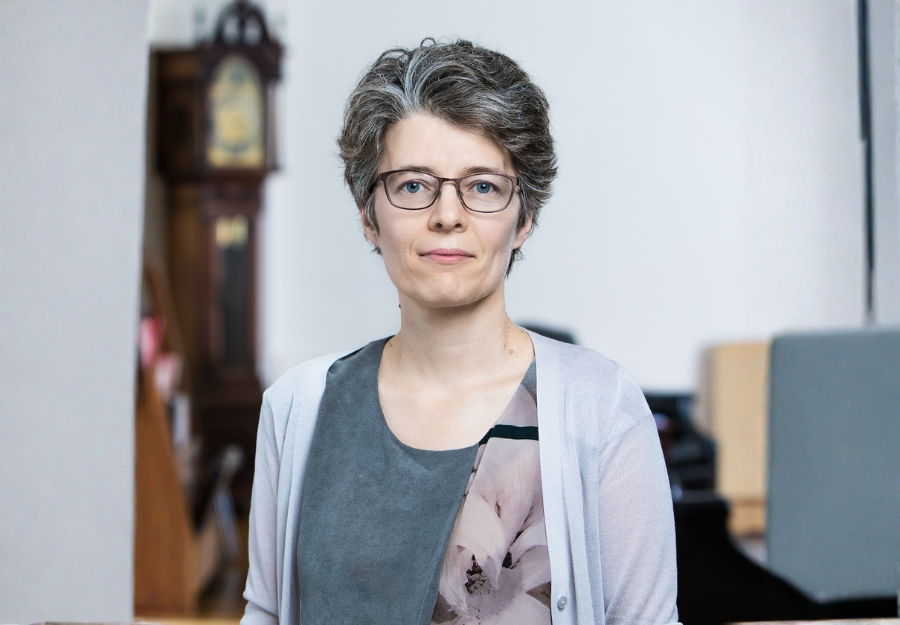
Photo: Dan Komoda / Institute for Advanced Study