Corvinus Swap Shop turns sustainable fashion into action on campus
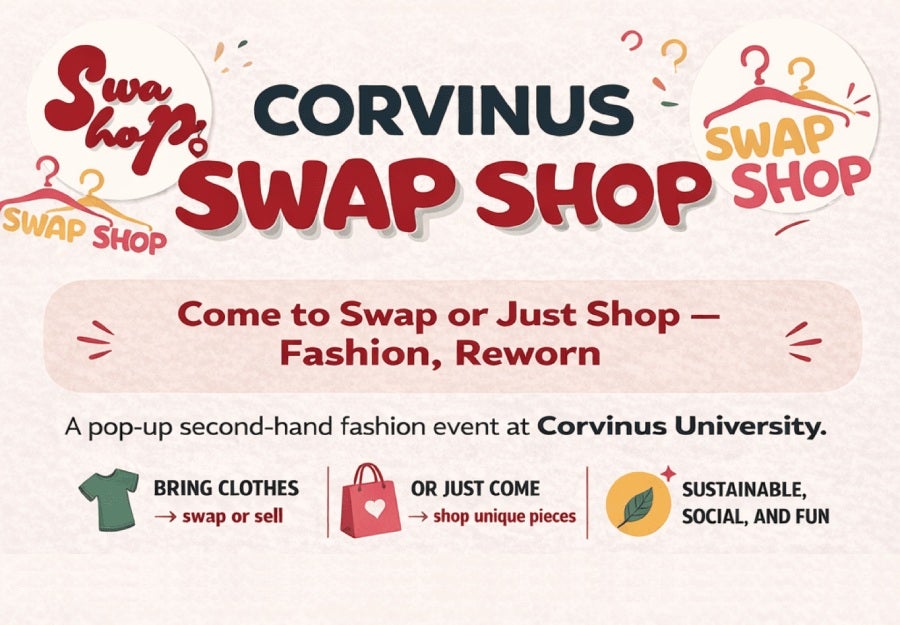
Date: 29 April 2026, 9:00-17:30
Location: Corvinus University of Budapest, Building E, Room III.
The Corvinus Swap Shop is more than a fashion event. Created as a student-driven educational initiative at Corvinus University, it is designed to promote sustainability, circular fashion, and greater awareness of the environmental and social harms associated with fast fashion. Developed as a practical learning exercise, the project connects consumer behavior, sustainability, and real-world action, while creating a space where people can engage with second-hand fashion in an accessible, positive, and community-oriented way.
At its core, the Swap Shop offers a simple idea with broad impact: people can bring clothes, swap items, or simply browse and shop unique second-hand pieces. That openness matters. The event is not only for those who already live sustainably or regularly shop second-hand. It is also for students who are curious, price-conscious, style-conscious, or just looking for a different kind of campus experience. By making participation flexible and welcoming, the project helps show that fashion can be more sustainable, more circular, and less wasteful without feeling restrictive or inaccessible.
The initiative also responds to a much larger global problem. The fashion industry is enormous: the project presentation notes that in 2023 the global industry was estimated to be worth $1.7 trillion, with retail sales projected to reach $3 trillion by 2030, and more than 300 million people working somewhere along the clothing value chain. Yet this scale comes with serious consequences. The same presentation describes fast fashion as a model built on ultra-low prices and extreme speed, allowing consumers to refresh wardrobes quickly and cheaply through compressed design, production, and distribution cycles.
That speed has changed how people buy and discard clothing. The presentation highlights that some fast-fashion systems release new styles constantly, with Shein cited as adding 10,000 designs per day, while garments are worn on average only 7 to 10 times before being discarded. It also notes that from 2000 to 2014, clothing production doubled and the number of garments purchased per person increased by about 60 percent. In other words, clothing is being produced faster, bought more often, and kept for less time.
The environmental consequences are severe. According to the project materials, the textile industry generates 1.2 billion tons of greenhouse gas emissions annually, and fashion accounts for 4 to 8.6 percent of global carbon emissions. The presentation also states that 92 million tons of textile waste are produced globally each year, a number projected to rise to 134 million tons by 2030, and that the equivalent of one garbage truck of clothes and textiles goes to waste every second. These figures help explain why student-led responses such as the Corvinus Swap Shop matter: they turn abstract sustainability concerns into something visible, practical, and immediate.
The project also speaks directly to the habits and pressures shaping younger consumers. The presentation’s “Gen Z paradox” section points out that core buyers aged 18–29 are heavily affected by trend culture and social pressure, with 41 percent reportedly feeling pressure not to repeat outfits. At the same time, young people—especially young women—also score highly on climate concern, ethical consumption intentions, and interest in sustainable fashion options. That contradiction helps explain why events like the Swap Shop are so relevant: many students care deeply about sustainability, but existing shopping culture often pushes them toward speed, novelty, and low prices instead.
This is where the Corvinus Swap Shop becomes especially powerful. Rather than only criticizing fast fashion, it offers a practical alternative. It invites people to experience reuse as something social, stylish, and enjoyable. It creates a setting where fashion can be community-driven rather than purely commercial, and where students can see that buying second-hand or swapping clothes is not just an ethical gesture, but a realistic and attractive option. The initiative also extends its impact beyond the event itself: 10% of all sales will be donated to the Tuzcsiholo Egysulet, giving the Swap Shop an added charitable dimension and reinforcing its commitment to social responsibility as well as environmental awareness.
Ultimately, the Corvinus Swap Shop shows that sustainability on campus does not have to remain theoretical. It can be visible, participatory, and creative. By extending the life of clothing, reducing waste, encouraging more mindful consumption, and contributing part of its proceeds to a wider cause, the event demonstrates that small, local actions can support both environmental and community goals. In a world shaped by overproduction and disposable trends, the Swap Shop offers a different vision—one where fashion is reworn, recirculated, and reimagined through community.