20th-century violin virtuosos can hold their own in the YouTube era
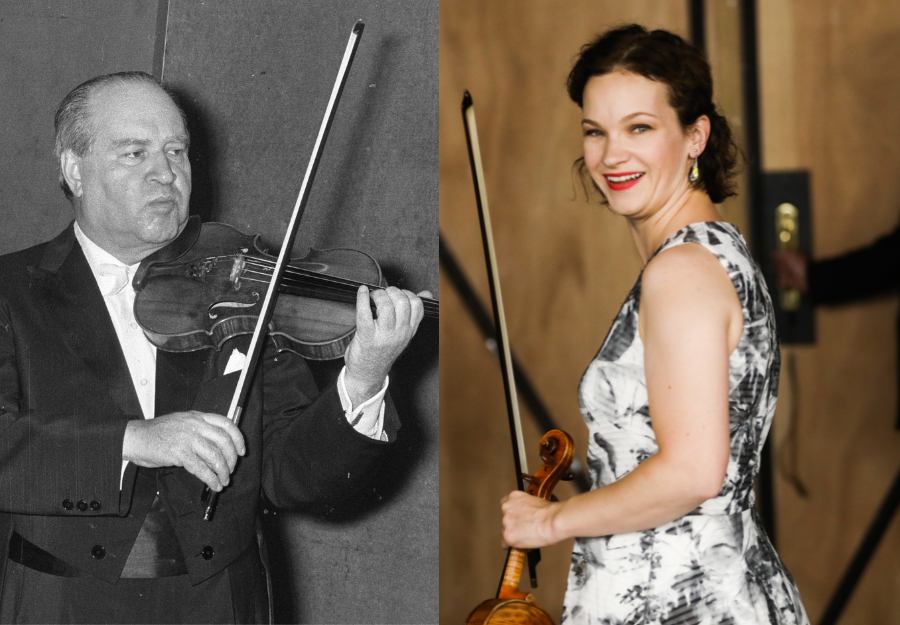
Based on YouTube view counts, 20th-century performers are almost as appealing to today’s audiences as contemporary artists – according to a new study by researchers at Corvinus University of Budapest. The most popular performer was 46-year-old Hilary Hahn, while among deceased artists David Oistrakh placed fourth.
In the study, Clemens Puppe and Attila Tasnádi, two mathematicians at Corvinus University of Budapest, analysed the YouTube viewership of recordings by 32 violinists, based on 46 works that are central to the classical violin repertoire. Their paper summarising the findings was published in the European Journal of Operational Research. One of the main conclusions is that the outstanding violinists of the mid-20th century are almost as interesting to today’s internet users as active performers. This is in sharp contrast to popular music: among music videos released before YouTube launched in 2005, none appear in the top 30 most-viewed music videos.
Four women and six men in the top ten
The results suggest that the ranking is fairly stable even when different ranking and statistical methods are applied. Most mathematical approaches place Hilary Hahn first, as she is the most-viewed performer for seven works. Across eight computational methods she is the most popular, while Itzhak Perlman is most often second. Maxim Vengerov appears in the top 10 in every popularity ranking. Joshua Bell, Sarah Chang, and the late Jascha Heifetz and David Oistrakh made it into the most popular group under at least nine methods.
In what the Corvinus researchers consider the most reliable ranking (based on the so-called relative Nash ranking), the world’s two most popular violin virtuosos are two American violinists: Hilary Hahn and Sarah Chang. The top ten also includes two musicians who have since passed away: David Oistrakh and Jascha Heifetz. The authors highlighted this method because it assigns equal weight to each canonical violin work included in the study and is considered the most scale-independent.
Several musician lists were used
The selection of artists was based on Classic magazine’s list of the 25 greatest violinists of all time, supplemented by classical music writer and critic Jeremy Nicholas’s list of the 20 greatest violinists ever, and the ranker.com list where visitors vote for the greatest violinist of all time. In addition, the researchers included any violinist who was among the six most-viewed performers for at least one of the 46 pieces. From this resulting list of 128, they filtered down to 32 artists for whom a substantial number of YouTube recordings are available. The researchers used ten aggregation methods to address the fact that not every violinist performed the same works. The final field meeting the strict criteria consisted of 32 violinists whose recordings exceeded the 50,000-view threshold for at least ten works.
The repertoire included 29 violin concertos, 9 orchestral or piano-accompanied works, and 8 compositions among the most demanding solo violin pieces – including Bach’s Violin Concerto in A minor (BWV 1041), Beethoven’s “Kreutzer” Sonata, and Paganini’s Caprices. Each work was given equal weight, and if multiple recordings of the same piece were found for one performer, the most-viewed video was used.
Similar patterns may be found on other streaming platforms
Attila Tasnádi, Corvinus researcher and co-author of the study, noted that using view counts comes with caveats: YouTube tends to favour younger generations, as many contemporary artists run their own channels and the algorithm prioritises newer content. “If, under these conditions, the older masters still hold their own, it only strengthens our results,” he said. He added that similar conclusions could likely be drawn from data on other streaming platforms such as Spotify or Apple Music Classical.
Interestingly, based on the combined figures for the top three most-viewed videos by each artist, the Hungarian violinist Antal Zalai would rank 34th.
Popularity ranking of the 32 performers according to the method the researchers consider most reliable
| Name | Year of birth (–death) | Gender | Citizenship | |
| 1. | Hilary Hahn | 1979 | female | American |
| 2. | Sarah Chang | 1980 | female | American |
| 3. | Maxim Vengerov | 1974 | male | Israeli |
| 4. | David Oistrakh | 1908–1974 | male | Soviet |
| 5. | Itzak Perlman | 1945 | male | Israeli |
| 6. | Ray Chen | 1989 | male | Australian |
| 7. | SoHyuon Ko | 2006 | female | South Korean |
| 8. | Jasha Heifetz | 1901–1987 | male | American |
| 9. | Julia Fischer | 1983 | female | German |
| 10. | Augustin Hadelich | 1984 | male | German-American |
| 11. | Joshua Bell | 1967 | male | American |
| 12. | Janine Jansen | 1978 | female | Dutch |
| 13. | Clara-Jumi Kang | 1987 | female | South Korean-German |
| 14. | Leonidas Kavakos | 1967 | male | Greek |
| 15. | Anne-Sophie Mutter | 1963 | female | German |
| 16. | David Garrett | 1980 | male | German-American |
| 17. | Sayaka Shoji | 1983 | female | Japanese |
| 18. | Gil Shaham | 1971 | male | American |
| 19. | Kyung Wha Chung | 1948 | female | South Korean |
| 20. | Ai Takamatsu | 1999 | female | Japanese |
| 21. | Isaac Stern | 1920–2001 | male | American |
| 22. | Nicola Benedetti | 1987 | female | Scottish |
| 23. | Maria Dueñas | 2002 | female | Spanish |
| 24. | Frank P. Zimmermann | 1965 | male | German |
| 25. | Leonid Kogan | 1924–1982 | male | Ukrainian-Russian |
| 26. | Han Soojin | 1986 | female | South Korean |
| 27. | Nathan Milstein | 1904–1992 | male | American |
| 28. | Yehudi Menuhin | 1916–1999 | male | American–British–Swiss |
| 29. | Zia Hyunsu Shin | 1987 | female | South Korean |
| 30. | Shlomo Mintz | 1957 | male | Israeli |
| 31. | Pinchas Zukerman | 1948 | male | Israeli |
| 32. | Daniel Lozakovich | 2001 | male | Swedish |
Photos: Hilary Hahn – Wikimedia Commons
David Ojsztrah – By Anefo / Punt – [1] Dutch National Archives, The Hague, Fotocollectie Algemeen Nederlands Persbureau (ANeFo), 1945-1989, Nummer toegang 2.24.01.05 Bestanddeelnummer 925-6733, CC BY-SA 3.0 nl, https://commons.wikimedia.org/w/index.php?curid=22616385