Three researchers from Corvinus have also been awarded the MTA Bolyai Fellowship
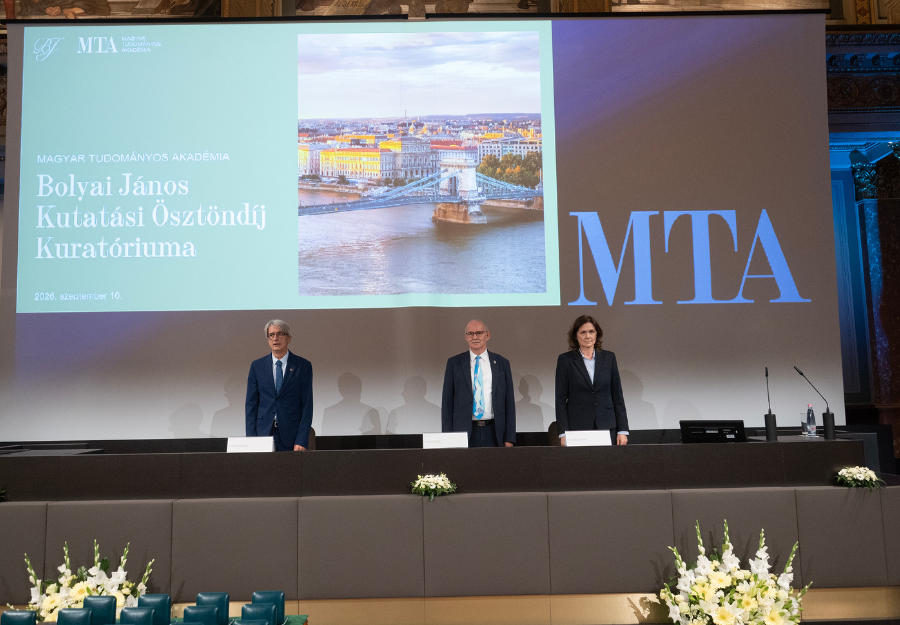
The Hungarian Academy of Sciences established the János Bolyai Research Fellowship in 1997, which is a performance-based, highly prestigious grant open to applicants nationwide. Its aim is to encourage and recognise outstanding research and development achievements amongst young researchers, as well as to facilitate their preparation for obtaining a PhD from the Hungarian Academy of Sciences. This year, the grant was awarded to 157 applicants and, in keeping with tradition, was presented at a ceremony held on 16 September at the MTA headquarters as part of Bolyai Day celebrations.
The Bolyai Scholarship is an academic grant that links the Hungarian Academy of Sciences, MTA doctoral candidates and members of the younger generation of researchers. Its aim is to enable young researchers to carry out research in Hungary after obtaining their doctoral degrees, whilst ensuring predictability and the ability to plan ahead. Furthermore, it plays a key role in encouraging recipients to write their MTA doctoral theses and obtain their academic titles.
Further details of the award ceremony can be found on the Hungarian Academy of Sciences’ website.
Corvinus researchers and their scholarship-funded research topics:
Dr Helena Naffa’s work focuses primarily on sustainable finance, biodiversity financing and nature-related financial risks. In her Bolyai Fellowship research, she is investigating how considerations relating to the protection of nature and biodiversity can be integrated into financial decision-making, investment strategies and the assessment of sustainability risks.
Dr Eszter Kirs’s research in international law focuses on the enforcement of human rights. The aim of her research, supported by a Bolyai Fellowship, is to map, in an international comparative context, the identity of protest movements in Hungary between 2010 and 2025 that relate to fundamental rights, with particular regard to protesters’ perceptions of the state of the rule of law; the legal policy environment surrounding the exercise of the right to assembly; and the use of strategic and defensive litigation as a tool in relation to peaceful protests within the narrowing space for civil society to assert its interests.
Dr László Czaller’s research primarily covers the fields of regional and urban economics, with a particular focus on uncovering and empirically examining the micro-mechanisms underlying agglomeration economies. His work centres on analysing how the characteristics of the urban environment and local labour markets influence workers’ labour market opportunities and adaptability, and how they contribute to the emergence of spatial economic disparities. The research, supported by a Bolyai Fellowship, aims to examine the geographical distribution of development grants provided under the Hungarian Village Programme and the programme’s short-term demographic effects. The aim of the research is to explore how the grants have influenced population movements in small settlements, utilising the programme’s eligibility threshold of 5,000 inhabitants to identify causal effects.
Congratulations on the scholarships!