Patrick Bolton on The CO₂ Question – Technical Progress and the Climate Crisis
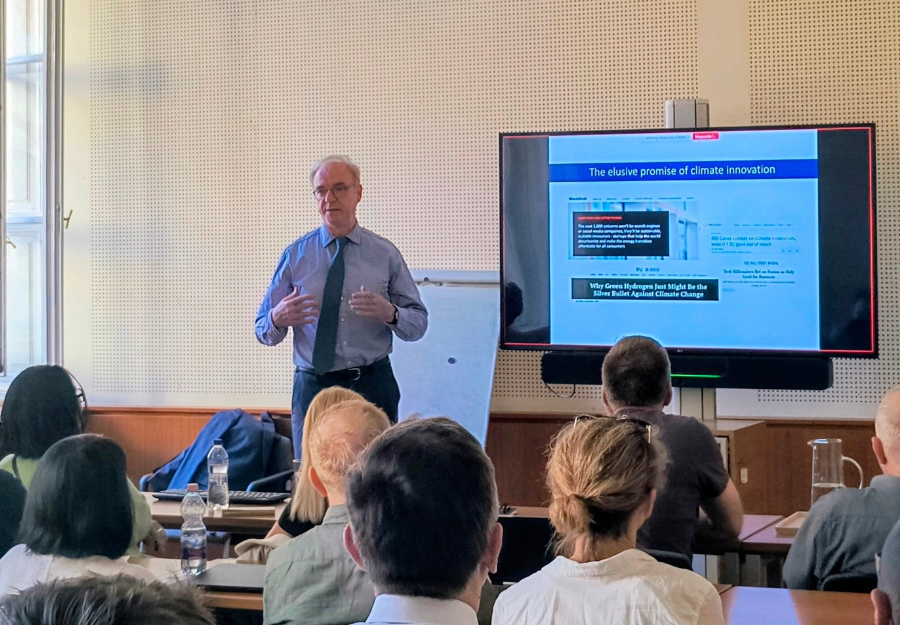
The seminar was jointly organized by the Institute of Economics (CUB), the Institute of Finance (CUB), and the Doctoral School of Economics and Business Informatics (CUB).
Professor Bolton presented his latest joint research with Marcin Kacperczyk and Moritz Wiedemann, entitled “The CO₂ Question: Technical Progress and the Climate Crisis”.
Professor Bolton has made fundamental contributions to understanding the relationship between financial markets, corporate behavior, and climate change. His work has significantly influenced both academic research and policy discussions concerning the financing of the green transition.
Main Messages of the Presentation
The presentation addressed a central puzzle of contemporary climate policy. Despite substantial technological progress, growing investment in renewable energy, and a steady increase in green innovation, global greenhouse gas emissions continue to rise and atmospheric CO₂ concentrations have reached historically high levels.
Using a unique global dataset combining firm-level emissions, patenting activity, and financial information between 2005 and 2022, the authors investigated whether environmental innovation actually leads to lower corporate emissions.
The research distinguishes between two broad categories of environmental innovation:
- general green innovation,
- fuel-efficiency and energy-efficiency innovation.
One of the key findings is that fuel-efficiency innovations do reduce firms’ carbon emission intensity. However, these efficiency gains are often offset by subsequent increases in production, sales, and investment. As a result, total emissions frequently remain unchanged. The authors interpret this pattern as evidence consistent with a modern form of the Jevons Paradox, whereby improvements in efficiency can lead to increased overall resource use.
The presentation concluded that innovation remains essential for addressing climate change, but technological progress alone is unlikely to deliver the required reductions in global emissions. Effective climate policy may therefore need to combine innovation support with measures addressing rebound effects, accelerating technology adoption, and targeting absolute emissions rather than emission intensity alone.
Presentation Materials
Those interested in receiving the presentation slides are kindly invited to contact Balázs Sárvári directly via email on balazs.sarvari@uni-corvinus.hu.