One Economy, Three Perspectives: Rethinking Potential Output

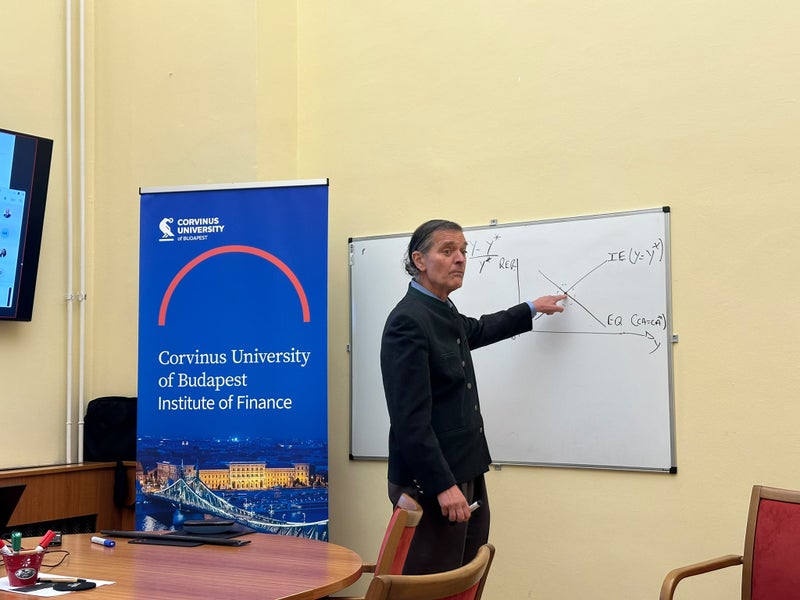
On 2 November 2026, the Institute of Finance at Corvinus University of Budapest hosted Rodolfo Maino for a research seminar titled “Potential Output and the Cycle: Three Modeling Approaches in One Transparent Workflow, ” exploring how economists assess an economy’s productive potential and why different approaches can lead to different policy conclusions.
When economic activity slows, the underlying causes are not always clear. Is the economy experiencing weak demand, a loss of productive capacity, or the effects of slowly adjusting prices and wages? Distinguishing between these possibilities is essential for designing appropriate economic policies. Maino introduced three established modeling approaches that offer different perspectives on these questions: a multivariate filter to assess cyclical fluctuations, a production-function model to evaluate productive capacity, and a New Keynesian small-open-economy model to examine the role of price and wage rigidities.
Drawing on applications to the United States, Sri Lanka, and Colombia, the presentation illustrated the respective strengths and limitations of these approaches. The examples demonstrated how different definitions of potential output provide distinct insights into economic conditions, while also highlighting the importance of data availability, model assumptions, and sensitivity to economic shocks.
Maino also presented GapScope, an integrated Excel-based tool that brings these three approaches into a common analytical framework. Rather than proposing a new economic model, GapScope makes established methods easier to apply, compare, and interpret. Its accessible design is particularly relevant for institutions with limited analytical resources, helping policymakers and researchers examine alternative assumptions and communicate their implications more transparently.
A central takeaway was that estimating potential output is not simply a technical exercise, but an important part of economic policy judgment. Different models can produce different assessments because they answer different economic questions. By making these distinctions and their underlying uncertainties explicit, the seminar highlighted the value of transparent, comparable, and well-informed economic analysis in supporting more effective policy decisions.