What Can a Fulbright Scholarship Offer a Young Researcher?
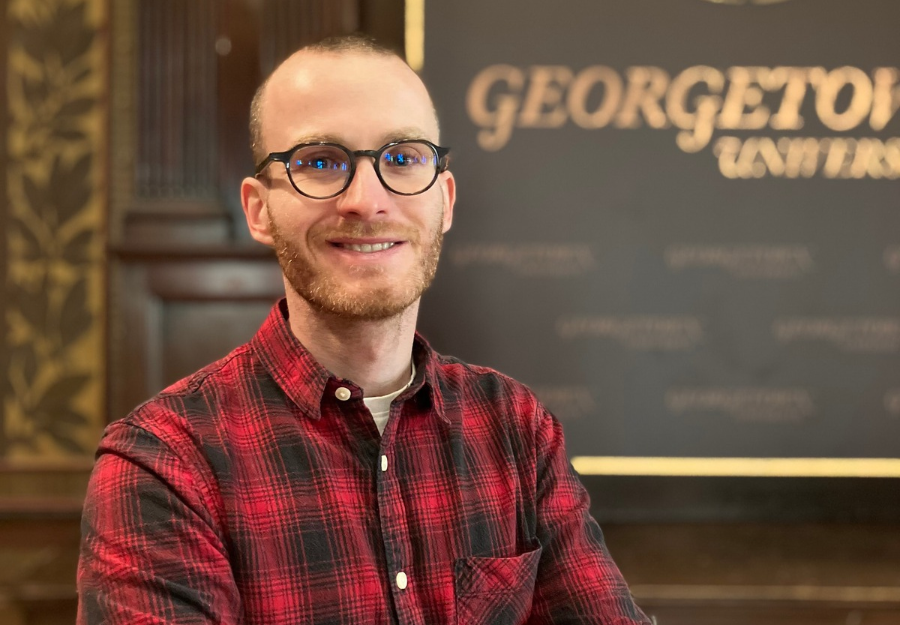
During his time in Washington, he worked on his research on the Western Balkans, participated in conferences, taught, and built professional connections with American researchers. In our interview, he talks about what the Washington research environment gave him, what advice he would offer to those preparing a Fulbright application, and how Corvinus can benefit from such an experience.
What motivated you to apply for a Fulbright scholarship? When did you first decide that you would like to spend a longer period conducting research in the United States?
Fulbright is the world’s largest and best-known international educational and cultural exchange programme, with roots dating back to the period following the Second World War. Participating in the programme is prestigious in itself, precisely because it gives university students, researchers and academics from countries around the world the opportunity to undertake shorter or longer periods of research or teaching at renowned universities in the United States.
During my doctoral studies, I decided that I would like to spend five months conducting research in the United States to support the completion of my dissertation. It made the process easier that I had already collaborated with the American university I selected, and having an established relationship was also an advantage when applying. Moreover, the opportunity offered by the Fulbright scholarship fit well with my research profile.
Why did you choose Georgetown University? From a professional perspective, what did you hope to gain access to in that research environment?
Georgetown University is one of the most highly regarded universities in Washington, D.C., with strong expertise in international relations, political science and democracy-building. This was a particularly good fit for my research portfolio, which focuses primarily on the Western Balkans. Before applying, I had already established connections with professors at the university whose research interests overlap with mine and with the topic of my doctoral dissertation. So, in this respect, it was almost as if Georgetown found me rather than the other way around.
What was the added value that contributed to your work beyond what you could have achieved by spending this time in Hungary?
One of the added values comes from differences in mentality. The American university, teaching and research environment is quite different from the European one. There is a different understanding of where a lecturer or researcher fits within the university community and what opportunities are available to them.
And that leads to the second major advantage: from a research perspective, these five months provided a great many opportunities. I am not only referring to physical resources, such as access to databases and libraries, but also to the intellectual research community that Washington, D.C. offered and that I was able to become part of during my Fulbright scholarship. As a young researcher, I was able to attend several political science conferences across the United States, where I had the opportunity to get to know researchers and academics from American universities better and, to some extent, become part of their professional community. I hope that I will be able to further develop these connections after returning to Budapest.
During my Fulbright period, I attended conferences in New York, Cleveland and Albuquerque, and I also had the opportunity to become more familiar with the community around Georgetown University. Beyond my research activities, I was able to build closer relationships with students and join student-led groups. I also had the opportunity to give lectures in Georgetown’s master’s programme focusing on democracy-building, not only on my research topic, the Western Balkans, but also on the democratic transitions and political dynamics of our broader region. Naturally, the 2026 Hungarian election made these topics particularly timely.
Did you experience this while you were there?
Yes, and not only at the university. There was also considerable interest in Washington in what would happen on April 12, and then in what would happen after April 12.
Was there an expert or researcher there who changed your perspective, set you on a different path, or otherwise had a significant impact on how you approach your research?
I would definitely highlight my Georgetown mentor, Elton Skendaj. He is a professor who grew up in Albania and studied in the United States. We discussed my doctoral dissertation in great detail, and during my five months there, he supported me as a mentor and introduced me to many professionals with similar research interests and profiles.
How important is the proximity of political or policy institutions in Washington? Is there a connection between the academic community and the administration?
There is a great deal of movement between the two. At Georgetown and other higher education institutions, speakers from government institutions and research organisations are invited not only to give individual lectures or classes, but many people also move from the administration into academia when the political climate changes, and of course the reverse happens as well.
A university, especially one located in Washington, D.C., should not be imagined as an ivory tower or a bubble. The research environment exists in close interaction with the political world.
What advice would you give to a student or academic who is currently considering applying for a Fulbright scholarship?
Fulbright is an opportunity that should not be missed. More specifically, it is very important to pay close attention to the deadlines. This may sound simple, but the application process involves quite a lot of paperwork, and you need to plan one and a half to two years ahead. In the current application period, the deadline for researchers and academics is October 15, while for postgraduate students it is in mid-May. These applications are already for the 2027–28 academic year.
It is therefore worth looking at the call for applications with the understanding that such an opportunity may become available in one and a half to two years’ time, and planning your professional and family life accordingly, taking this waiting period into account.
What makes a Fulbright application truly convincing? What should a researcher who is currently considering applying pay attention to?
I would highlight three points. As a researcher, it is definitely advisable to demonstrate that you already have both domestic and international experience in your research field.
And this leads to the second point. It is also helpful to have a letter of invitation from an American host institution with which you have already established some form of professional relationship. For example, you may have collaborated with a lecturer or researcher at the host institution, co-authored a publication, participated in a joint research project, or given a presentation at a conference. This demonstrates that the Hungarian scholar will not be arriving in a vacuum.
And this leads to the third point: plan ahead and formulate precisely and concretely what you intend to do in the United States. Coordinate with the host institution: if you will be teaching classes, what kind of classes will they be? If you will be conducting research, exactly how will you do it? And where do you want your research to be by the end of the scholarship period? The more specific your goals are, the better they should be substantiated.
Did you already know which conferences you wanted to attend?
Yes, and I can only recommend that if someone is considering Fulbright, they should start looking for conference opportunities that fit their profile now. Major American conferences are generally held in the spring each year, so you can prepare your application in advance.
Let me add a fourth point as well. Applicants need to know how they will make practical use of the knowledge they gain in the United States at their own university, institution or research centre in Hungary. Applicants should not remain at the level of general statements, but should identify the specific areas, topics or ways in which they will apply what they have learned back home. For example, they might complete their dissertation, introduce new methodological elements into their teaching, or do both.
Does Fulbright itself cover the costs of attending conferences, or did you simply manage your scholarship funds particularly well?
The Fulbright scholarship is very generous, and the Fulbright office in Hungary also makes an effort to cover conference-related costs and expenses that arise. The financial opportunities naturally depend on the budget available in a given year, but there is a strong commitment to supporting conference participation when it can be demonstrated to be relevant and necessary for the scholar’s professional profile.
You mentioned this as the third point, so it seems particularly relevant to ask: what knowledge and experience did you bring back from Georgetown that you can apply at Corvinus in your own research and teaching?
When it comes to teaching, there is a significant difference between a university seminar in the United States and one at a European or Hungarian university. One thing I was able to learn particularly well in the United States was how to keep students engaged for 60–90 minutes. I also learned how to design group assignments and present their results in a way that makes them interesting not only to the group itself but to the other students as well. I developed considerably in the field of teaching methodology, including how to use different media platforms and AI in education.
It is also very important for a researcher writing a dissertation not to receive feedback only from experts in Budapest or, more broadly, from a European circle of scholars, but also from American researchers, who may have a very different perspective on what should be emphasised in a research proposal or a publication intended for an academic journal. I feel that American researchers are more experienced in making these kinds of decisions. They have a kind of know-how that could also benefit the community of lecturers and researchers at Corvinus University of Budapest.
Two years ago, we spoke with Ferenc Németh about his experiences in the doctoral programme at Corvinus: “The university has always been a great help in the search for answers” – Ferenc Németh’s PhD story