Milán Gauder: “Today, I only take on things I would happily do for free”
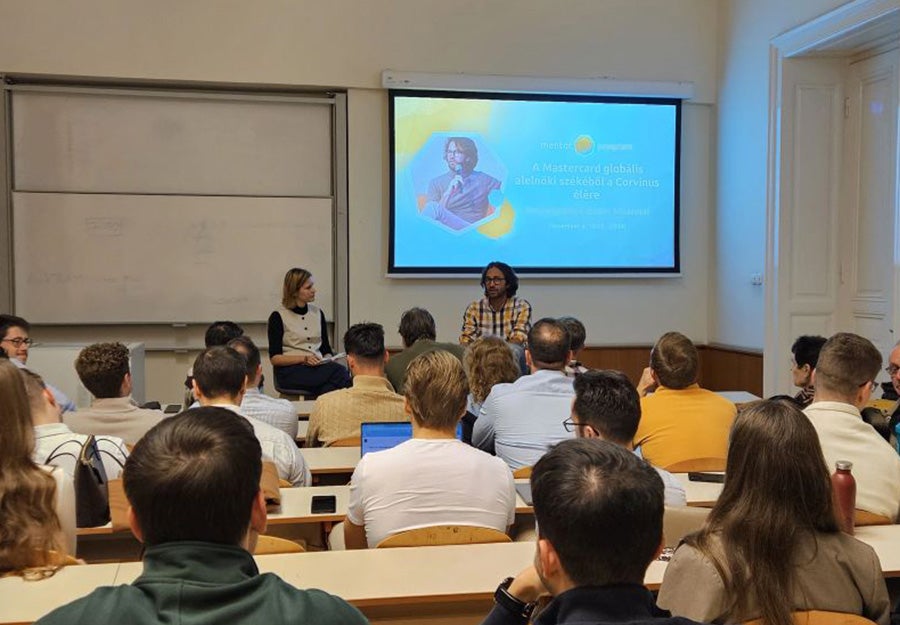
How do you land a good job? What should you do during a job interview to make sure the HR manager remembers you and wants to hire you? What will drive a student’s career forward: the degree they earn, their talent, or their ambition? These were the questions the organisers wanted to hear answered by Milán Gauder, Chairman of the Board of Trustees of the Maecenas Universitatis Corvini Foundation, which maintains Corvinus University.
In a lecture hall packed with students, Hargita E. Vörös was the first to interview Milán Gauder, who, as is well known, is a Corvinus alumnus and graduated with a degree in economics 25 years ago. Asked how the labour market had changed over that time, Gauder highlighted that when he graduated, Facebook did not yet exist, the world’s leading publicly listed companies were quite different from those at the top today, and there was no need to worry about AI yet.
“Never be late for a meeting”
The Chairman of the Board of Trustees recalled that his first job was at Deloitte Consulting. He had other options but chose this opportunity because it offered HUF 20,000 more in salary, and the company’s location was more convenient in terms of commuting. At the time, these were his most important considerations. Later, after some difficulty, he moved to McKinsey, where Anthony Radev (who also served as President of Corvinus from 2019 to 2024) initially did not want to hire him. Gauder, however, refused to give up. As he put it, “I had a fighting spirit.” He applied again and got the job. In 2005, he joined Mastercard, where he held a variety of management positions across several continents. Eventually, at the age of 45, he resigned from his position as Global Vice President.
Looking back, he believes that professional conduct and basic workplace etiquette are at least as important as the academic theories students spend years memorising. “A job interview is basic common sense: 1) never be late for a meeting, 2) answer the questions you are asked in complete sentences, and 3) don’t overwhelm your audience with data. Tell a story instead. Make sure whatever you produce is of high quality, and give your Excel spreadsheets a story to tell as well,” said Milán Gauder. Of course, leadership skills also need to develop over time; they cannot simply be learned from a book. “Before your first job interview as an interviewer, you will probably be more nervous than the candidate. And before you have to fire someone for the first time, you won’t sleep for days,” the Chairman of the Board of Trustees summed up his experience.
Social mobility must be supported from birth
Speaking about the concept of success, he noted that every economics student learns at university that profit is the measure of success. In business, however, the picture is much more complex. “Another important factor is the type of company you work for. I also worked for a 150-year-old German family-owned business. In my experience, family businesses move cautiously, take their time and carefully weigh their options. Start-ups, on the other hand, live in the moment and are constantly looking for new stories. Large publicly listed companies are different again: they live under the spell of quarterly results and are captivated by major announcements. Yet, in theory, all three types of companies are trying to maximise profit,” Gauder explained.
The discussion then turned towards corporate social responsibility. As is well known, the Chairman of the Board of Trustees received the “Philanthropist of the Year” award in 2024. Among his other activities, he is a co-founder and co-owner of the Átrium Theatre and has long been involved with the Van Helyed Foundation, which supports Roma children living in segregated communities in Ózd from their early lives. “A good product alone is not enough. This is true both for start-ups and for the cultural sector. Even in the case of Béla Pintér, head of a theatre company, writing a good play is not enough,” said Milán Gauder. He added that he had initially tried to persuade Béla Pintér to stop charging the same price for every ticket and, for example, to charge more for seats in the first two rows. But that was merely a cosmetic adjustment. What was really needed was a business model, a much larger venue, dynamic pricing, a developing sales operation, and direct relationships with customers and fans.
Speaking about the children in Ózd and the programme supporting them, Gauder said: “It is impossible not to fall in love with them.” He described that people living in the segregated communities emerged in Ózd following the closure of the mines. Many households have no electricity, running water or heating, and parents cannot even afford to buy their children a pair of glasses when they need them. “Those children are not stupid. They simply don’t have the resources, the tools, the people or the place they need to study.” Later, in response to a student’s question about what could be done to improve Hungary’s very low levels of social mobility, the Chairman of the Board of Trustees replied that starting to help children at the age of 17 was already too late. The Van Helyed Foundation starts working with children from the moment they are born, and that is the right approach. He added that the university also wanted to contribute to this cause, for example through the Illyés Gyula Programme, but that this was not enough yet. He encouraged anyone interested in taking action towards this goal to contact him.
“You need to see both sides of the world”
Among his advice to young people starting their careers, he emphasised: “Arrive on time for your interview, look the interviewer in the eye, and speak in complete sentences.” Gauder added that humour is always valuable and welcome. Candidates should behave in such a way that, after conducting ten interviews in a single day, the HR manager will still remember them for something positive.
The discussion also addressed the value of university degrees today and what students can actually learn at university. “University simply provides you with a set of tools; success comes from within you. Companies also pay attention to the fact that a young person was admitted to university and saw their studies through to the end.” He did so himself, although, as he recalled, he took a year off during his university studies and travelled to India. Clearly, the experience left a deep impression on him.
“I really love the developing world. You need to see both sides of the world and experience for yourself that the relationship between happiness and GDP is not nearly as strong as one might think. “I remember travelling around India by train for six weeks when I was a student. Ten dollars a day was enough, and I had some incredible experiences. I often think about how, now that I have the financial means, my family and I, including my three daughters, might spend more on the first night of a skiing holiday than I spent during those entire six weeks back then. “I wonder what my daughters will remember from all this more than two decades later,” the Chairman of the Board of Trustees reflected.
Climbing the career ladder
Asked by a student how one can move into their boss’s position, Milán Gauder replied that, based on his experience, employee turnover at large companies is high up to middle-management level, but opportunities become much more limited beyond that. “At Mastercard, I often found myself in positions that had not existed before. They were created by technological progress. At companies that are not growing fast enough, everyone clings to their chair. It is worth joining a growing company,” he said.
Answering another student’s question, the Chairman of the Board of Trustees explained that going abroad to gain professional experience is clearly easiest before having children. Two of his mentees also shared their views on the subject. They emphasised that it is important to go abroad early, meet different people and experience other cultures. Later, one can always decide to return home and continue their career there.
“What made it possible for you to leave such a senior position at Mastercard, where other people stay until retirement?”, another important question asked. “Today, I only do things I enjoy and would happily do for free. Power can be intoxicating, and you become afraid that if you lose it, you will be nobody. Losing prestige and status can sometimes be frightening, so it is a difficult decision,” Gauder replied.
Why he accepted the position of chairman of the board of trustees
One question related directly to current events was inevitable: why had he decided to apply for a position on the Board of Trustees of the foundation that maintains the university? “I studied here, and I felt that I wanted to do something for Corvinus, even under the very different circumstances we face today. When I applied to this university, getting in was the ultimate dream for me. It never even occurred to me that there might also be a university in Norway. Today, borders have come down, and even the best universities are competing fiercely for students. Applicants today also have to consider whether the profession they are studying for will even exist in the age of AI. And, of course, the biggest question is what universities should teach and what kind of knowledge students should acquire. “Another very important change is that many students today work alongside their studies. One thing is certain: what will move you forward is the talent, knowledge and ambition that come from within,” the Chairman of the Board of Trustees concluded.
The event ended well after it was scheduled. Clearly, the students still had plenty of questions, so they all headed out for a beer with the Chairman of the Board of Trustees, who even cancelled his previously arranged evening plans to join them.
Katalin Török
Photo credit: Kép: Bankárképző Mentorprogram LinkedIn