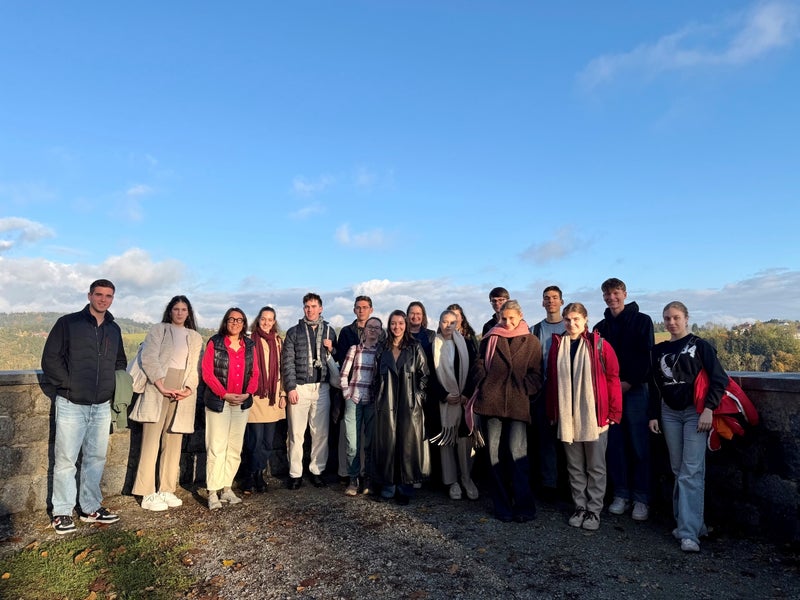
Report – DSG Study Trip, Passau 2026
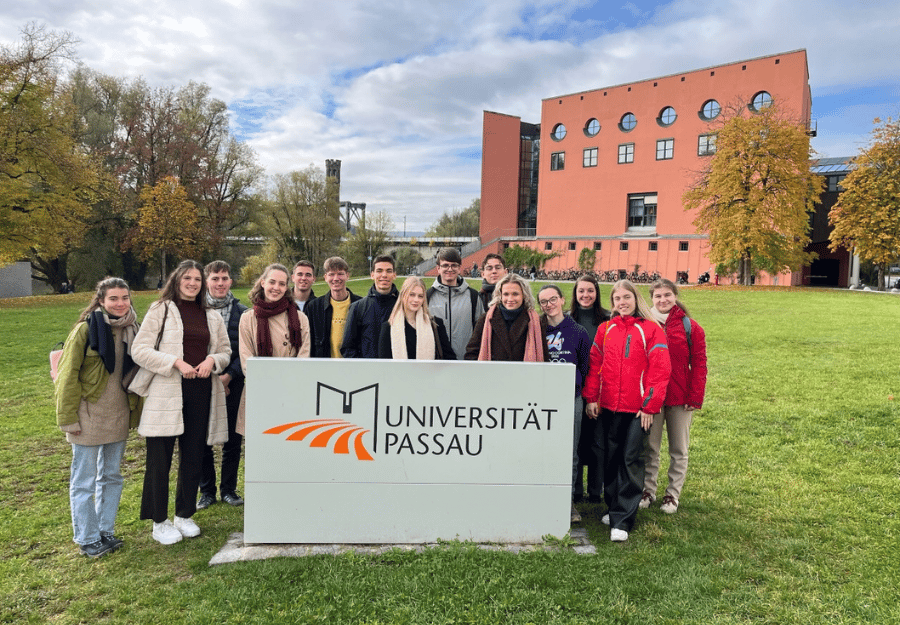
Tuesday, 27 October – University Lecture, City and Campus Tour
The first professional day began with Prof. Dr. Dirk Totzek’s International Marketing lecture, in which he explained when standardisation pays off in international marketing and when adaptation to individual markets is necessary. Topics included Hofstede’s cultural dimensions, consumption habits that differ from country to country, Levitt’s convergence hypothesis and the country-of-origin effect (for example, the power of the “Made in Germany” label).
We then explored the old town of Passau, the City of Three Rivers, on a guided tour. During this informative and entertaining walk, we learned about the city’s history and about the challenges that flooding poses for local residents. In the afternoon, a campus tour led us through the university buildings, where we learned about international study opportunities. The group met the Passau coordinator of the DSG programme, which has been supported by the DAAD for more than thirty years, and also had the chance to try the university’s excellent cafeteria. In the evening, we talked with students who are in Passau on an exchange semester or a double-degree programme; they shared their academic experiences and their impressions of local student life.
Wednesday, 28 October – IHK Niederbayern and INN.KUBATOR
The second professional day focused on the economy of Eastern Bavaria. At IHK Niederbayern (the Lower Bavarian Chamber of Industry and Commerce), we attended a presentation on the German chamber system: the chambers of industry and commerce represent the interests of businesses and provide advisory services and dual vocational training, while the network of German chambers of commerce abroad – including the German-Hungarian Chamber of Industry and Commerce in Budapest – supports international economic relations. The presentation outlined the economic situation of Germany and Lower Bavaria, as well as the main risks and prospects for businesses in the region. In addition, the students held an interactive discussion analysing the patterns emerging in Eastern Bavaria in the light of the location theories covered in their Allgemeine Betriebswirtschaftslehre (Business Administration, taught in German) course.
In the afternoon, at the INN.KUBATOR start-up centre, we learned how start-ups – often emerging from a university environment – are supported from the initial idea through to company formation, giving students insight into the coordinated work of the entrepreneurial ecosystem around Passau. The students also learned what support they could receive in realising their own business ideas, and that the centre supports foreign start-ups as well. The topic sparked lively interest: participants asked numerous questions, turning the presentation into an interactive discussion.
The day ended with a city rally where teams explored Passau by completing tasks. Every participant received a gift, and the top three teams also won prizes. We rounded off the evening at a student bar with German card games and plenty of laughter.
Thursday, 29 October – msg and CENTOURIS
On the morning of the third professional day, managers at the Passau office of the IT consultancy msg presented the company’s history, activities and business culture. The students gained insight into the global growth trajectory of a company founded in Bavaria, which they linked to the theories of business concentration from their studies, thereby complementing them with a practical perspective. We toured both wings of the office building and learned how closely the company cooperates with the University of Passau.
In the afternoon, we travelled to Neuburg am Inn, where CENTOURIS is based in Neuburg Castle. Originally founded as a centre for tourism market research, the institute today uses a range of research methods to produce data-driven analyses for tourism organisations, local authorities, companies and EU research consortia. Five of their projects were introduced, with UPSURGE being the most interesting, as it has a Hungarian connection: one of the programme’s pilot projects, which examines nature-based solutions for cities, is being implemented by the local government of Budapest’s 18th district. The visit tied in well with the DSG course Marktforschung (Business Market Research). From the castle, we walked to Wernstein railway station and took the train back to Passau.
Professional Experience and Benefits
Within a single week, the study trip brought together the topics of international marketing, business development and market research. The theories presented in the lecture reappeared as practical examples during the company and institutional visits, while CENTOURIS showed us the everyday reality of market research. The students gained an overview of internship and job opportunities in Germany and developed their language skills over five days in a German-speaking professional environment.
Acknowledgements
The programme ran punctually and smoothly; our hosts prepared a detailed programme booklet and took care of every detail. We would like to express our sincere thanks to Prof. Dr. Marina Fiedler and Christina Schäfer of the University of Passau for the organisation, to Prof. Dr. Dirk Totzek for the lecture, to the staff of IHK Niederbayern, INN.KUBATOR, msg and CENTOURIS for the professional programmes, and to the university staff member who led the campus tour. The study trip has further strengthened the excellent professional relationship between Corvinus University of Budapest and the University of Passau.