Hybrid working has become one of students’ top priorities
A student employability survey recently published by Corvinus University of Budapest examined employment alongside studies, career plans and expectations of the labour market. Based on responses from 1,840 Corvinus bachelor’s and master’s students, the findings reveal which industries, skills, working arrangements and corporate relationships students consider important.
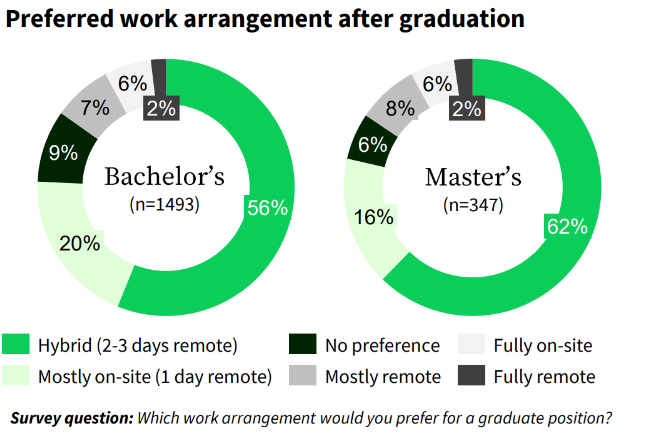
The responses show that hybrid working has become a defining element of Corvinus students’ plans for the future. After graduation, 56 per cent of bachelor’s students and 62 per cent of master’s students would like a job that allows them to work remotely two or three days a week. Only a minority would choose to work entirely from the office, suggesting that flexibility has become a basic workplace expectation among graduates entering the labour market.
Student employment is part of university life
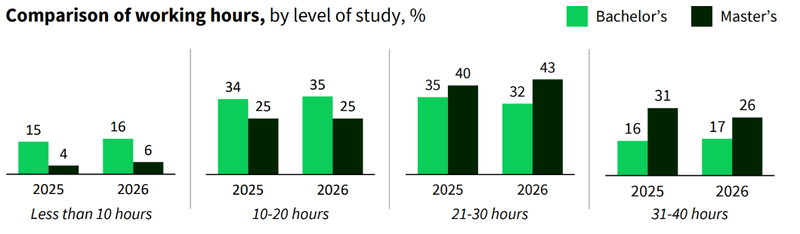
Most students do not focus exclusively on their studies. At Corvinus, 51 per cent of bachelor’s students and 68 per cent of master’s students are in employment, meaning that work is a significant part of student life. Most master’s students work more than 20 hours a week, while over a quarter spend between 31 and 40 hours a week working. Among bachelor’s students, a more moderate workload is more common, with 51 per cent working no more than 20 hours a week.
Their motivations also differ. Bachelor’s students most often take on work for financial reasons, while gaining professional experience is the strongest motivation among master’s students. More than 30 per cent of students also receive an academic scholarship worth between HUF 45,000 and HUF 85,000 per month.
The research also shows that students’ perception of the labour market value of their degree has improved. Among bachelor’s students, the proportion who view a Corvinus degree as a global advantage rose from 14 to 21 per cent. Among master’s students, this figure increased from 6 to 16 per cent within a year.
Finance and consulting top students’ career ambitions
Among bachelor’s students, finance and banking is the most attractive career field, followed by marketing, IT, media and entertainment, and consulting. Among master’s students, consulting ranks first, followed by marketing, finance and banking, media and entertainment, and the government sector.
The emergence of AI creates mixed feelings among students. Some 52 per cent of bachelor’s students and 56 per cent of master’s students believe that artificial intelligence will create new types of jobs and career paths. At the same time, 52 per cent of both groups expect fewer junior positions, while 48 per cent anticipate stronger competition in the labour market.
Communication, problem-solving and critical thinking continue to rank among the skills students consider most important.