Corvinus Advances a New AI Paradigm and Brings International Researchers Together at CogInfoCom 2026

Corvinus University of Budapest is developing — in collaboration with Washinton University (QS world rank 16th in AI) and The Chinese University of Hong Kong (18th in global world rank by QS) — a new paradigm of artificial intelligence, addressing one of the most significant transformations in AI: its emergence from computers into the physical world.
This scientific direction was among the central topics of the 17th International Conference on Cognitive Infocommunications (CogInfoCom 2026), held on 12–13 October 2026 in Hong Kong organised in collaboration with the Corvinus Institute for Advanced Studies (CIAS) and the Institute of Data Analytics and Information Systems (DAIS) at Corvinus University of Budapest, and the Centre for Perceptual and Interactive Intelligence (CPII) at The Chinese University of Hong Kong (CUHK ranked 18th by QS global), InnoHub for New Quality Industries, and The Chinese University of Hong Kong Shenzhen Research Institute.
Corvinus has introduced the following new paradigm of AI at the conference:
A New Vision: AI Entering the Physical World
Researchers at Corvinus have formulated a scientific vision that extends beyond the current dominance of language-based artificial intelligence:
“AI breaks out of computers and manifests itself in the physical world — through robots, intelligent objects, real data, and an expanding range of physical systems. This transformation is giving rise to entirely new paradigms of life, extending far beyond what we can imagine today.”
This vision suggests that the next major development in AI will not simply involve more powerful language models, but the emergence of new models of AI capable of understanding and operating within the physical world.
A New Concept by the Team: Logical Synthesis Models Complementing Large Language Models
To provide a conceptual foundation for this vision, Corvinus researchers introduced the concept of Logical Synthesis Models (LSMs) as a complementary AI paradigm to Large Language Models (LLMs). The fundamental distinction lies in the nature of reasoning.
While LLMs primarily perform information-to-information mapping, supporting knowledge-based reasoning and decision-making, LSMs are intended to reason based on the physical laws, dynamics, and real-world data governing physical systems.
An analogy with the human brain helps illustrate this distinction. LLMs resemble certain cognitive functions associated with the cerebrum, particularly knowledge processing and abstract reasoning. LSMs, in contrast, are conceptually closer to the cerebellum, which plays a fundamental role in coordinating movement, processing sensory information, and controlling physical actions.
Together, LLMs and LSMs may provide complementary foundations for future AI systems.
We developed a Mathematical Architecture: Neural Mesh
To support the development of LSMs, Corvinus researchers have introduced a new computational architecture called Neural Mesh, designed as a complement to conventional Neural Networks.
Neural Mesh builds on tensor-product structures and mathematical representations of multidimensional systems, providing an alternative approach to organizing and processing information.
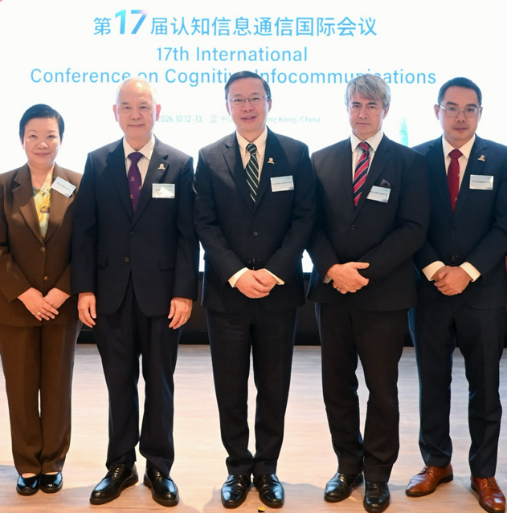
CogInfoCom 2026 – Conference Organizers and CUHK Leadership (from left to right):
Prof. Helen Meng – General Chair of CogInfoCom 2026; Director, CUHK CPII
Prof. Yeung Yam – General Chair of CogInfoCom 2026; Director, CUHK Shenzhen Research Institute (SZRI)
Prof. Anthony Chan – Pro-Vice-Chancellor and Vice-President, CUHK
Prof. Peter Baranyi – General Chair of CogInfoCom 2026; Head of the Cognitive Infocommunications Research Center, Corvinus Institute for Advanced Studies (CIAS)
Dr. Huangquan Lin – Executive Director, CUHK Shenzhen Research Institute (SZRI)