Joint research project on the future of AI-driven organizations
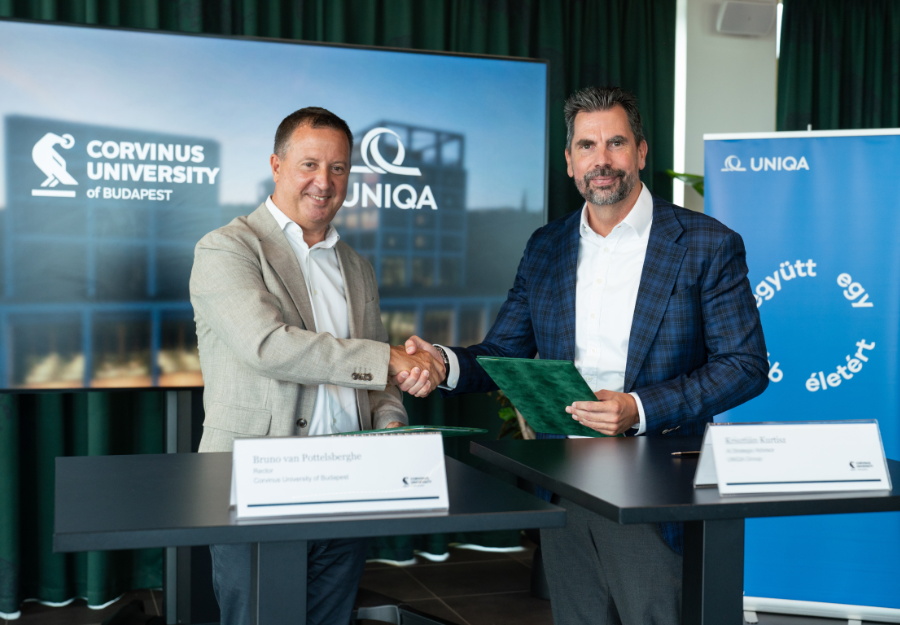
The agreement was signed on 2 September 2026 at Corvinus University of Budapest by Krisztián Kurtisz, CEO of UNIQA Biztosító, and Bruno van Pottelsberghe, Rector of Corvinus University of Budapest. The project will examine how artificial intelligence can support the transformation of corporate operations and what new organizational, leadership, HR and governance approaches are required for the successful implementation of AI-driven ways of working. The research is based on the recognition that the adoption of artificial intelligence is not merely a technological issue but also a catalyst for profound changes in organizational structures, leadership roles and the nature of work itself. The collaboration was established with the involvement of Corvinus- SEED, the university’s executive school and gateway to the corporate sector.
At the heart of the research is NiQA, UNIQA’s AI-powered virtual assistant, which supports automated claims handling processes. NiQA assists the end-to-end claims journey, from claim reporting and document processing to claims assessment, decision-making and, in certain cases, payment execution.
The study goes beyond the evaluation of a specific technology. It seeks to understand how job roles, competency requirements, leadership responsibilities and the conditions for effective human-AI collaboration evolve in organizations where artificial intelligence becomes increasingly embedded in business processes. The research also aims to identify how AI can be leveraged in ways that simultaneously enhance operational efficiency, improve customer experience and support successful collaboration among employees.
“Investigating the impact of artificial intelligence is one of the important responsibilities of universities, and Corvinus is committed to being at the forefront of this field. Our joint project with UNIQA reinforces this ambition. Beyond its immediate scope, the outcomes of the research may also provide valuable insights into the future of work, helping us better understand the conditions necessary for successful AI-driven transformation,” said Bruno van Pottelsberghe, Rector of Corvinus University of Budapest.
“The successful introduction of artificial intelligence is primarily an organizational and leadership challenge rather than a technological one. The true value of AI lies not merely in performing individual tasks more efficiently, but in its ability to fundamentally reshape how companies operate. Through the development and implementation of NiQA, we have learned that success depends not only on the technology itself, but on how we redesign processes and prepare leaders and employees for new ways of working. This is why our collaboration with Corvinus is particularly important. Through scientific rigor and independent research, it can help identify the human, leadership and organizational factors that underpin the success of AI-driven organizations,” emphasized Krisztián Kurtisz, CEO of UNIQA Biztosító.
Preparatory work for the project began in April 2026, while the first phase of data collection ran from June until mid-August. The research team is employing a mixed-methodology approach, including literature and corporate document reviews, executive interviews, employee focus groups, survey-based research and business impact analysis. The first research reports are expected to be delivered in autumn 2026.
The findings are expected to support evidence-based decision-making related to AI-enabled operating models, including the design of appropriate governance frameworks, the identification of key leadership capabilities and the effective management of organizational change. The collaboration is closely aligned with UNIQA’s long-term digital transformation strategy, which aims to simplify processes, further enhance customer experience and develop innovative operating models in which technology and human expertise work together to create sustainable value.
Corvinus University of Budapest’s long-term objective is to address pressing economic and societal challenges through partnerships that connect academic knowledge and business experience. The university has established strategic collaborations with numerous companies and institutions across research, innovation, education and knowledge transfer. These partnerships enable Corvinus researchers to provide scientifically grounded answers to real-world business challenges while creating tangible value for students and corporate partners through the integration of academic excellence and practical expertise.