José Lobo’s Visit to Budapest: Urban Sustainability, Innovation and New Research Connections
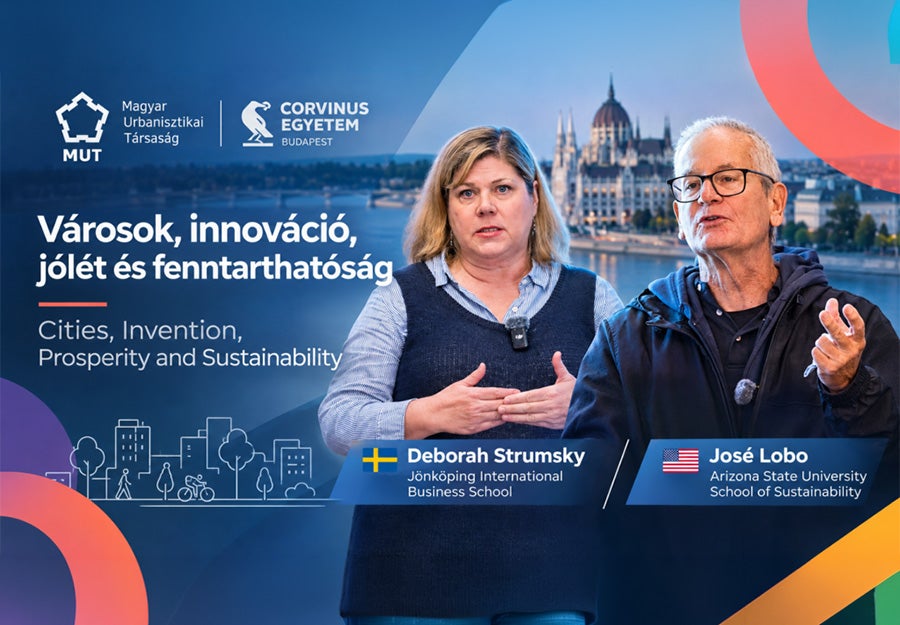
The internationally recognised scholar’s visit brought together researchers, faculty members, students and urban-planning professionals for two well-attended public events and a series of academic discussions on urban development, innovation and sustainability.
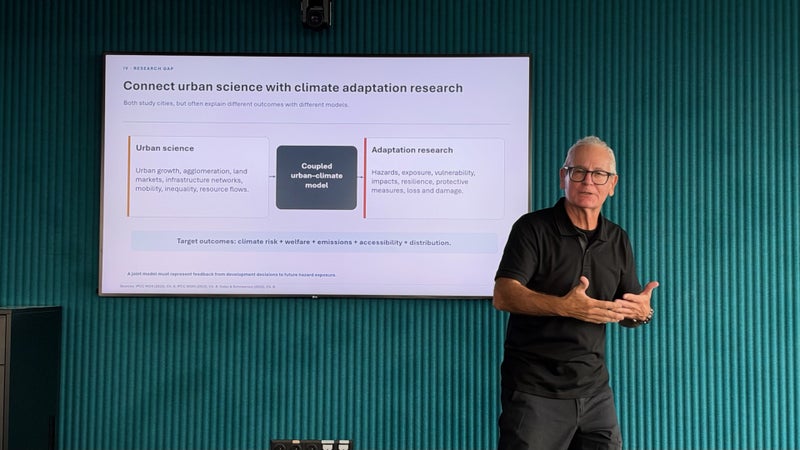
On Monday, 9 November, Lobo delivered a research seminar at Corvinus University’s Gellért Campus, titled “Sustainable Urban Development and Urban Adaptation to Climate Change: Does AI Help?” The participants heard a wide-ranging, in-depth examination of how artificial intelligence could connect urban science with climate-adaptation research. Drawing on Phoenix and the American Southwest, Lobo discussed extreme heat, water scarcity, energy systems, housing, relocation and the difficult choices facing urban policymakers. Numerous vivid stories, personal experiences and occasionally humorous examples illustrated the practical implications of his arguments.
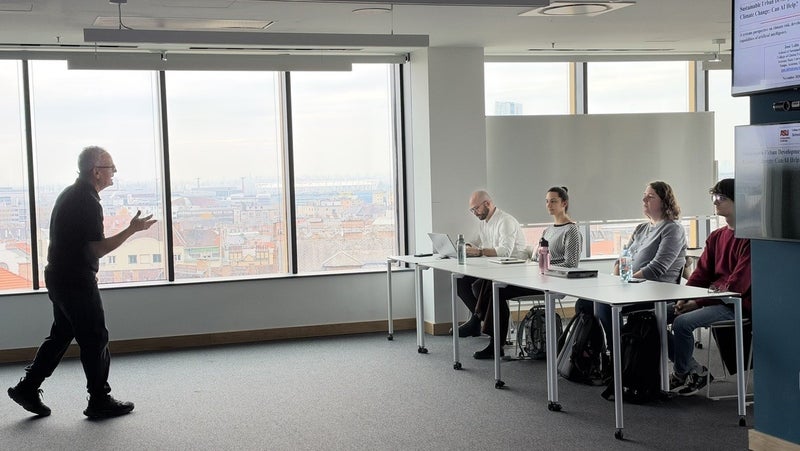
A central message was that increasingly sophisticated models and AI-assisted data analysis do not, by themselves, lead to effective urban decisions. Researchers must also understand institutional capacity, distributional consequences and the trade-offs between economic development and climate resilience. The presentation stimulated a lively discussion, extending to changes in the practice of scientific research and the role of AI in universities.
On Thursday, 12 November, a second event, “Cities, Invention, Prosperity and Sustainability”, attracted a substantial audience to the Hungarian Society for Urban Planning. Jointly organised by the Society and Corvinus University, it featured Lobo alongside Professor Deborah Strumsky of Jönköping International Business School. Strumsky explored why invention remains so strongly concentrated in cities: according to her findings, around 93% of patents worldwide originate in urban areas, while 10 US metropolitan regions account for nearly half of American inventions and approximately 62% of AI-related inventions. She emphasised the importance of face-to-face interaction, diverse knowledge networks and combining existing ideas in new ways.
Lobo, in turn, examined a central paradox of sustainability science: its remarkable success as an academic field has not been matched by comparable influence on public policy and everyday practice. He argued that sustainability cannot be framed simply as a restriction on growth, especially where employment, poverty reduction and rising living standards remain urgent priorities. Referring to energy transitions, infrastructure investment and the uneven distribution of costs, he called for approaches that advance environmental objectives, economic opportunity and human well-being together. Both speakers developed their arguments in depth, drawing on empirical findings, memorable examples and stories from their research experience; an animated professional exchange followed.
Beyond the public talks, discussions with various university leaders, faculty members, and researchers during the visit explored potential future research collaborations in sustainability, urban studies, urban development, and climate adaptation. The exchanges identified shared interests and promising directions for collaboration between Corvinus University, Arizona State University, and their wider academic networks.