Sustainable tourism or growth? Both goals can be achieved together
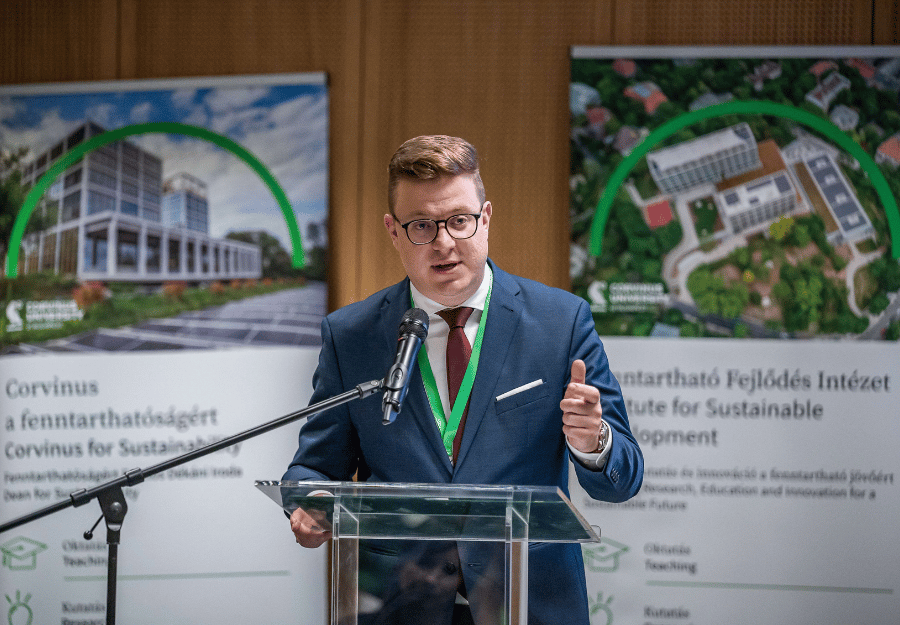
As part of its ESG Overview research series, the Institute of Sustainable Development at Corvinus University of Budapest organised a professional conference entitled Sustainable Tourism or Sustainable Growth? ESG Challenges in the Hungarian Hotel and Tourism Sector on Friday, 20 November 2026. University researchers, tourism professionals and leading representatives of the hotel industry gathered to discuss the sector’s sustainability challenges.
In her opening remarks, Dr Katalin Ásványi, Corvinus University’s Dean for Sustainability, noted the significance of holding the event at the Gellért Campus, the University’s most sustainable building. Is sustainability a cost, an obligation or a competitive advantage? As the Dean emphasised, these were the questions the conference sought to address. She added that the University actively encourages its students to embrace sustainability.
Welcoming participants, Dr Attila Jámbor, Head of the Institute of Sustainable Development at Corvinus, explained that three years ago the Institute had decided to place particular emphasis on environmental, social and governance (ESG) requirements. Since then, several hundred students have graduated from the University having studied this important framework.
In his remarks, Botond Boros, CEO of Visit Hungary, emphasised that tourism and sustainable development are inseparable. He illustrated this with an example: sustainable tourism involves much more than changing hotel towels less frequently. Careful attention must also be paid to energy consumption.
“ESG is reflected in the financial accounts as well. It is a practical consideration that directly affects revenue. Energy costs, for example, have risen dramatically in recent years, making energy efficiency essential,” said Balázs Kovács, Vice-President of the Hungarian Hotel & Restaurant Association.
He argued that sustainability and competitiveness can go hand in hand, highlighting the optimisation of water consumption as an example. Kovács also stressed the importance of the human factor: employees are the ones who deliver an excellent guest experience.
“That is why how we treat our colleagues matters. Employers should be ethical, stable and attractive to their employees,” he explained.
Book launch featuring a tourism ESG index and interviews with hotel managers
Dr Gábor Harangozó, Professor at the Institute of Sustainable Development at Corvinus, introduced the publication presented at the conference, which is freely available online in the University’s repository.
A key feature of ESG Overview 2026: Focus on Sustainable Tourism (in Hungarian) is an analysis based on the Opten ESG Index, which assesses the ESG performance of businesses in the tourism and hospitality sector. The index evaluates companies on a ten-point scale using more than 75 variables.
According to Harangozó, who is also one of the publication’s authors, a company’s financial stability is positively associated with its ESG performance: “Those who perform well in one area may also perform well in the other.” He added that it is essential for every tourism business to measure and understand its own ESG performance.
Dr László Kökény, Head of the Department of Tourism at Corvinus and one of the book’s authors, explained that tourism businesses now need measurable data and certification to substantiate their sustainability claims.
The EU’s current objective is to focus mandatory and detailed sustainability reporting on the largest companies, whose economic significance, resources and value chains generally entail greater sustainability impacts, risks and reporting capacities. As a result, reporting obligations apply to a narrower group of businesses, simplifying EU requirements.
One particularly valuable and engaging section of the publication consists of nine interviews conducted in summer 2026 with senior managers of hotels in Budapest and other parts of Hungary. The interviews explore sustainability measures already implemented and the challenges that lie ahead.
As Dr Kökény, one of the book’s editors, explained, the interviewees were selected to reflect the diverse operational characteristics of Hungary’s five-star hotel segment. The publication features managers of hotels in both Budapest and the regions, including properties housed in historic buildings and newly constructed hotels, as building characteristics also play an important role in energy supply and consumption.
The human side of ESG
Kökény also emphasised the importance of the human dimension of ESG, a topic explored extensively in the publication. “Happy employees will hopefully lead to happy guests,” he said.
He also highlighted the importance of digital infrastructure and visibility. The guest journey now typically begins with an online search, and even seemingly minor details deserve attention. For example, slow-loading images on a hotel’s website can increase its carbon footprint.
During the discussion, a participant asked Dr Kökény whether guests actively seek out green and sustainable accommodation. His response suggested that sustainability is generally not the primary motivation when choosing a hotel, but it can influence decisions between otherwise similar options.
“Most guests only request fresh towels every three days, although there are exceptions, such as guests at five-star hotels who ask for towels to be changed several times a day. I once stayed at a hotel in Amsterdam where guests who requested less frequent towel changes received a voucher they could exchange for a beer,” he recalled.
Eliminating 109 tonnes of food waste
The panel discussions explored different segments of the tourism industry, with several participants also featured as interviewees in the publication. During the first panel, Lívia Szabóné Pintér, Master Lecturer at Corvinus, asked participants what role ESG plays in a hotel.
“ESG is essentially a colleague who is present everywhere in the hotel, 24 hours a day. It has no boss, it learns a lot, and we learn from it too,” said Ádám Zakharides, Rooms Division Manager at the Radisson Collection Hotel Basilica in Budapest.
The moderator then invited the panellists to present their most important ongoing ESG projects.
Zsófia Nádor, Deputy Director of the Anantara New York Palace Budapest Hotel, discussed the hotel’s approach to composting food waste. The property faces a particularly challenging situation due to its proximity to the legendary New York Café, which welcomes around 2,500 guests daily, including hotel guests.
This generates substantial quantities of food waste. However, the hotel has partnered with a company specialising in food-waste composting. The process takes six weeks and enables the waste to be fully processed. This year, the amount involved reached 109 tonnes.
To illustrate the scale, Nádor explained that this is approximately equivalent to the weight of 100–110 cars. The hotel also works to educate guests about ordering appropriate quantities of food.
À la carte service is better than a buffet
Tamara Lencsés, Deputy Director of Hotel Essence, described a different set of challenges and solutions. Located in Pogány, near Pécs, the hotel is an independently developed premium property whose ESG approach is primarily shaped by the owners’ philosophy rather than international standards. “The expectations of guests at a five-star hotel and the local labour supply are far apart,” she explained.
The hotel has 92 rooms and employs between 65 and 70 people. Lencsés said she had been surprised by the labour market situation in Baranya County: unemployment is increasing, yet there is a shortage of qualified professionals. As a result, the hotel trains its own employees to meet the required standards, including developing the skills needed for specialist roles such as sommeliers.
She also stressed that, despite the prevalence of undeclared employment in the county, the hotel employs all its staff legally.
Guests sometimes need educating too. Their initial reaction to the hotel’s dining arrangements is often that there is “not enough food”. However, the hotel is committed to reducing food waste and continues to serve plated dinners rather than offering a buffet, which would generate considerably more waste.
The hotel also prioritises regional cuisine rather than competing through exotic seafood dishes.
A significant advantage is its 500 kW solar park, which delivers substantial savings while supporting environmentally responsible operations.
Choosing from 141 webpages
The second panel discussion, entitled Sustainable Destinations and Responsible Tourism, was moderated by Gergely Ferenczi, Director of Opten’s Business Information Division. György Huszics, co-founder of Carbon.Crane, emphasised that digitalisation now has a major influence on travel, with 70–80% of bookings made online. Travellers typically begin researching destinations around 45 days before departure and browse an average of 141 webpages before making their decision.
Huszics explained that reducing the digital carbon footprint is an important objective, and companies can contribute by optimising their websites with sustainability in mind.
He also suggested that travellers could occasionally delete some of the many photographs taken during their holidays, as storing digital images also requires energy.
Bianka Benkő, founder of the travel agency No Planet B Travel with B, organises ethical travel experiences. Her guests frequently visit businesses run by local women and spend money there, for example in Zanzibar.
In her view, travelling has become almost as essential a need as eating. She expects the number of travellers seeking sustainable experiences to increase and believes that such journeys can help visitors understand the value of supporting products made by disadvantaged women.
Katalin Török