Book launch: The Digital Transformation of Tourism
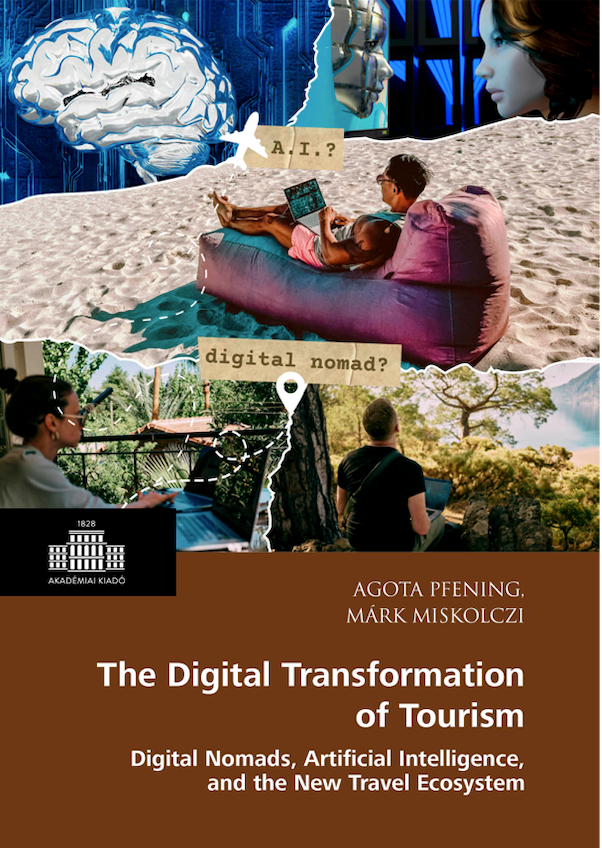
The book examines the digital transformation of tourism through two closely interconnected phenomena: digital nomadism and artificial intelligence (AI). It is published by Akadémiai Kiadó on the MeRSZ platform as part of the Tourism and Mobility book series. The book was peer-reviewed by Professor Melinda Jászberényi and Professor Jhanghiz Syahrivar.
The launch was jointly organized by the EMOK Tourism Marketing Section and the Corvinus Centre for Transport Studies (CCTS).
The event was opened by Professor Ádám Csapó, Dean for Artificial Intelligence at Corvinus University of Budapest. He began with a personal story: a conversation with AI during a flight had convinced him that the toolkit travelers use to gather information has been radically transformed. He recalled that tourists once relied mainly on guidebooks and later had to review dozens of websites to piece together a coherent picture and itinerary. Today, AI acts as a personal assistant and interpreter that greatly supports this work, and in some cases takes it over entirely. According to the dean, the number of digital nomads keeps growing, and this trend will only accelerate as AI develops.
In her welcome address, Professor Melinda Jászberényi, head of the EMOK Tourism Marketing Section and editor of the book series, noted that the series now includes 30 titles. She added that the new book will be one of the core texts of the English-language tourism specialization launching in September 2027, and that a Hungarian edition is planned for spring 2027.
The two authors each presented one part of the book in a short talk. Ágota Pfening spoke about digital nomadism and how it is reshaping the relationship between work, mobility, and destinations. Márk Miskolczi introduced the chapters on artificial intelligence and also touched on the bridge chapter that links the book’s two parts. He highlighted the many new concepts and AI-related changes in the field that the book introduces, and stressed its value for teaching: the chapters include review questions, glossaries, and seminar assignments. The book’s practical value is further strengthened by its managerial takeaways and case examples.
Roundtable: AI search, digital catch-up, and livable rural areas
The roundtable on the digital future of tourism was moderated by Tamás Iványi, assistant professor at the Budapest University of Technology and Economics (BME). The panelists were Pál Bíró, Director of Google Hungary; Botond Boros, CEO of Visit Hungary; Mirkó Petényi, Managing Director of the Active Hungary Development Center; and Professor Ádám Csapó, Dean for AI.
Life situations instead of keywords. According to Pál Bíró, users now run longer, more complex searches that describe a specific life situation and expect equally complex answers. He expects that AI will soon do more than help with planning: it will organize and book an entire trip in an instant. Mirkó Petényi added that 60–70 percent of users no longer click through on a traditional Google search but get their information from the summary on the results page, and hikers use this feature eagerly too. Service providers and destinations therefore need to create high-quality, structured content that AI search tools can easily process: “we need to be able to imagine what our future guests will search for.”
Small businesses falling behind. The panelists agreed that for Hungarian small and medium-sized enterprises (SMEs), the priority right now is not a complex AI strategy but basic digital skills. Botond Boros pointed out that many providers do not even have their own website, so AI cannot find them. In his view, they need training programs that put concrete, practical tools in business owners’ hands. Mirkó Petényi considers changing mindsets the most important task: smaller providers need to understand that digitalization is key to their survival and competitiveness.
Digital nomads and the countryside. Pál Bíró noted that thanks to good network coverage, people in Hungary can work effectively from anywhere, including rural areas. Botond Boros emphasized that livability matters most to digital nomads: whether there are kindergartens and schools for their children, what healthcare and transportation are like, and where they can take care of official paperwork. As a result, smaller towns and rural regions are gaining value. Mirkó Petényi recalled the impact of the pandemic: many people kept their jobs in Budapest while their lives and their place of work moved to the countryside.
The role of the university. Ádám Csapó said that in addition to providing a scientific foundation, universities must also develop skills that students need in the job market. To this end, Corvinus brings many outside experts into its teaching and researches the impact of AI together with its students. Highly skilled digital nomads are also worth involving in university life through guest lectures and workshops. When it comes to AI, he argued, the main question is not which platform we use, but what we are able to do with it.
Availability: The Digital Transformation of Tourism is now available on Akadémiai Kiadó’s MeRSZ platform, and a Hungarian edition will follow.