Equity risk across horizons in 150 years of UK data
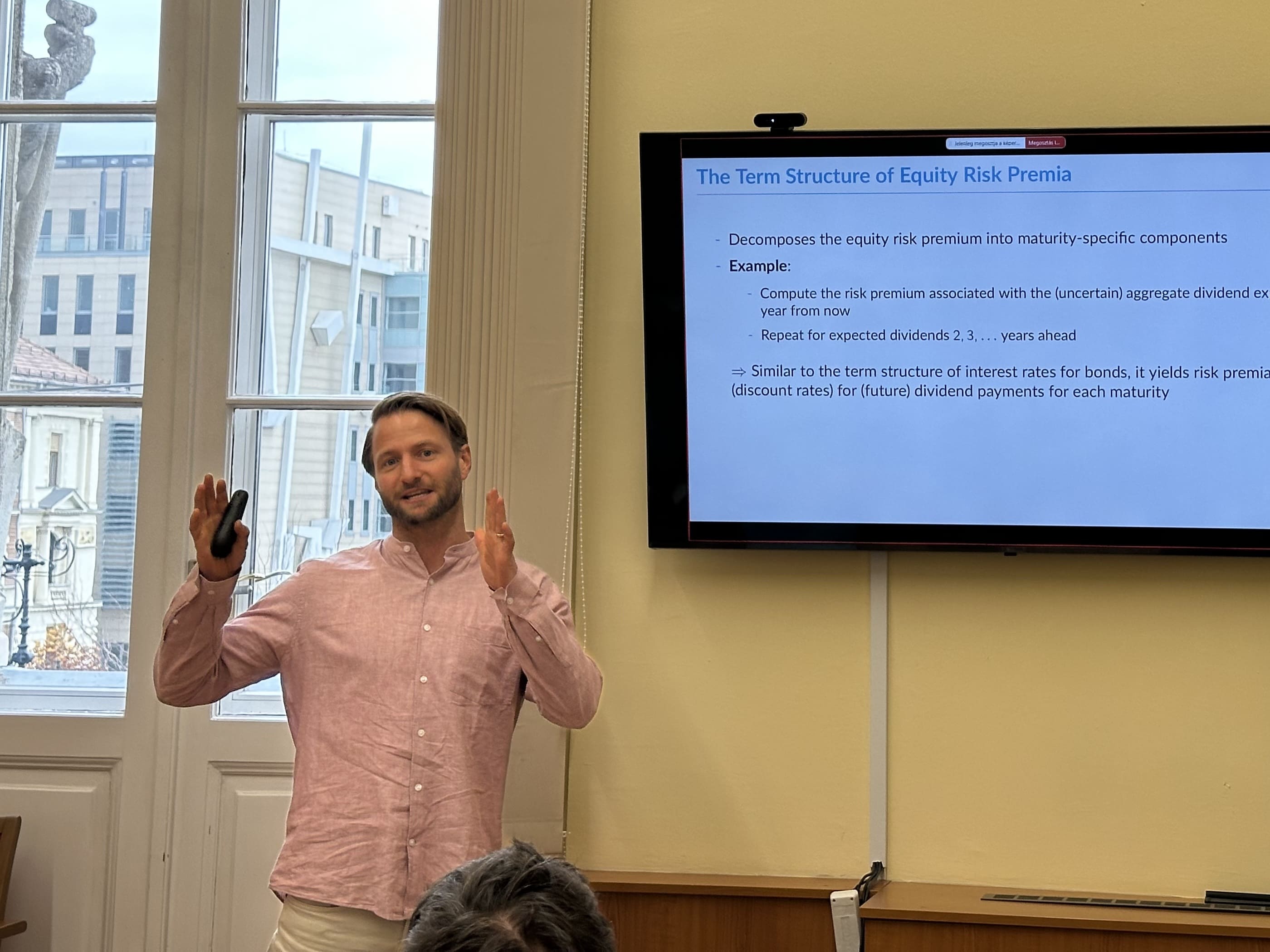
On 9 November 2026, the Institute of Finance at Corvinus University of Budapest hosted Professor Ole Wilms of the University of Hamburg for a research seminar titled “Financial Integration and the Equity Term Structure: Insights from 150 Years of UK Data.” Wilms presented joint work with Jens Soerlie Kvaerner and Jan Sandoval.
A government bond yield curve shows how yields vary with the time until repayment. A similar curve for stocks shows how much extra return investors expect, above the risk-free rate, for bearing the risk of dividends they might receive in one year, ten years or 30 years. This is the idea behind the equity term structure.
Using UK equity data from 1870 to 2019, the researchers estimated that the annualised equity risk premium averaged about 2.5% at one year and 4.6% at 30 years. In recessions, the curve flattened because short-term premia rose more than long-term premia. From 1980 onward, the curve was steeper because short-term premia fell more than long-term premia.
The authors proposed an international asset pricing model to explain the shift from 1980 onward. In the model, greater financial integration lets investors share more risk across borders. This cushions the impact of local shocks and reduces the premium on near-term dividends more than the premium on dividends further in the future.