Corvinus at COP31: international climate policy dialogue, student engagement and a new research partnership
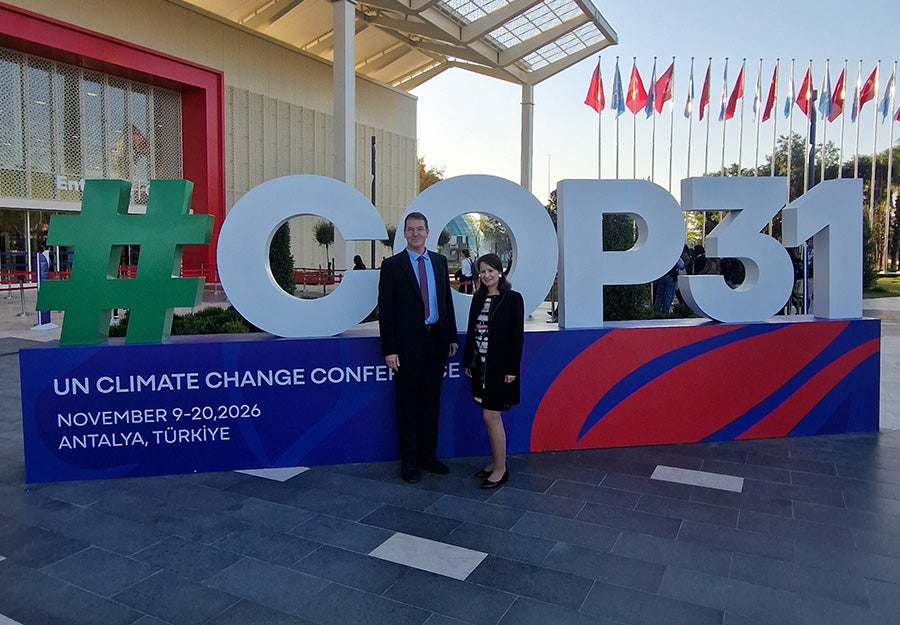
Three representatives of Corvinus University of Budapest attended the 31st United Nations Climate Change Conference (COP31) in Antalya, Türkiye. At the conference, Corvinus faculty members and a doctoral student took part in discussions on global sustainability challenges, while Corvinus and India’s CHD Group signed the first official international cooperation agreement of the university’s CORR research centre. The Corvinus doctoral student also represented European students involved in responsible management education at one of the world’s most important climate policy events.
Held from 9 to 20 November, COP31 brought together government leaders, international organisations, researchers, businesses and civil society organisations. The conference focused on emission reductions, the transition to clean energy, climate change adaptation and climate finance. Alongside the political negotiations, numerous professional events explored how global commitments could be translated into concrete economic and social action.
Corvinus was represented by Katalin Ásványi, the university’s Dean for Sustainability; Attila Wieszt, Co-Director of the Centre for Organisational Realities and Renewal (CORR); and Ben Rahma Lazreg, a Corvinus doctoral student and European Student Leader of the Principles for Responsible Management Education (PRME).
The sustainability transition also requires leaders with a new mindset
One of the key lessons of the conference was that technological solutions alone are not enough to address climate change. Changes in economic incentives, financing mechanisms, organisational practices and decision-making processes are equally important. The implementation of climate policy goals is often hindered not by a lack of solutions, but by conflicting economic interests, institutional capacities and social priorities.
“At COP, it is particularly clear that the sustainability transition is not only an environmental or technological issue, but also an economic, managerial and social challenge. As a university of economics and business, we have a particular responsibility to prepare our students to deal with these complex problems. This is why we are working at Corvinus to ensure that sustainability is part not only of individual courses, but of the entire student experience. We also want to bring back from the conference not only new knowledge and contacts, but also experiences that we can directly incorporate into teaching and research,” said Katalin Ásványi.
The issues discussed at the conference are closely related to Corvinus’s teaching and research activities in sustainable economic transition, ESG, responsible business practices and organisational adaptability.
Corvinus doctoral student representing european students
Ben Rahma Lazreg, a Corvinus doctoral student and PRME European Student Leader, attended the conference in cooperation with Tunisia’s Ministry of Environment, taking an active part in several international professional events.
At the Portuguese Pavilion, Rahma shared insights on the relationship between scientific research and corporate climate action during the roundtable discussion Bridging Science and Business for Climate Action. At the Francophone Pavilion, Rahma presented the PRME Students initiative.
Rahma’s doctoral research examines institutional differences and the legitimacy of climate policy measures. COP31 provided a valuable opportunity to connect these research questions with the practice of international climate policy and engage directly with people involved in decision-making.
Rahma’s participation demonstrates that Corvinus students can not only study global sustainability challenges but also actively contribute to shaping international professional dialogue.
From global goals to local action
The experiences gained at COP31 reinforced the important role universities play in the sustainability transition. Universities not only create new knowledge but also prepare future decision-makers, connect research with practice and set examples through their own operations.
For Corvinus, the conference offered opportunities for international networking and research, as well as inspiration for further developing its teaching activities.
A new international research partnership
The conference also brought a concrete institutional outcome: the Centre for Organisational Realities and Renewal (CORR) at Corvinus and India’s CHD Group signed the research centre’s first official international memorandum of understanding (MoU).
The Indian NGO, which works on public health and sustainable development, made the conference participation of Katalin Ásványi and Attila Wieszt possible through its invitation and support.
The partnership builds on existing research collaboration
The two organisations had already started working together before COP31. Researchers developed a teaching case about Dr Edmond Fernandes, founder of CHD Group, and the Indian NGO he established. CHD primarily works on healthcare for disadvantaged communities, disaster preparedness and the health impacts of climate change.
Based on interviews and organisational data, the teaching case examines a specific strategic dilemma: how can a mission-driven organisation ensure its long-term financial sustainability without compromising its mission or the trust of the communities it serves? The case allows students to examine the benefits and risks of different financing and organisational options through a real-world decision-making situation.
Joint research and international educational opportunities
The new agreement aims to expand joint research activities, particularly in social and sustainable entrepreneurship, organisational development, leadership and community development. Plans include further research based on CHD programmes and data, international academic publications, teaching cases and policy analyses, as well as joint research grant applications.
The partnership also offers new opportunities for Corvinus students and researchers. Master’s and PhD students may take part in research visits to India, where they can conduct field research, programme evaluations and social impact assessments. The agreement also provides a framework for reciprocal research visits, guest lectures and joint doctoral workshops.