The Power of ‘Enough’ – Resource Conservation and Conscious Choices for the More-than-Human World
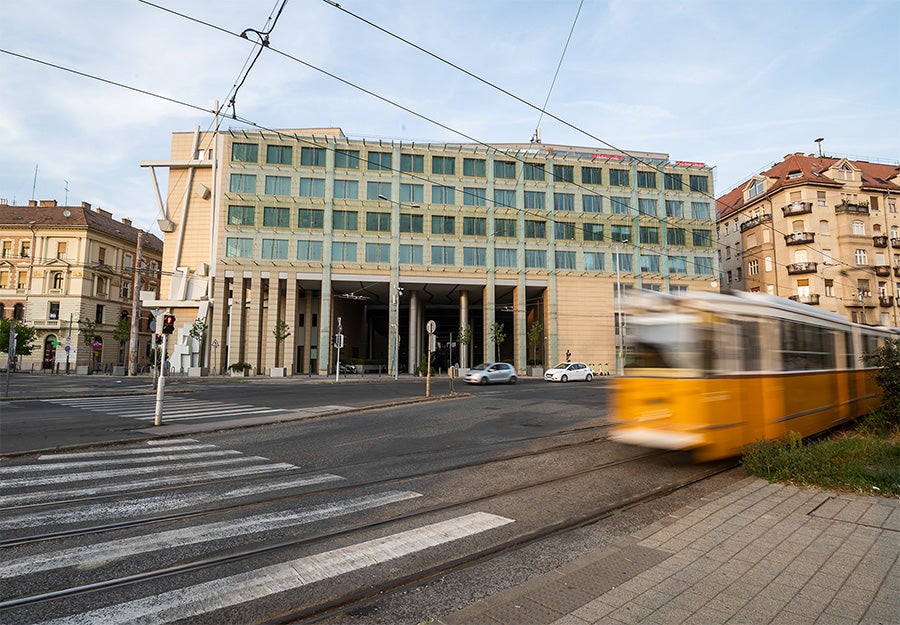
Venue: Corvinus University, Building C, 1st floor, University Library (Budapest, Közraktár u. 4–6, 1093)
Language: Hungarian
Facebook event: at this link
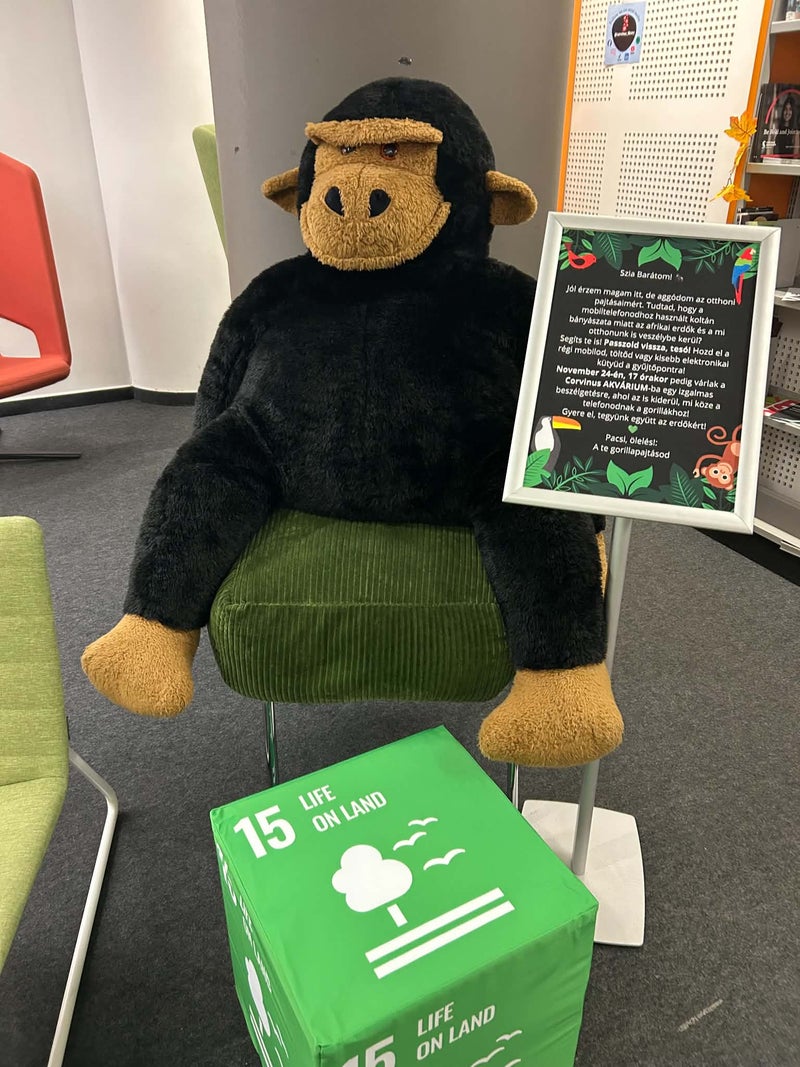
Hello, my friend!
I’m having a great time here! The sun is shining, there are lots of young people around, and everyone has been really kind to me. But sometimes I do think about home and worry about my friends there.
Did you know that your mobile phone contains a mineral called coltan? Because of the mining of this mineral, more and more forests in Africa are disappearing, and our home is under threat too.
But here’s some good news: you can help us, too!
Spread the word, everyone! Bring your old mobile phones, chargers, and small electronic gadgets to the collection point. This will help ensure that fewer new raw materials are needed and that more of our forests are left intact.
I’ve also got another invitation for you!
Meet us at 5 pm on 24 November in the Corvinus University library. There will be an exciting Hungarian-language round-table discussion revealing what your mobile phone has to do with African rainforests and how we can work together to help the gorillas.
You’ll come, won’t you? I’ll be there! Your old mobile phone could give us new hope!
With lots of gorilla hugs,
Your gorilla friend
Pass it back, Buddy!
Why do we need to recycle mobile phones? The metal tantalum is extracted from an ore called coltan. It is used to make coating for capacitors, which is why it can be found in mobile phones, laptops, GPS devices, and tablets. Eighty per cent of the world’s coltan reserves are found in Africa, with a large proportion of this in the Democratic Republic of the Congo (DRC). This is the same region where mountain gorillas, Grauer’s gorillas, bonobos, and chimpanzees live. Mining is drastically altering their habitats. Forest cover is shrinking, and what remains is crisscrossed by a network of roads used for extraction – and this is just one example of the severe environmental cost of our technological progress, even when it comes to renewable energy sources.
That is why the focus of the 2026 European Week for Waste Reduction is Material sufficiency. It encourages us to design more consciously, choose and use our resources wisely, use our products for longer, and then recycle them. This reduces the demand for new raw materials. If we choose to be content with what we have, there will be enough for tomorrow – not just for us, but for future generations and all living creatures.
In addition to having these discussions, it is crucial that we start acting ourselves, one small step at a time. That is why we have joined the Jane Goodall Institute’s ‘Pass it on, buddy’ campaign, which has been running for several years; from now on, we will also be collecting discarded mobile phones at the Corvinus Library. The campaign aims to recover valuable materials (such as gold, silver, cobalt, tantalum, and coltan) found in electronic devices through a closed-loop system in partnership with a trusted organization.
How can we transform our economic and social systems so that our decisions are guided by genuine needs rather than ever-increasing and unsustainable demands at the individual, community, corporate and societal levels? How can we reassess the material flows necessary for human activity, taking into account the environmental impact from mining to waste disposal? Is it enough to simply close the loop in a circular economy without questioning the growth paradigm?
On Tuesday 24 November, we will be discussing this topic from 5.00 pm at the Corvinus Library, in Hungarian language. We will be exploring it together with two civil society organizations and community partners, as well as our expert colleagues.
-
András Kádár, Director of the Jane Goodall Institute, will discuss the significant environmental impact of mining rare-earth metals, which are crucial for our technological devices, on the unique natural environment and the lives of gorillas, chimpanzees, and bonobos in the Congo Basin. He will also talk about the work of the Institute through the Roots & Shoots program, which supports local human and more-than-human communities.
-
Viktória Doró, representing the PET Cup, will discuss how these materials pose a serious problem for local ecosystems, such as the wildlife of the River Tisza, when products become waste at the other end of the linear material flow. She will also talk about the work of the ‘PET Pirates’, who clean up the waterways and floodplains year after year to reduce this burden.
-
We will also be joined by Alexandra Köves, an ecological economist and Associate Professor at Corvinus University, who is also the president of the European Society for Ecological Economics. We will discuss degrowth, the difference between desires and necessities, and the potential of alternative economic models – a subject currently being explored in an international research project called MAPS, in which Corvinus colleagues are participating.
-
Meanwhile, Máté Kovács, a former student of ours who is now a member of the staff at Corvinus University’s Office of the Dean for Sustainability and a student on the Human Ecology program at ELTE, will speak about the relationship between humans and nature, the consequences of this artificial separation and why it is important to move beyond it. This could be key to creating a new, nature-based socio-economic paradigm.
10 challenges: What can we do in our own lives to use materials more responsibly?
1. Take part in the Corvinus Library’s programme for European Week for Waste Reduction, which will focus on the responsible use of materials and reducing the environmental impact of material flows! Event: soon
2. Bring your broken or unused mobile phone or tablet to the collection point at the Corvinus Library (with data deleted and the device switched off) and join the Jane Goodall Institute’s ‘Pass it on, mate’ campaign!
3. Take a look at the Hungarian page for the 2026 European Week for Waste Reduction campaign to find an event near you that you would like to take part in or that conveys a message you find compelling.
4. With the festive season just around the corner, take a moment to think about what you’ll genuinely need during this time and make a list. Stick to this list to avoid impulse buying!
5. The Black Friday period is full of adverts and campaigns encouraging you to buy things you don’t need. That’s precisely why you should designate a ‘buy nothing’ day during the last week of November! How difficult was it to resist those tempting purchases?
6. Before the festive season begins, take a moment to think about – or even discuss with your friends in advance – what sort of quality time you could spend together instead of giving each other unnecessary gifts! This could be a walk in the woods together, a community concert, or some other kind of experience. Bear in mind that even non-material gifts can have a significant environmental footprint!
7. Use the calculator provided by CarbonCrane – a partner organisation involved in our university’s teaching programme – to work out the carbon footprint of your social media use, then find out how the activities of companies specialising in social media and artificial intelligence are linked to harmful environmental impacts. What do you think the companies operating these apps should be held accountable for?
8. Have a look around on Beeco’s eco-map, where you can find environmentally friendly, packaging-free, circular and sustainable venues – which might even help with your festive preparations!
9. Check out the programme for the Bolygó Community Space’s series of events – Make Something Week is a celebration of creativity, connection and experiences that truly make us happy, strengthen our communities and empower us to bring about change!
10. What is the one key message you’ve learnt from this month’s challenges and events? Share this with your family and friends and think together about what small changes you could make together in your own communities!