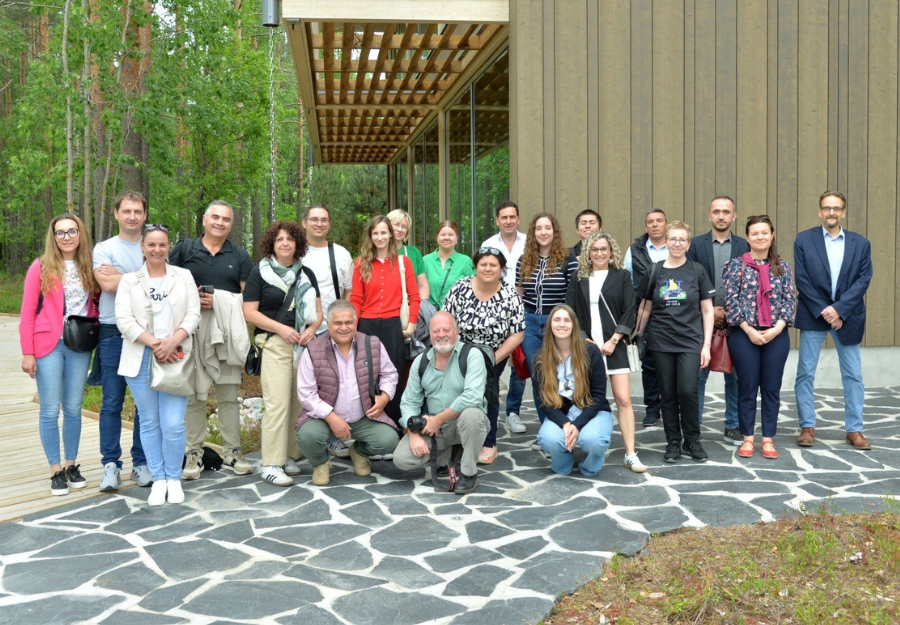
17th March, 2026, Budapest Seminar of the project “Changing Role of Secondary Cities in the Polycentric Development of Visegrad Countries (SECPOLYC)” funded by the International Visegrad Fund
Report of the seminar
1. Background
Between March 16–18, 2026, Corvinus University of Budapest hosted the closing event of the SECPOLYC project (“Changing Role of Secondary Cities in the Polycentric Development of Visegrad Countries”). On the 16th and 18th, the teams from the participating universities, 10-20 people each, held an introductory workshop, site visits, and a progress meeting on the project’s activities. On the 16th, the lecture by Edvard Glaser, the world-famous urban scientist from Harvard University, was also included in the SECPOLYC events’ agenda. The seminar on the 17th was a public conference open for wider audience.
The aim of the conference was to summarise the project’s results so far, share experiences, and discuss future directions for polycentric urban development in Central Europe with academics, planning and policy practitioners. The conference was organised by Corvinus University of Budapest and the Hungarian Urban Planning Association, in cooperation with the three partner universities, University of Wrocław, Pavol Jozef Šafárik University in Košice, and the University of South Bohemia, with support from the International Visegrad Fund.


2. Research objective and goals
The project examined the possible shift toward a polycentric development model in Central European countries. The focus was on the development and growth challenges faced by the secondary cities (e.g., Brno, Łódź, Wrocław, Košice, and Debrecen) in the Visegrád countries (the Czech Republic, Poland, Slovakia, and Hungary). The study examined to what extent these cities can help make the country and the entire Central European region more polycentric, thus more sustainable and economically and socially balanced, by exploring their role in regional development. As part of the project, workshops, consultations, and empirical research were conducted with relevant stakeholders in the major secondary centers of the participating countries. The project’s mission is to support effective policies and regional and urban planning by generating new evidence, initiating policy dialogue, and preparing for collaboration within the region.
3. Agenda
More than fifty-five participants attended the conference, representing almost equally both the policy and planning sectors as well as the academic community (twenty-six and thirty-one participants). Apart from the Hungarian attendees, notable international communities from the Czech Republic, Slovakia, and Poland have also joined the conference (nine, six, and four delegates, respectively).


4. Plenary lectures
The conference was opened by Tamás Bartus, Professor and Vice-Rector for Faculty and Research of Corvinus University of Budapest. As a leading higher education institution, Corvinus aims to contribute to solving major social issues. It has seen internationalization in recent years, both in research and among students, with a diverse, globally connected group. This extends to strengthening academic collaboration within V4, which is a key goal, as universities have responsibilities that extend beyond borders. There are strongly monocentric development patterns in the region, and many secondary cities cannot realize their potential; the enthusiastic group of economic geographers at Corvinus has contributed greatly to these academic debates. The focus is on supporting more balanced and sustainable development, inspiring future research, and strengthening the international academic network and collaboration.

Tamás Bartus, Vice-Rector for Faculty and Research of Corvinus University of Budapest
The second conference opener, György Alföldi, President of the Hungarian Society for Urban Planning, stated that the main challenge our nations face is monocentric development, which depends on their ability to address inequalities and developmental imbalances. At his university, the Budapest University of Technology and Economics, their focus on urban future planning directly relates to this issue. The swift transformations of the 21st century have posed significant challenges for our countries; secondary and tertiary cities are experiencing difficulties, including population decline and stalled economic growth. The question arises: are centralized measures and institutions necessary? The answer lies at the local level, specifically, in strategies to retain residents. Development holds critical importance not only for the future but particularly for the youth residing in these regions. Successful spatial development initiatives are characterized by the engagement of local communities, which enhances social cohesion and fosters shared objectives. The significance of local initiatives cannot be overstated.

György Alföldi, president of the Hungarian Society for Urban and Spatial Planning
Géza Salamin, Head of the Doctoral Programme at Corvinus University of Budapest and Vice-President of the Hungarian Society for Urban Planning, followed up with his keynote lecture on the SECPOLYC project. Understanding polycentric development issues is essential; it is necessary to contribute through scholarly research, facilitate policy dialogues, and prepare for networking and collaboration within the region. Polycentric development in Central and Eastern Europe (CEE) has been a key goal of the EU since the 1990s, featured prominently in many agendas, yet it remains under-researched in the region. CEE countries have followed very different paths regarding spatial development. After regime change, foreign direct investment (FDI) became the primary mode of development, favoring large cities and the western parts of countries. Secondary cities do have distinct roles in the spatial structure, but face many challenges. Countries with monocentric urban structures, in which human capital, knowledge, and innovation are concentrated in a single area, risk falling into a development trap. Research on the GDP of capital regions shows that Poland is performing better, while Budapest falls behind, despite the capital making up a large share of the country’s economy. In Hungary, Budapest is a major hub; other cities are relatively small in scale. Budapest accounts for 40% of GDP and 60% of the innovation and technology sector. There are only five functional urban areas with populations over 250,000, most near borders, indicating peripheral weaknesses (border closures) or potential opportunities. Population growth in secondary cities is occurring, especially in the northwest and central parts of Hungary, forming a new urbanization axis or suburban expansion of Budapest. In 2014, the V4+2 countries adopted a common spatial development strategy, marking the first effort to coordinate urban network policies.

Géza Salamin, associate professor of CUB, Vice-President of Hungarian Society for Urban and Spatial Planning, leader of SECPOLYC project
Main factors influencing the (lack of) polycentric development include Poland’s larger size compared to the other three countries, which has a major impact on polycentric development. A key geographical feature of Slovenia is its elongated shape, with the capital in the west and a secondary center in the east, which also affects the potential for polycentric development. History-wise, Poland suffered extensive damage during World War II, and its reconstruction occurred during the highly centralized socialist period. Hungary was affected by the Treaty of Trianon after WW1, losing two-thirds of its territory, disrupting a relatively balanced system, and leaving small cities with a single major center. Economically, foreign direct investment (FDI) is concentrated in major cities, especially in Hungary and Slovenia, while in Poland, the capital is located in the east, with western regions developing due to proximity to Western markets. Agglomeration benefits are significant, including access to high-skilled workers, knowledge hubs, and economic growth. All countries face regional structural challenges, a common being selective migration from smaller to larger cities. Concerning travel patterns, it is observed that movements predominantly converge towards urban centers, signifying a high degree of centralization. Governance models vary: Poland is relatively decentralized, with regionalization over the past few decades; other countries are highly centralized, with decision-making concentrated in the capital and a highly fragmented local municipal system.
As for policy options and solutions, each country has strategies that emphasize polycentric development, but a gap remains between policy declarations and actual progress. For example, in Hungary, since the development plans in 1971, the second and third levels of cities should fulfill their designated potential; this was reaffirmed in 2005 and again in 2014, emphasizing the importance of functional urban areas and strengthening secondary urban regions. Nevertheless, goals and keywords need to be complemented with more targeted development programs and practical approaches. The importance of regional universities should be emphasized, and they should be encouraged to demonstrate greater competence. Besides the capital network, fostering transversal connections is vital, while digital connectivity can also help reduce the spatial divide. Genuine integrated urban and territorial planning must be carried out and implemented, and decentralization for regions and cities is essential. It should be recognized that in some aspects, we are one region, not four separate countries, and competitiveness should be supported through cross-border cooperation, such as between eastern Hungary, Slovakia, and southern Poland. It is essential to develop a CEE knowledge network and define how professionals can support this concept through a less formal but more active network. Overall, the research shows that in the post-transition period, foreign direct investment is primarily concentrated in major cities, further strengthening the role of capitals. Promoting polycentric development requires targeted policies, such as strengthening regional centers, expanding university capacity, improving transport and digital connectivity, and encouraging cross-border cooperation.
For the second presentation, Robert Szmytkie, Professor and Head of the Institute at the University of Wrocław, delivered a comparative analysis of urban networks in the Visegrad countries, titled “Urban Hierarchies and Polycentricity in the Visegrad Region”. The research was based on the examination of 81 functional urban areas by EUROSTAT, including areas with more than 100k inhabitants, and assessed the position of individual cities using several indicators, including population, economic performance, employment, higher education presence, and business activity. The research hypothesis was strong capital-city dominance with a monocentric structure, despite differences, while examining the absolute and relative hierarchies of cities in the V4. The challenge of the research included that datasets differ across all areas between the four nations; even with the chosen 8 indicators, the countries used different scales. The final indicators included total population, airport passengers, office space area, students in higher education, and other individuals from statistical databases. The analysis employed the Perkal method and weighted travel time, and the results were analyzed within each country. The prominence of Prague in the Czech Republic is evident; Brno serves as the secondary city, yet the disparity between the two is substantial. In Slovakia, a comparable situation exists. The dominance of Budapest in Hungary is even more pronounced. Several studies indicate that the urban system in Poland is more polycentric than monocentric, particularly based on population analysis of the Functional Urban Area (FUA), characterized by a dominant capital city and a cluster of secondary cities.

Robert Szmytkie, head of institute, University of Wroclaw
A comparison of the results across the region indicates the presence of three primary cities (Budapest, Krakow, Prague), alongside a group of secondary cities, third-tier cities from Czechia, and additional areas regarded as sub-regional centers. The size of the country matters; Poland is large and requires more secondary cities. The hinterlands of cities in the V4 include both major and secondary cities, and interestingly, the influence extends beyond borders, particularly in northern Slovakia. This reflects the impact of other cities from the western part, such as Berlin and Vienna. As for ranking the FUAs in the regions, Wroclaw and its hinterland show very strong dominance and polarization. In conclusion, both hypotheses are confirmed: a strongly monocentric structure exists, while Poland appears more polycentric; this difference is due to its larger size and strong hierarchical structure. First-, second-, and third-tier cities can be distinguished, with nine major zones of influence. The internal structure of the regions is also predominantly monocentric. The Hungarian case study, presented by Bence Tarnóczi, Chief Economic Analyst at EDC Debrecen Nonprofit Ltd., detailed Debrecen’s regional development hub position. Debrecen, the second-most-populated city and the second-largest by GDP in Hungary, accounts for 3% of the country’s total GDP. Over the past 10 years, the city’s economy has tripled in annual growth. There are more than 125,000 workers in the city, of whom 60% are white-collar workers. Investment-wise, Debrecen has attracted a significant wave of FDI, with 12 billion EUR invested in the past decade. The city hosts over 10,000 companies, primarily multinationals, which are the dominant players. It has created 21,000 new jobs and boasts a low unemployment rate. The EDC agency was established in 2015 to attract foreign investment, with BMW as the most notable investor, and some previously dominant companies have also since expanded. Debrecen is recognized as an FDI champion. While developing an investment attraction strategy, the city looked at best practices from Poland. The city’s economic performance has grown dynamically, and it is increasingly functioning as a regional centre with a significant commuting catchment area.

Bence Tarnóczi, Chief Economic Analyst, EDC Debrecen Nonprofit Ltd (Development company of municipality of Debrecen)
The catchment area of Debrecen extends beyond the administrative border, with the commuter zone covering nearly the entire county. By 2025, 83 percent of workers commute to Debrecen within an hour, crossing the border as well. The university attracts students from eastern Hungary, making it the largest rural university and a strong point for investors. A third of the workers come from outside the city’s borders. Employees are distributed as follows: 64% from the city, 25% from the county, and 11% from outside the county. As for unemployment, there are still available workers in the eastern part of Hungary, near Debrecen. The local employment rate has increased significantly, surpassing the national average, and the city still has reserves, including 11,000 more workers, such as young adults in education, who could be included in dual and training programs. The unemployment rate has now declined below the national average. Concerning average gross earnings, salaries are increasing and exceed the national average. Local business tax, a value-added tax applied to companies, has been instrumental in economic development and experienced a significant shift after 2022. The demographic changes are also noteworthy; only three counties have experienced growth, with Pécs and Debrecen demonstrating positive trends despite the overall population decline in the country. The significant calculated corporate revenue is derived from the existing economy; for example, BMW’s revenue has doubled. Regarding employment creation, in 2020, 10,000 jobs were already occupied, with a target of 24,000 by 2030. At the same time, the presenter emphasised that rapid growth also generates serious challenges, particularly in the areas of transport infrastructure, housing, and public services.
The third keynote was presented by Stanislav Kraft, Vice-Dean of the University of South Bohemia, titled “The Impact of Urban Systems on Spatial Justice – The Case of Educational Deserts in the Visegrad Region”. His analysis focused on the phenomenon of so-called “educational deserts” and was based on daily school commuting distances and spatial accessibility. At its most basic, spatial mobility refers to movement within geographical space to fulfill our needs and desires. In our hypermobile, post-industrial society, spatial mobility is increasing, largely driven by cars and aircraft; it involves aggregating movements, such as spatial flows and interactions. Educational mobility is characterized by fewer choices for better educational opportunities; “desert” is a collective term for areas with a significant lack or unavailability of certain services, including “food deserts”, “medical deserts”, and “transit deserts”. Study results indicate that longer school commutes can lead to poorer academic performance and negative effects on mental and physical health. All four countries’ previous communist regimes shaped their current political systems and aimed to reduce inequalities, including in school accessibility. However, since the regime change, new problems have surfaced, especially in peripheral regions. In this new era, issues like job relocation arise, but schools remain in the same areas. Problems such as suburbanization, including reduced capacity and increased commuting, also create challenges.

Stanislav Kraft, Vice-dean, South Bohemian University (Czech Republic)
The data used included population census data and daily school commute flows to identify polycentricity. It used weighted distances based on commuting to schools, which is effective when the nearest regional school is chosen, but problematic when the farthest is selected. Within the Czech Republic, peripheral areas face daily commuting, with Prague being an interesting case as suburbanization leads families to move while they still rely on city facilities. A large proportion of people need to commute long distances, mostly on the eastern side; in the northern inner peripheries, the situation is much worse. Commuting is more difficult for socially and economically disadvantaged groups. The V4 shows similar trends across countries, with a threshold between normal and disadvantaged situations; 26 km marks the daily community threshold. Educational desert, therefore, also refers to limited options for reaching essential destinations for daily life. In this case, polycentric development can also be understood as a matter of social justice.
5. Roundtable and Q&A Session
The event ended with a roundtable discussion moderated by Géza Salamin, featuring four experts with expertise, practical experience, and knowledge in their respective cities or regions, serving as regional centers, and in professional fields relevant to developing regional cities.

Participants (from left to right):
Through the examples of Debrecen, Győr, Veszprém, and Košice, the participants discussed the role of regional centres. The first discussion is centered around Veszprém and drivers of its recent development; as Márton Péti explained, Veszprém is a burgeoning urban center, notably unique, positioned at the intersection of various functional urban zones. It forms part of the highly popular resort region, Lake Balaton. The expansion of the functional urban area of Veszprém influences cities within a radius of 50-100 km, such as Győr and Székesfehérvár. It is not primarily an industrial city but boasts a rich historical heritage and attracts numerous tourists, particularly due to its proximity to Balaton. Many second-home owners and digital nomads have chosen Veszprém as their new home, and permanent residents have increased after COVID. Several families have settled around Veszprém, with parents working remotely. The edge of Budapest’s metropolitan area also touches Veszprém, and many economic actors commute directly to Budapest. Veszprém is becoming even more attractive, with a significant rise in housing prices. According to some surveys, it offers a very high quality of life, accessible services, and recreational options. The city’s value is even higher because of these features.
The second discussion concerned Győr, which is often cited as one of Hungary’s most important economic hubs, and questions arose about its success factors. Gábor Mayer also underlined, that Győr is recognized as one of Hungary’s most significant economic centers and it is more revealing to analyze the current situation rather than just the years of development. A key factor for a city’s success, not just Győr’s, is its strategic central location. Being a city isn’t merely an administrative label; it also involves providing essential services. Cities extend beyond their borders; they can encompass a larger area. For example, Győr attracts 60,000 people for education and jobs. Many individuals utilize its infrastructure and social services. Győr acts as the core of a larger urban region, with smaller to medium-sized towns functioning effectively by offering services.

The next discussion was related to what we can know about the role of Kosice, whether it is fulfilling a central role in eastern Slovakia, and whether it can provide the services and support the economic development of the region. The role of Košice is shaped by its physical and geographical factors, explained Ladislav Novotný, unlike Bratislava, which is situated in the far west. Mountain ranges isolate the eastern part of the country, making Košice important. Its significance is limited in the V4 region but is very important locally in the south. The economy plays a crucial role. During the socialist era, Košice was developed around heavy industry linked to Soviet industries. The regime change dismantled this industrial base, but over the last 20 years, the city has developed its IT sector, which depends on educated, white-collar workers. They are increasingly relied upon. The population is declining as young, highly educated people are attracted to the city, while older residents are moving away. Housing prices are high, but jobs tend to be lower-paying. This makes the city unaffordable for some. Presov is another key city next to Kosice: it tends to be more competitive than cooperative, since both cities are county seats. Košice is divided into 22 urban districts, each with a member of the local parliament and a mayor who is often also part of the city government; cooperation between the city and these districts is very complicated. The city hall was built during socialism in a brutalist style, with a spacious design and a good work environment. Many plans are being drafted to advance sustainable development and combat climate change.
The last discussion focused on the crucial factors for attracting investment and development, the state of urban development, and what it can provide for workers. Bence Tarnóczi clarified that Debrecen and the EDC took the first step in 2014, by establishing a separate entity, a team of experts from various fields, with many functions, acting as a bridge between large companies and the cities. They began developing industrial parks early on to attract large investments (roads and electrical systems). In 2018, BMW arrived, which became a strong marketing point for the city. In East Hungary, there is inexpensive land and labor, but that’s not enough. Strong vocational and university backgrounds are also necessary, along with a large labor market. Investors seeking to hire a large pool of workers could be drawn in. Regarding the second question, the first phase, the economic development, has been challenging but is mostly complete. Now, transportation is the next focus: developing public transportation, tram lines, and trains. The city is congested, and the property market presents another issue: property prices are the second-highest, and many workers cannot afford to move into the city, so large suburban developments surround it. The aging population is also a factor. Now, investment in healthcare, education, and urban development is needed.

As for audience questions, the experts debated whether polycentric development is pushing services and jobs into smaller cities, prompting people to commute there. It’s not a success that many people are commuting to the city, Bence Tarnóczi clarified; economically, it’s a win, but developers need to plan with the surrounding areas, including lots of development, especially in the transport sector. The idea of polycentric areas is not at the expense of rural areas; it means more cities can become economically developed and better accessible, but it is not a complete solution. Márton Péti also focused on the importance of the organic nature of development, emphasizing how to build polycentric city networks, while the internal structure of these networks is another question. The outcome of policy development is that some cities can succeed, and their catchment areas change, altering their functions. However, for those settlements, the only way to preserve their vitality might be to adapt. In the 21st century, many of these settlements could eventually die out.
They also faced conflicting goals in the Northeastern region: Kosice is growing but in a one-sided way; in Hungary, Debrecen University has a strong advantage, but BMW focuses on a different aspect: blue-collar workers. How can we increase the number of white-collar workers when many companies prefer blue-collar workers, even as first-tier cities compete for educated talent? Bence Tarnóczi explained that, for each city, it’s helpful if its economic structure isn’t too homogeneous. Ladislav Novotný elaborated on how Kosice’s strength in IT offers a good boost but also presents challenges, such as AI and remote work. The two experts reminisced on how Kosice competed with Debrecen for BMW investment but lost due to inadequate infrastructure, underscoring the importance of stronger FDI preparation and a more balanced sector mix. A diverse economy is also essential for Debrecen. Industrial growth was emphasized in the presentation because of its prominence: Debrecen has 500 office spaces, nearly all of which are occupied by the Big 4 firms, which are linked to the accounting and reporting industries of the main multinational companies. Meanwhile, the business service sector is expanding, and the city aims to attract FDI into this area.

In their closing remarks, the speakers mulled over how to support a more balanced urban system, provide more equal services for citizens, and develop the countryside. Gábor Mayer emphasized that the basic pillars of territorial development in Hungary are the county system, which provides a solid foundation, and the 30-minute functional regions within these areas. It is interesting to see how some cities have inflated, while fewer than half meet the criteria for a functional center. We can identify what is missing and where in these cities to enable them to play functional central roles and support their future development. As for Ladislav Novotný, the Slovakian expert explained that all cities in Slovakia understand their needs; the government should pay more attention to them, especially in the eastern region, where poor transport infrastructure hampers development; they mostly require connections to Poland and Hungary. The railway system functions well, and western Slovakia is prioritized because it’s more developed and needs extensive infrastructure. However, if development doesn’t reach the east, that area will be completely left behind. Bence Tarnóczi highlighted the importance of more local funding for FUAs; a good starting point is the competitive district program, which collects a significant solidarity tax to support less developed areas; part of this tax should be allocated to FUAs. Márton Péti underlined that it is also important to note the lack of information and data on these issues slows development. There is less data available on these issues, and, unfortunately, the vitality of smaller and medium-sized cities should also be demonstrated using quantitative methods.
6. Conclusion
All in all, the experts agreed that strengthening secondary cities is essential; at the same time, development must be implemented through a functional regional approach so that smaller settlements do not end up in an even more disadvantaged position. In conclusion, the Visegrad countries’ urban networks share structural problems, so solutions are only partly national. Promoting polycentric development needs regional coordination, targeted policies, and international cooperation. The SECPOLYC project’s closing event in Budapest reinforced this dialogue. The project will continue as a platform for collaboration and knowledge sharing.

The report was elaborated by Zsófia Fehér, a doctoral student of the Urban and Environmental Studies Doctoral Program of Corvinus University of Budapest